
Your $2 million HR tech stack isn't solving the problem. It's digitizing it.
Every quarter, the pitch arrives: AI-powered performance management. Skills-based job architecture platforms. Predictive analytics dashboards. The promise is always the same, visibility, alignment, accountability. The reality? You're automating a broken operating model and calling it transformation.
Here's what nobody in the vendor demo mentions: technology can't build accountability where structure doesn't support it. If your decision rights are tangled, your roles are ambiguous, and your operating model still runs like it's 2010, no amount of software will save you. You're just moving faster in the wrong direction.
The Seduction of the Dashboard
The appeal is obvious. A system promises to show you who's accountable, who's performing, and where the gaps are. It's clean. It's visual. It looks like progress in a board deck.
But accountability isn't a data visualization problem. It's an organizational design problem.

You can track every metric in real time and still have no idea who owns what. You can map every skill in your workforce and still have three people making the same decision in different directions. The dashboard shows you the symptoms. It doesn't fix the disease.
The research backs this up. Accountability cannot be mandated by software, it's built on trust, clear roles, and honest communication about who knew what, thought what, and did what. That's a cultural and strategic foundation, not a technology deployment.
What Accountability Actually Requires
Real accountability has prerequisites. And they're not technical.
Clear decision rights. Not "we collaborate on this." Not "we have a RACI chart somewhere." Actual clarity on who decides, who executes, who has input, and who gets informed. If your organization can't answer this cleanly for the decisions that matter, your new org design software is just expensive documentation of confusion.
An operating model that matches your strategy. If you're trying to scale fast but still operating like a 50-person startup, adding technology won't bridge that gap. If you're post-merger and haven't reconciled two different ways of working, your HR tech is just highlighting the fracture lines. The operating model, how work flows, how decisions escalate, how teams interact, has to be intentionally designed. Software supports it. It doesn't create it.
Roles with actual boundaries. Job architecture platforms are useful. But only after you've done the hard work of defining what roles should exist, why they exist, and how they ladder into your business model. If you're using the software to figure out your structure, you're doing it backwards. Architecture requires blueprints. You can't build the foundation and the building at the same time.
Technology Amplifies What You Already Are
Here's the uncomfortable truth: HR technology is an accelerant. It makes good design better and bad design worse.
If your processes are solid, your roles are clear, and your teams understand how decisions flow, tech becomes a multiplier. Automation removes friction. Analytics surface insights. Platforms enable scale.
But if your structure is a mess, technology just moves that mess faster. You'll automate broken workflows. You'll create dashboards that track the wrong things. You'll generate reports that nobody acts on because the underlying accountability structure doesn't exist.

A Fortune 500 client once showed me their new "talent marketplace" platform, a slick internal tool where employees could bid on projects and managers could source skills dynamically. It looked brilliant in the demo. In practice? Chaos. Nobody knew who had final say on project assignments. Managers were double-booking people. Employees were unclear whether participation was optional or expected. The technology worked perfectly. The org design didn't.
They didn't need a better platform. They needed to decide how work got allocated, who owned capacity planning, and what "dynamic staffing" actually meant in their operating model. The tech could have supported that, but only after they built it.
The Fix Comes First, Then the Tools
If you're serious about accountability, the sequence matters.
Start with strategy. What are you actually trying to achieve? Growth? Integration? Operational excellence? Your org design flows from that answer. If you don't know where you're going, no amount of job leveling or skills taxonomy will help you get there.
Define your structure. Spans of control. Reporting lines. Decision authority. Cross-functional coordination. This is the unglamorous work that most companies skip because it's hard and political. But it's the foundation. Without it, you're building on sand.
Clarify roles and responsibilities. Not just job descriptions, actual accountability frameworks. Who owns revenue? Who owns customer experience? Who decides on resource allocation? If the answer is "it depends" or "we all do," you're not ready for technology.
Design your processes. How does work move through the organization? How do decisions get made? How do you handle exceptions? This is where most org design efforts stall out, because it requires confronting how things actually work versus how you wish they worked.
Only then, after you've built the architecture, do you layer in technology to enable it. The platform supports the process. The dashboard tracks what's already defined. The automation scales what's already working.
The Question Nobody Wants to Answer
Here's the part that makes boards uncomfortable: building real accountability means making hard calls about power, ownership, and structure. It means telling someone they no longer have final say. It means consolidating decision rights. It means redesigning roles that people currently hold.
Technology lets you avoid that conversation. It's easier to buy a system than to tell your executive team that their decision-making structure is broken. It's easier to implement a job architecture platform than to admit you've been promoting people into roles that don't actually fit your business model.

But avoidance has a cost. You end up with expensive tools tracking poorly designed processes. You generate reports on accountability gaps that nobody has the authority to fix. You create visibility into a system that nobody has permission to change.
And the vendors keep calling, promising that the next version, the next module, the next AI enhancement will finally solve it. It won't.
What This Means for You
If you're a CHRO staring at a stack of vendor proposals, ask a different question: Do we have the organizational foundation to make this technology valuable?
Can we clearly articulate our decision rights? Do we have an operating model that matches our strategy? Are our roles designed with intention, or are they just inherited from five years ago?
If the answer is no, the tech won't save you. It'll just make the gaps more visible and more expensive.
If you're a CEO who just approved an HR tech budget, ask your CHRO what structure changes are happening alongside the implementation. If the answer is "the platform will help us figure that out," you're about to spend a lot of money digitizing chaos.
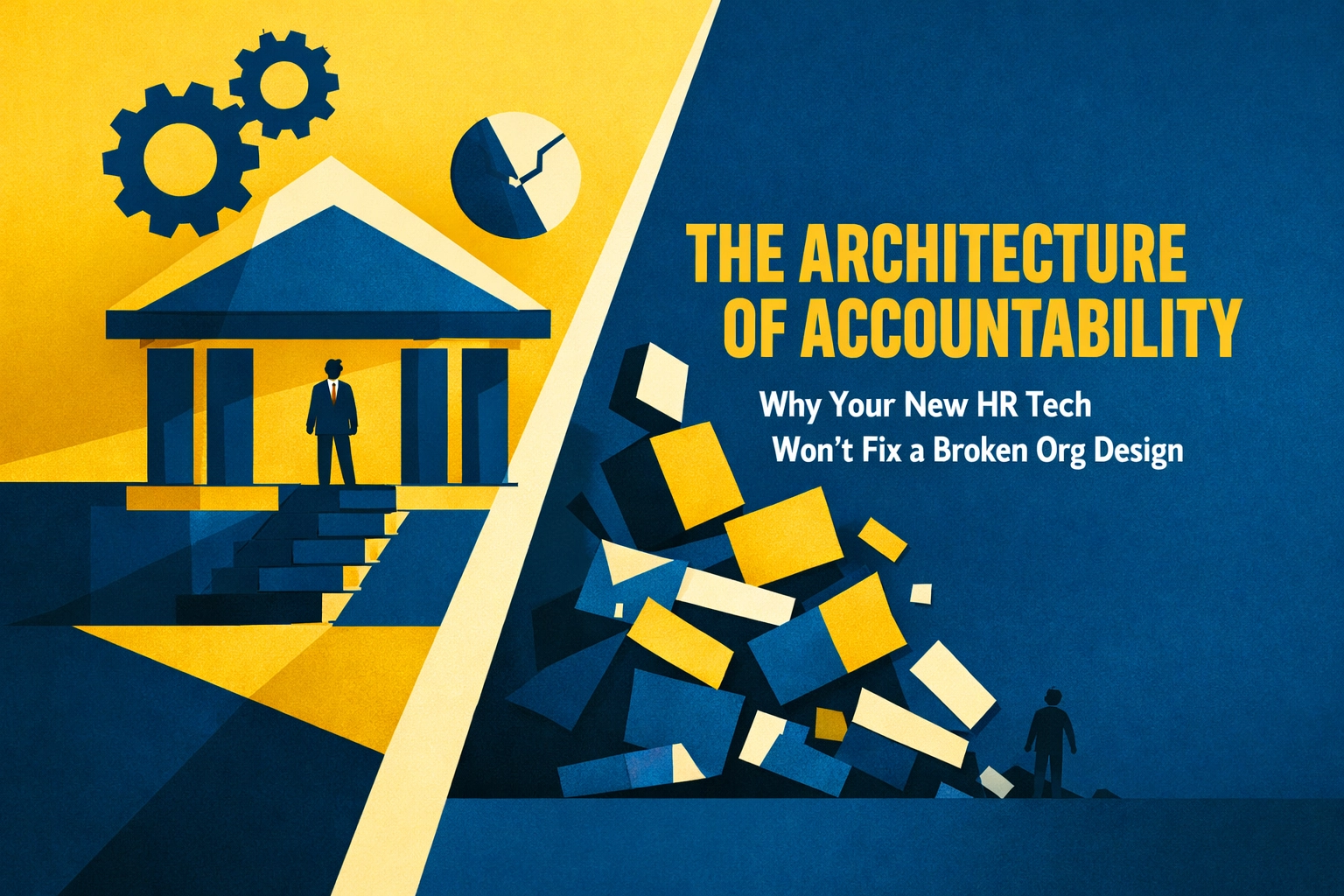
The architecture of accountability isn't built in a dashboard. It's built in the hard, unglamorous work of organizational design: clarifying strategy, defining roles, establishing decision rights, and building processes that actually support how work gets done.
Technology comes after. Not before.
The Path Forward
This isn't an anti-technology argument. The right tools, implemented at the right time, can be transformative. But they're tools, not solutions. They support a well-designed organization. They don't create one.
If you want real accountability, build the foundation first. Define your structure. Clarify your decision rights. Design your operating model with intention. Then; and only then: deploy the technology to scale what's already working.
Anything else is just expensive decoration on a crumbling building. And no amount of AI can fix a broken blueprint.