
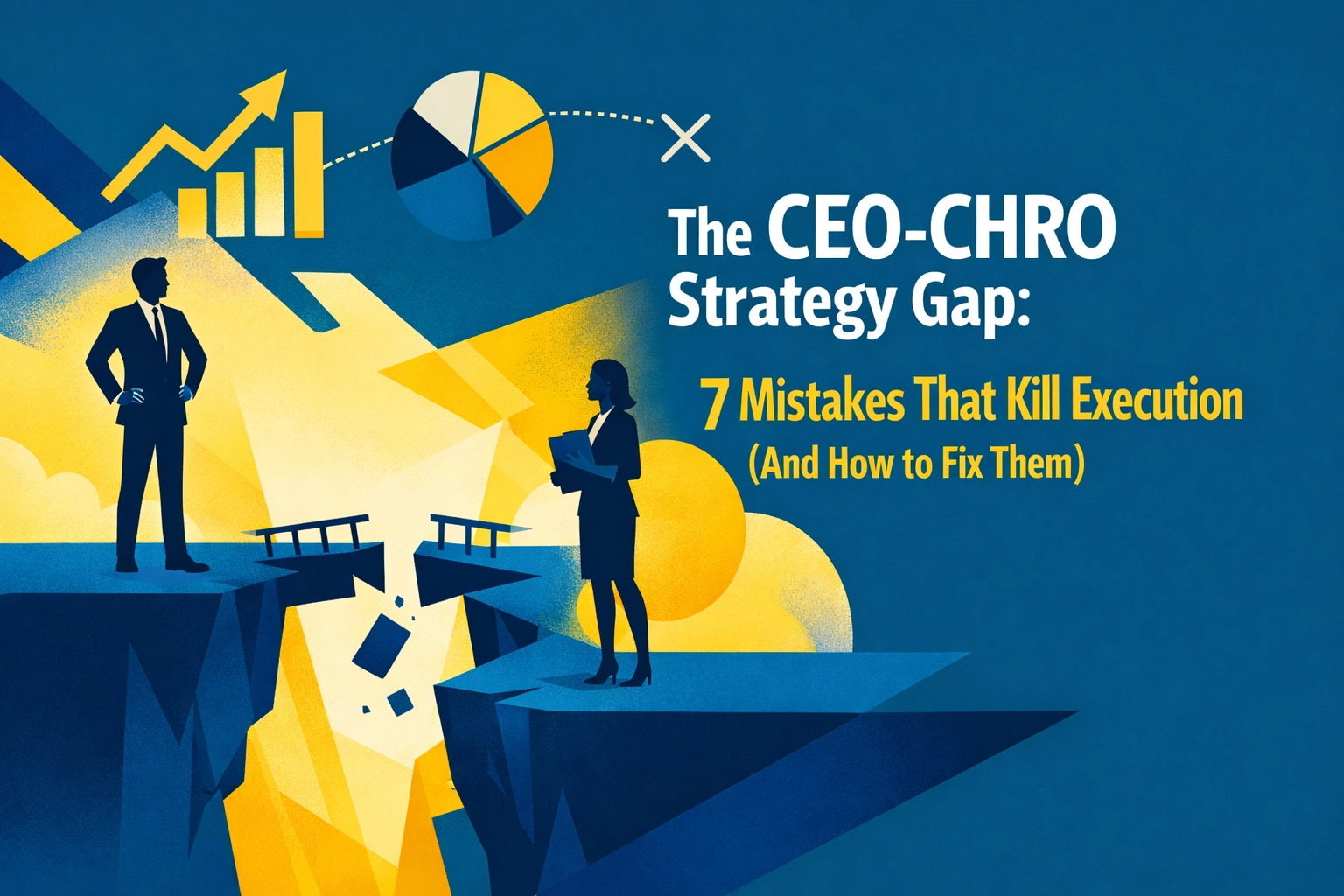
The strategy deck looks flawless. Leadership is aligned. The board is on board. Then, six months later, execution stalls, turnover spikes, and the very leaders who championed the transformation start asking what went wrong.
The answer usually sits in the blind spot between the CEO and the CHRO. While the CEO drives quarterly targets and competitive positioning, the CHRO focuses on engagement scores and retention metrics. They're both doing their jobs. They're just not doing them together.
For Fortune 2000 CHROs and growth-stage CEOs navigating transformation, M&A integration, or organizational redesign, this misalignment isn't a nuisance. It's a risk factor that quietly erodes enterprise value. Here are the seven mistakes that create the gap: and how to close it.

Mistake 1: Mismatched Timelines and Success Metrics
CEOs operate on quarterly earnings cycles. CHROs build multi-year culture initiatives. The CEO wants proof in 90 days. The CHRO thinks in terms of 18-month maturation curves. Neither is wrong, but when their clocks aren't synchronized, strategic priorities fragment.
The result? The CHRO presents engagement survey improvements while the CEO is staring at missed revenue targets. The board hears two different stories about organizational health, and neither fully answers the question: Are we executing or not?
The fix: Align on shared metrics that matter to both sides. Workforce productivity tied to EBITDA. Leadership pipeline strength mapped to succession risk. Turnover cost calculated against deal integration timelines. When both leaders can point to the same dashboard and interpret performance through a unified lens, execution becomes measurable in real time.
Mistake 2: The CHRO Operates Outside the Business Model
Too many CHROs build parallel narratives. They speak the language of "employee experience" and "time-to-fill" while the CEO and CFO discuss margin compression, competitive threats, and capital allocation. When the boardroom runs out of time, the parallel narrative gets cut first.
This isn't about HR being less important. It's about HR being positioned as separate from the business model instead of embedded within it. When the CHRO can't explain how workforce investment links to shareholder value, they lose credibility at the table that matters most.
The fix: Stop reporting HR metrics. Start reporting business outcomes enabled by workforce strategy. Show how leadership development reduces execution risk. Demonstrate how organizational design accelerates speed-to-market. Speak the language of competitive advantage, not compliance.

Mistake 3: Undefined Strategic Expectations
The CFO role is standardized. So is the COO. But the CHRO role remains loosely defined, and "strategic" means something different to every CEO. One expects operational excellence in HR delivery. Another wants a thought partner who challenges the entire operating model. The CHRO often discovers the difference six months too late.
Without explicit role clarity, the CHRO either over-indexes on transactional execution or stretches into strategic territory the CEO didn't invite them into. Both create friction, and friction at the top cascades.
The fix: CEOs and CHROs need to co-author the CHRO role definition within the first 90 days. Be explicit about where the CHRO should drive, where they should advise, and where they should execute. Document decision rights. Clarify board-level responsibilities. Ambiguity at this altitude is expensive.
Mistake 4: Limited CHRO-Board Engagement
Some CEOs treat the CHRO as a supporting player in board meetings: invited for the "people update" and excused before the real strategy conversation begins. This signals to the board that workforce strategy is a hygiene factor, not a competitive lever.
When boards don't hear directly from the CHRO on succession risk, leadership pipeline gaps, or culture as performance infrastructure, they default to viewing HR as administrative. That perception shapes budget allocation, strategic influence, and the CHRO's ability to drive enterprise-level change.
The fix: The CEO must champion the CHRO's board presence and explicitly position human capital as a strategic priority. The CHRO, in turn, must earn that seat by delivering insights the board can't get anywhere else: the honest read on leadership bench strength, the truth about execution capacity, and the unvarnished assessment of whether the culture can absorb the strategy.

Mistake 5: Weak Commercial and Financial Acumen
HR leaders who can't translate workforce investments into ROI or speak fluently about capital efficiency struggle to influence at the executive level. A board member recently put it bluntly: "HR leaders who speak the language of finance and operations are far more valuable in the boardroom."
This isn't about CHROs becoming CFOs. It's about understanding how business models generate value and where people decisions either accelerate or constrain that value creation. Without that fluency, even the best HR strategy gets dismissed as soft.
The fix: CHROs must develop commercial literacy as aggressively as they develop organizational psychology expertise. Understand the P&L. Know where margin comes from. Speak in terms of cost-per-hire versus revenue-per-employee. Link leadership development investment to reduced M&A integration risk. Make the business case in the language the business speaks.
Mistake 6: CEO-CHRO Partnership Treated as Optional
Research consistently shows that the strength of the CEO-CHRO partnership is one of two critical dimensions determining CHRO impact. Yet many organizations treat this relationship as transactional rather than foundational. The CHRO reports to the CEO but isn't treated as a peer to the CFO or business unit leaders.
Without a trusting, strategic partnership, the CHRO becomes an order-taker rather than a co-architect of the operating model. The CEO makes people decisions in isolation. The CHRO learns about organizational changes after they've been announced. Dysfunction compounds.
The fix: The CEO, CFO, and CHRO should function as a tightly knit strategic triad. They control the levers that matter most: capital, operations, and talent. Regular touchpoints. Shared decision-making frameworks. Mutual accountability. When this trio operates as a unit, the organization executes with precision.

Mistake 7: Succession Planning as CEO Avoidance
Succession planning routinely stalls not because CHROs aren't ready, but because CEOs avoid the conversation. Yet when boards prioritize succession, CEO engagement jumps from 28% to 70%. The problem isn't lack of process. It's lack of executive-level ownership.
When the CHRO is left to drive succession planning without CEO partnership, it becomes an HR project instead of a board-level governance imperative. Talent reviews lack teeth. High-potential programs become performance theater. The organization drifts into leadership risk without realizing it.
The fix: Boards must explicitly designate CEO succession as the board's responsibility, not the CEO's. This removes ambiguity and elevates the CHRO's role in the process. The CEO, in partnership with the CHRO, normalizes succession conversations across the leadership team. Together, they create a culture where leadership pipeline transparency is a competitive advantage, not a threat.
Closing the Gap
Organizations that eliminate the CEO-CHRO strategy gap position themselves as next-generation, high-impact enterprises. The CHRO moves from the periphery to the center. The CEO gains a strategic partner who can translate vision into executable people strategy. The board gets the honest intelligence required to govern effectively.
At Rinnovare, we work with Fortune 2000 CHROs and growth-stage CEOs to close this gap during critical inflection points: M&A integration, organizational redesign, leadership transitions, and transformation programs where execution risk is highest. If your strategy is sound but execution keeps stalling, the answer might not be in the plan. It might be in the partnership.
Need to align your executive team around a unified strategy? Let's talk.