
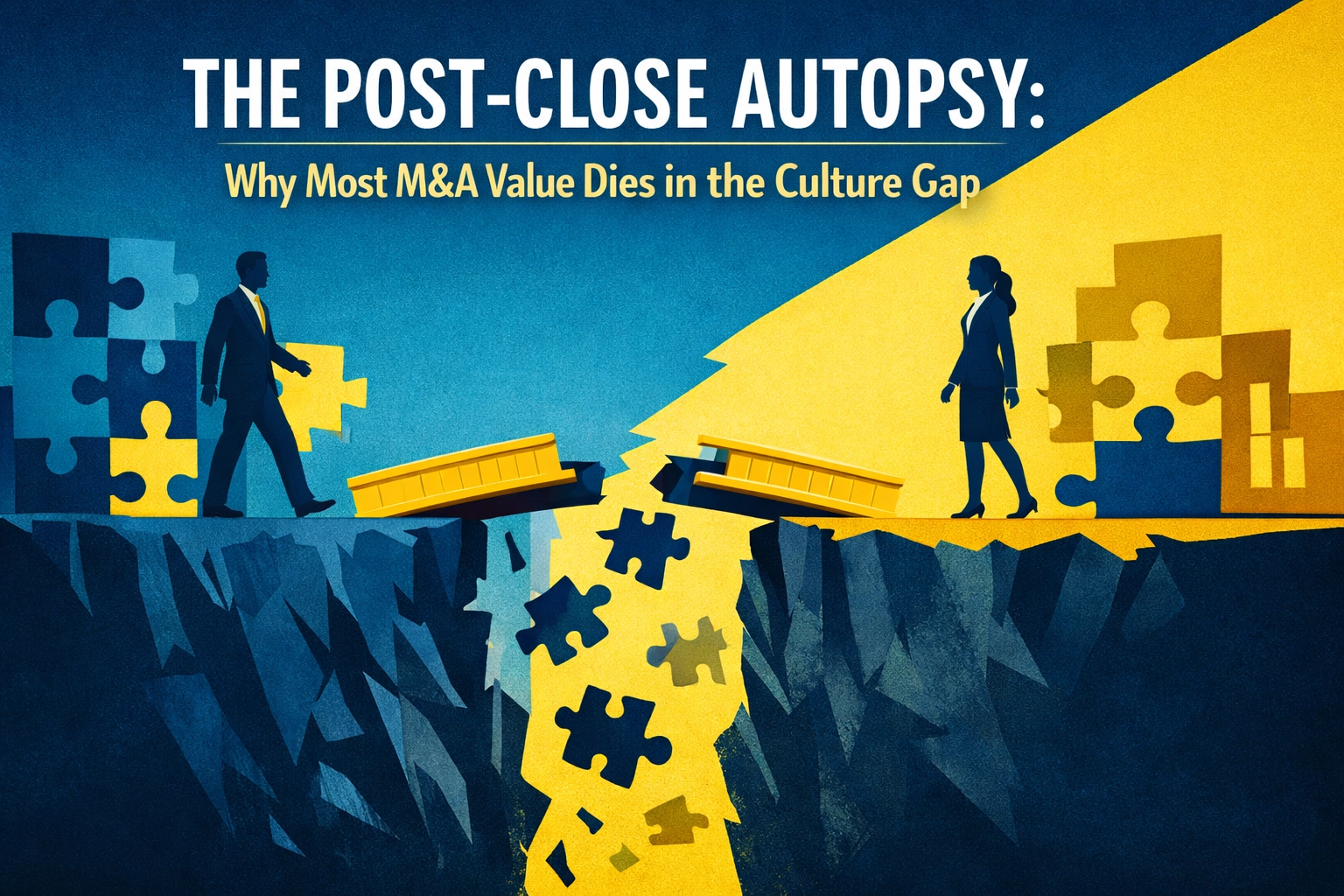
You paid $120 million for a company with solid EBITDA, clean books, and a defensible market position. Six months post-close, your star VP of Sales just walked. Three months after that, half the product team followed. Revenue's flat. Integration's a disaster. And your operating partner is now living on-site trying to stop the bleeding.
Welcome to the post-close autopsy. Cause of death? Culture gap. Time of death? The moment you signed the LOI and ignored everything that wasn't on a spreadsheet.
Here's the thing nobody wants to admit: Most M&A failures aren't financial, they're human. And the evidence isn't hidden. According to Harvard Business Review, somewhere between 70-90% of acquisitions fail to create expected value. But here's what's wild: the autopsies almost never blame the balance sheet. They blame integration. Leadership conflict. "Cultural fit."
Translation: We bought a company and forgot it was full of people.
The Due Diligence Blind Spot

Let's talk about what gets measured during due diligence. You'll spend weeks, sometimes months, crawling through financials, legal exposure, IP portfolios, customer concentration, and supply chain risk. You'll model out synergies down to the decimal point. You'll stress-test the hell out of revenue projections.
And then you'll spend maybe three days on "people and culture," usually outsourced to a firm that runs employee surveys and calls it a day.
That's not due diligence. That's a checkbox.
Here's what you're actually missing, what I call Hidden HR Debt. It doesn't show up on a P&L, but it will absolutely destroy your deal value post-close. It comes in three flavors:
1. Leadership Misalignment
You bought a company because the CEO sold you on "the vision." Great. Now ask yourself: does anyone else in that building share it?
In half the deals I've worked, the executive team is already fractured pre-close. The CFO and COO haven't spoken in six months. The VP of Sales is secretly interviewing elsewhere because she knows the founder's about to get cashed out. Middle managers are running shadow operations because they don't trust the C-suite.
And nobody tells you this during diligence because, surprise, the people selling you the company don't want you to know their leadership team is held together with duct tape.
Post-close, this blows up fast. You parachute in a new CFO to "professionalize" finance, and suddenly three directors quit because they were loyal to the old CFO. You try to integrate sales teams, and discover the acquired VP has been running a completely different comp structure that you can't unwind without a mutiny.
The autopsy finding: Leadership misalignment doesn't resolve itself. It metastasizes.
2. Cultural Drift
Here's a question PE firms almost never ask during diligence: What's the emotional contract here?
Not the employment contract. The emotional one. The unspoken deal between the company and its people about what's expected, what's rewarded, and what happens when you break the rules.
In the target company, maybe the deal was: "We're scrappy, we move fast, we don't have bureaucracy, and if you hustle, you'll get promoted." That emotional contract built the company you just bought.
Your deal is different. You're bringing process. Compliance. "Rigor." KPIs that get rolled up to a board deck. Suddenly that scrappy engineer who used to ship features on gut feel is filling out Jira tickets and sitting in sprint planning meetings.
You just broke the contract. And he's updating his LinkedIn.
This isn't about "culture clash" in some soft, hand-wavy sense. It's about contractual breach. The people in that building traded their effort and loyalty for something specific. You changed the terms without asking. They're walking.
The autopsy finding: You can't bolt your culture onto theirs and expect people to stay. You're not integrating, you're colonizing.
3. Broken Trust Cascades
Here's the thing about M&A: the deal always leaks. Employees know something's happening weeks before the announcement. And in that vacuum, they imagine the worst.
By the time you show up post-close to do your "we're excited about this partnership" town hall, half the room has already decided you're going to gut the company, offshore their jobs, or replace them with your people.
And then, because you didn't do the human due diligence, you accidentally prove them right.
You lay off the HR coordinator who everyone loved because "we have corporate HR now." You sunset a product line that a third of the team built their careers on. You move the office because the lease is up and you found a cheaper space, never mind that half the employees chose this company specifically because it was close to home.
Every one of those decisions makes perfect sense on paper. Every one of them is a trust grenade.

The autopsy finding: Trust collapses fast and rebuilds slow. You're not starting from zero post-close. You're starting from negative.
What Actually Gets Measured vs. What Actually Matters
Let's be honest about what most firms look at during people diligence:
- Headcount and fully-loaded costs
- Benefits and comp benchmarking
- Open litigation or EEOC complaints
- Turnover rates (last 12 months)
- Maybe an engagement survey if you're fancy
Here's what actually predicts post-close success:
- Who are the linchpin employees? Not the executives. The senior engineer everyone goes to when something breaks. The account manager who's the only one who really understands your top three customers. The ops lead who built every process in her head and never documented anything.
- What's the real reporting structure? Not the org chart. The actual influence map. Who makes decisions? Who gets overruled? Who's about to bail the second their retention bonus clears?
- What promises were made? The founder told his early employees they'd get promoted when the company hit $50M in revenue. You just bought them at $60M. Surprise, they're expecting promotions you didn't budget for.
- What's the unwritten culture code? In this company, do people stay late because they love the mission, or because the CEO sends passive-aggressive Slack messages at 9 PM? Do they speak up in meetings, or have they learned to shut up and nod? Is "feedback" a gift, or a precursor to a PIP?
You can't see any of this in a data room. You need to actually talk to people. And not in the sanitized executive interviews where everyone performs for the buyer.
The Post-Close Reality Check
Here's what happens if you skip this work:
Month 1-3: The honeymoon. Everyone's cautious. People are waiting to see what you'll do.
Month 4-6: The exodus begins. Your best people start interviewing. They're not leaving because of comp, they're leaving because they've decided you don't get it.
Month 7-12: The value destruction accelerates. You're now hiring backfills at a premium because you're desperate. Projects slip. Customers notice. The integration you modeled as "6 months to full synergies" is now at 18 months and counting.
Month 13+: You're in crisis mode. The operating partner is now the de facto COO. You're flying in consultants. You're throwing money at retention bonuses for people you should've figured out were critical six months ago.
I've seen this movie a dozen times. The plot doesn't change.
The Fix: Treat People Diligence Like Financial Diligence

If you're a PE operating partner or CEO walking into a deal, here's what changes:
Pre-close: Spend real time on human due diligence. Not surveys, interviews. Not with the executive team, with the people three layers down who actually run things. Map the real org chart. Identify linchpins. Understand the emotional contract. Document the unwritten rules.
Post-close: Don't announce big changes on Day 1 to "show momentum." You're not showing strength, you're showing you don't understand what you bought. Spend the first 90 days listening. Yes, you'll have to make hard decisions. But make them after you understand what actually holds the place together.
Integration: Stop treating culture as a soft skill. It's a risk factor. If you're integrating comp structures, promotion paths, or decision rights, model the people impact the same way you model cost synergies. Who's going to hate this? Who's going to leave? What's the dollar cost of that turnover?
And most importantly, bring in someone who’s done this before. Not a recruiter. Not a corporate HR generalist. Someone who understands how to navigate the human side of M&A without eroding value—quietly, credibly, and without creating unnecessary disruption. (If you want a discreet senior partner for this work, we can help.)
The Bottom Line
The irony of M&A is that we've gotten really good at modeling financial risk and terrible at modeling human risk, even though the humans are the ones who actually generate the cash flow we're buying.
Culture gaps don't destroy deals because people are "soft" or "emotional." They destroy deals because culture is the operating system. You can't just uninstall it and expect the business to keep running.
If you're a PE firm or CEO looking at a deal right now, ask yourself: do you actually know what you're buying? Not the EBITDA. The people. The leadership dynamics. The emotional contracts. The unwritten rules that make the place work.
Because if the answer is no, you're not doing due diligence. You're gambling. And the house always wins.
If you’re heading into a deal—and want a discreet, senior-level gut check on the people risks—get in touch.