You closed the deal. The financial models looked solid. The EBITDA was clean. The management team passed the smell test.
Then six months later, you're staring at a $2.3 million settlement demand from the Department of Labor. Or a class-action lawsuit over misclassified employees. Or a pension liability that somehow didn't show up in diligence.
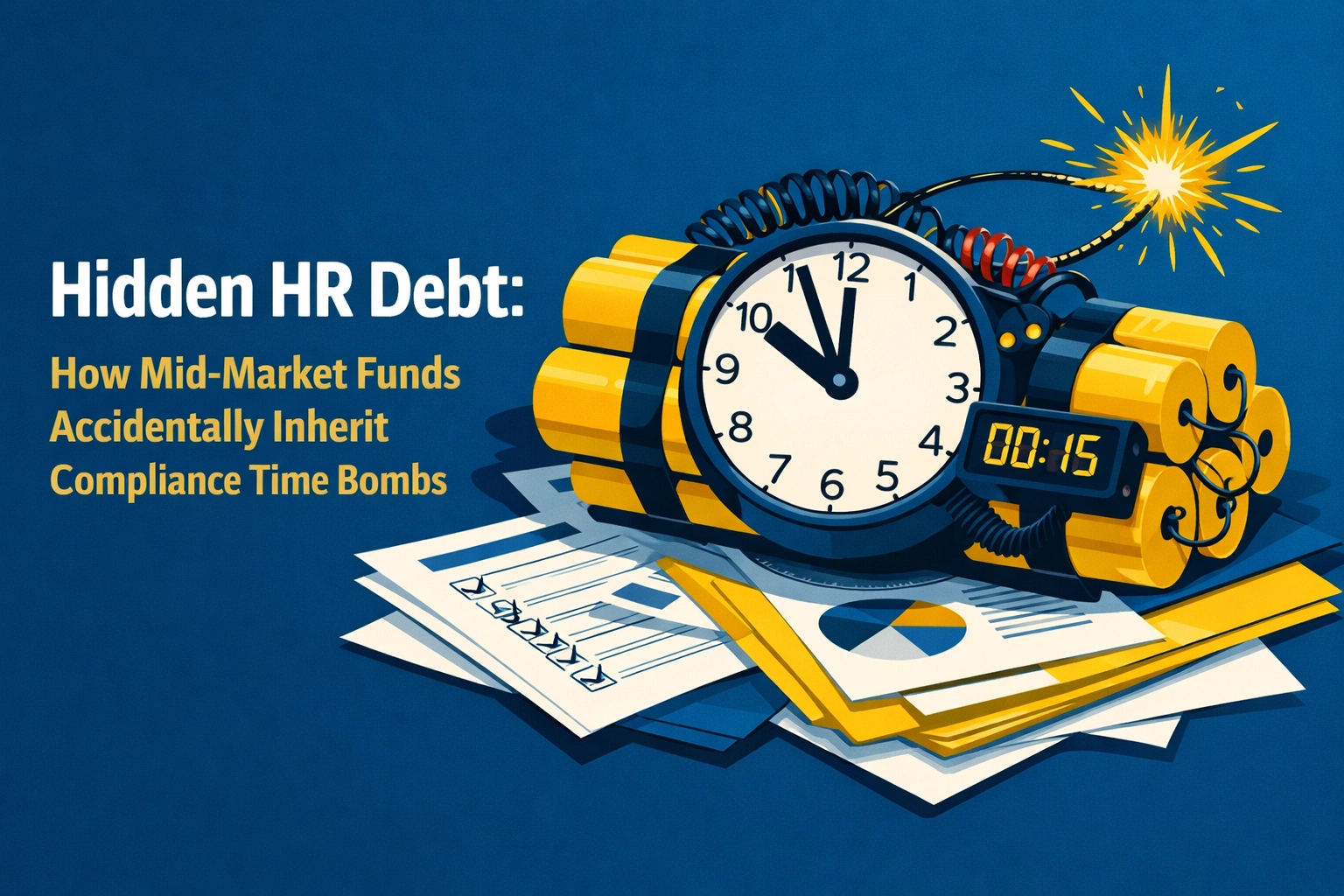
Welcome to HR debt, the silent EBITDA killer that mid-market PE firms inherit every day because they treated the "people review" as a compliance checkbox instead of a forensic investigation.
I've been the CHRO cleaning up these messes post-close, and I've been the advisor called in when Operating Partners realize the HR function they acquired is a ticking time bomb. Here's what most mid-market funds miss, and how to stop accidentally buying someone else's HR crisis.
What Is HR Debt, Really?
HR debt isn't just "outdated policies" or "paper files instead of an HRIS." It's the accumulated liability, regulatory exposure, and cultural dysfunction that compounds over time when leadership treats HR as administrative overhead instead of a risk management function.
Think of it like deferred maintenance on a building. You can ignore the foundation cracks and the leaky roof for years, until you can't. The difference? HR debt doesn't just cost money to fix. It destroys deals, tanks valuations, and creates existential risk for portfolio companies.

Most financial due diligence teams are built to find accounting irregularities and revenue recognition issues. They're not trained to spot the VP of Sales who's been misclassifying account executives as exempt employees for three years. Or the "gentleman's agreement" severance policy that creates $4 million in unfunded termination liability. Or the benefits broker who's been auto-renewing plans without competitive bidding, and pocketing override commissions the CFO doesn't know exist.
That's HR debt. And it's hiding in plain sight in most mid-market deals.
The Five Categories of HR Debt PE Firms Inherit (And Regret)
1. Compliance Time Bombs
Wage and hour violations are the single biggest source of inherited liability I see in deals. The target company has been treating salaried employees as exempt without meeting the FLSA criteria. They've been docking exempt employees for partial-day absences. They've been miscalculating overtime for employees who work across state lines.
None of this shows up in financial statements until the lawsuit lands. And the statute of limitations can reach back two to three years, sometimes longer if willful violations are involved.
The kicker? This is preventable with a forensic classification audit during diligence. But most PE firms rely on management's self-reporting or a cursory policy review. That's not enough.
2. Unfunded Benefit Obligations
I've seen PE firms inherit pension plans they didn't know existed. Deferred compensation arrangements with executives that weren't disclosed. Retiree medical plans with no reserve funding. Post-employment benefit obligations buried in employment agreements that HR never tracked.
This isn't sophisticated fraud, it's just institutional neglect. The benefits were promised years ago. The liabilities accrued. Nobody tracked them centrally. And suddenly, they're the new owner's problem.

3. Talent Concentration Risk
You bought the company because of the management team and the top-tier sales force. What you didn't realize? Half of the revenue is generated by five salespeople who don't have non-competes (or have unenforceable ones). The VP of Operations has been talking to a competitor for six months. And the CFO is three months from retirement eligibility, with a pension multiplier that makes staying financially irrational.
This is talent concentration risk, and it's HR debt because it's preventable with retention design, succession planning, and compensation forensics. But most funds don't look at this until post-close, when it's too late to negotiate protections.
4. The "Shadow HR System"
The company has an HRIS. Great. What they also have is a spreadsheet the Controller maintains with the "real" PTO balances. And a Word doc the CEO's assistant updates with the "handshake agreements" for executive severance. And an email thread from 2019 where the VP of Sales promised unlimited commission accelerators that were never formalized.
I call this the Shadow HR System, the undocumented, inconsistent, impossible-to-defend tangle of policies and promises that exist outside the official record. It's the source of wrongful termination claims, misalignment between HR and Finance, and post-close employee relations disasters.
You can't find this with a Q&A questionnaire. You need forensic document review and interview-based diligence with the people who actually know where the bodies are buried.
5. Toxic Culture as Liability
This one's harder to quantify, but it's just as dangerous. The company has a reputation for tolerating bad behavior from high performers. There's a pattern of EEOC complaints that were "settled quietly." Exit interview data (if it exists) shows consistent themes around discrimination, harassment, or retaliation.
Post-close, that culture doesn't disappear: it metastasizes. And the new owners inherit the legal exposure, the talent flight risk, and the reputational damage. I've seen portfolio companies lose key customers because employees went public with culture grievances the PE firm didn't know existed pre-deal.
Why This Slips Through Traditional Due Diligence
Most mid-market PE firms run lean diligence teams. HR gets a week of Q&A, a policy manual review, and maybe a benefits benchmarking analysis. That's not forensic: it's surface-level.
Here's what's missing:
-
No independent verification. The target company's HR leader provides the answers. If they're incompetent, overwhelmed, or incentivized to hide problems, you get bad data. And you don't know it until post-close.
-
No employee interviews. The best source of truth about HR debt is the employees who live it. But most funds don't talk to employees during diligence: they rely on management to represent the ground truth. That's a mistake.
-
No compensation forensics. Payroll data tells the story of misclassification, pay equity issues, and off-cycle "handshake" deals. But most diligence teams don't run statistical analyses on compensation data: they just ask, "Are people paid fairly?" and accept the answer at face value.
-
No document review. Employment agreements, offer letters, separation agreements, benefits summaries: these documents contain the actual obligations the company has incurred. But they're rarely reviewed in detail. Instead, diligence teams rely on summaries provided by HR or legal. That's where liability hides.

The Forensic Approach to HR Diligence
If you're serious about protecting value and avoiding inherited HR disasters, here's the diligence approach that actually works:
Run a Classification Audit. Pull the job descriptions, compensation data, and actual job duties for every role classified as exempt. Compare them to FLSA criteria. Flag the gaps. Quantify the exposure. This takes two days and saves millions.
Interview a Sample of Employees. Not just management: actual employees across levels, functions, and tenure. Ask about unwritten policies, informal agreements, and what they've been told about benefits or severance. This is where the Shadow HR System reveals itself.
Conduct a Benefits Liability Analysis. Don't just accept the actuary's report on the pension plan. Review the plan documents, the SPDs, and the actual benefit calculations. Look for off-balance-sheet obligations, unfunded retiree medical promises, and deferred comp arrangements that weren't disclosed.
Map the Talent Dependencies. Identify which individuals drive revenue, hold institutional knowledge, or control customer relationships. Analyze their retention risk. Review their employment agreements for gaps in non-compete, non-solicit, or IP assignment provisions. Quantify the value destruction if they leave post-close.
Analyze Historical Claims and Complaints. Pull EEOC charges, unemployment claims, workers' comp incidents, and exit interview trends (if they exist). Look for patterns. One complaint is an incident. Five complaints with the same theme is a liability.
This isn't a "nice to have" expanded diligence scope. This is the difference between buying a platform and buying a lawsuit.
What This Means for Operating Partners
If you're an Operating Partner in a mid-market fund, HR diligence is your job: not just the deal team's. You're the one who's going to own the post-close stabilization. You're the one who's going to get the call when the COO quits or the class-action complaint gets filed.
Here's the mindset shift: HR diligence isn't about checking a box. It's about forensic risk identification. You're not asking, "Does this company have an HR function?" You're asking, "What liabilities are we inheriting, and can we mitigate them before we wire the money?"
That requires a different level of rigor. It requires advisors who've been CHROs, not just consultants who've read about HR. And it requires treating people risk with the same seriousness you treat financial risk.

The Bottom Line
HR debt is real. It's expensive. And it's hiding in most mid-market deals because funds treat the people review as a compliance exercise instead of a value protection strategy.
The fix isn't more paperwork. It's forensic diligence: independent verification, employee interviews, compensation analytics, and document review by people who know what they're looking for.
You wouldn't skip financial diligence because the CFO said the books were clean. Don't skip HR forensics because the HR leader said everything's fine.
If you're evaluating a deal and want to know what HR debt you're actually inheriting, let's talk. We run forensic HR diligence for mid-market PE firms who want to protect value: not just close deals.
Contact Rinnovare to schedule a diligence scoping conversation.