Every CHRO I know has been in this meeting. The CEO leans back, arms crossed, and asks: "Why can't we keep good people anymore? What happened to loyalty?"
The answer most won't say out loud? You broke it first.
Not recently. Not with some tone-deaf return-to-office mandate or a botched DEI initiative. You broke it forty years ago when Corporate America collectively decided that employees were too expensive to carry from hire to retirement. When the balance sheet became more important than the social contract that held organizations together for generations.
And it all started with an accounting rule change that most people have never heard of.
The World Before FAS 87
Let's rewind to the early 1980s. If you worked for a Fortune 500 company, you had something most employees today can't even imagine: a defined benefit pension plan. You showed up, did your job for 25 or 30 years, and the company paid you a predictable monthly income for the rest of your life. No market risk. No guesswork. No spreadsheets calculating "safe withdrawal rates."
The company promised to take care of you. And in return? You stayed. You were loyal. You built a career, not a resume.

The 401(k) existed, but it was supposed to be a supplement, a way to save a little extra on top of your pension. Congress passed it into law in 1978 as part of the Revenue Act, primarily intended for executives who wanted additional tax-advantaged savings. It was never designed to be the primary retirement vehicle for American workers.
But then came 1985. And everything changed.
The Inflection Point: FAS 87
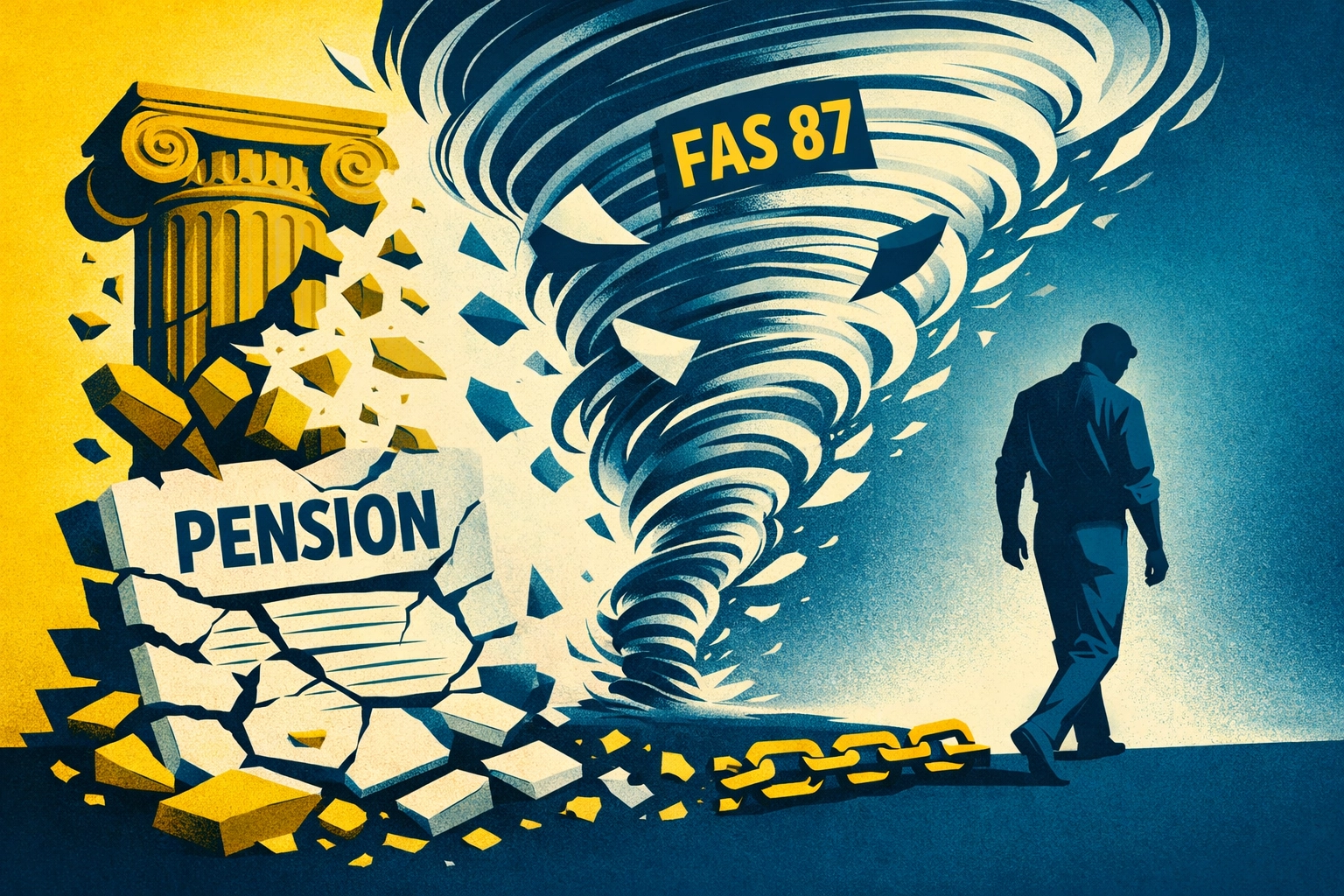
In December 1985, the Financial Accounting Standards Board issued FAS 87 (Statement of Financial Accounting Standards No. 87), which fundamentally altered how companies had to account for pension liabilities.
Before FAS 87, pension obligations were somewhat opaque. Companies could smooth over underfunding, use optimistic assumptions, and keep the true cost of their promises off the balance sheet. It was financial alchemy that allowed executives to make generous commitments without fully reckoning with the bill.
FAS 87 changed that. It required companies to:
- Recognize the present value of pension obligations on their balance sheets
- Calculate and disclose unfunded liabilities when pension assets fell short of promises made
- Use standardized actuarial methods that made underfunding impossible to hide
Suddenly, the cost of "cradle-to-grave" became painfully visible. CFOs looked at their balance sheets and saw billions in unfunded liabilities staring back at them. Wall Street analysts started asking uncomfortable questions. Credit ratings agencies took notice.
And Corporate America made a choice.
The Great Pension Purge
Rather than fund the promises they'd made, most companies simply terminated their defined benefit plans. They froze accruals. They shifted to 401(k)s as the sole retirement benefit, not a supplement.
The justification was always the same: "We can't afford this anymore. Markets are too volatile. Regulations are too burdensome."
But here's what they were really saying: We don't want to be responsible for you anymore. It's too expensive.
And they didn't just "pivot." They dismantled it at scale.
In 1985, there were approximately 114,000 defined benefit plans. By the early 2000s, that number had plummeted by more than 70%.
The carnage wasn't abstract. In the 1990 plan year alone, over 60,000 plans were terminated, affecting millions of participants. And between 1986 and 2004, over 100,000 plans were terminated.
Read that again. This wasn't a market-driven evolution. It was a systematic unwind designed to protect balance sheets—and it came straight out of the employee relationship.

Employers took the long-term liability of retirement funding, something they had owned for generations, and said, "This is your problem now. Here's 4% if you contribute 6%. Good luck with the market."
They handed employees a 401(k) statement and called it "empowerment." They rebranded abandonment as "portability." And they acted shocked when employees started treating their employers the same way employers had just treated them.
The Emotional Contract: Shredded
The concept of the emotional contract isn't new. It's the unwritten set of expectations between employer and employee, what each party believes they owe the other beyond what's in the written contract.
For decades, that contract looked like this:
Employer: "Commit to us. Work hard. Stay loyal. We'll take care of you, not just while you work here, but after you retire."
Employee: "I'll give you my best years. I'll build expertise here. I'll turn down other opportunities. Because I know you've got me."
FAS 87 and the pension purge obliterated that contract. Employers unilaterally rewrote the terms:
Employer: "We'll pay you. You manage your own future. Don't expect us to carry you."
Employees heard the message loud and clear. If the company won't take care of me long-term, why should I tie my fortunes to this place? If my retirement is 100% my responsibility, then my career is 100% my responsibility too.
The era of the free agent was born, not because employees got greedy or Millennials invented job-hopping. It was born because employers broke trust first.

Reaping the Whirlwind
Fast forward to 2026. CEOs, boards, and talent leaders are wringing their hands over:
- High turnover rates that make workforce planning nearly impossible
- Declining engagement scores despite increased investment in perks and culture initiatives
- Talent wars where employees treat employers like Tinder swipes, disposable and interchangeable
- The "quiet quitting" phenomenon, employees doing the minimum because why go above and beyond for an organization that's already told you you're on your own?
And every time I hear a leader lament "the end of loyalty," I want to pull out a timeline and say: You ended it. In 1985. When you chose your balance sheet over your people.
You wanted employees to act like independent contractors managing their own risk. Congratulations. They do.
You wanted to eliminate long-term obligations. Congratulations. Employees eliminated theirs too.
This isn't about the 401(k) being portable. Portability is fine. It's about what portability represented: a complete transfer of risk from employer to employee. A message that said, "You're not part of a family. You're a line item. And when line items get too expensive, we cut them."
What Now?
Here's the uncomfortable truth: you can't rebuild cradle-to-grave. Those economics are gone. Defined benefit pensions aren't coming back, and pretending otherwise is fantasy.
But you can stop being surprised when employees behave exactly how you taught them to behave.
If you want loyalty, you have to earn it: not with pizza parties and Employee Appreciation Day, but with real investment:
- True development opportunities that increase an employee's market value, even if they leave
- Transparent career pathing that shows people a future worth staying for
- Equity in success, not just equity in risk
- Leadership that treats people like assets to develop, not costs to manage
The whirlwind you're reaping isn't a generational shift. It isn't "quiet quitting" or "the Great Resignation" or whatever term McKinsey coins next quarter. It's a rational response to a promise broken four decades ago.
Employers taught employees to be mercenaries. And now they're shocked that employees act like mercenaries.

The smartest executives I work with understand this. They don't whine about loyalty. They build cultures where staying is a choice people want to make, not an obligation people feel trapped by. They recognize that trust isn't a given: it's earned, daily, through consistent action.
And they sure as hell don't blame employees for playing by the rules that Corporate America wrote.
The Bottom Line
FAS 87 wasn't just an accounting standard. It was the moment Corporate America chose shareholders over stakeholders. Balance sheets over people. Short-term relief over long-term relationships.
You can't have it both ways. You can't eliminate your obligation to employees and then demand theirs in return. That's not how trust works. That's not how loyalty works.
The whirlwind is here. And it's not going away until leaders reckon with the fact that this crisis didn't start with Gen Z or remote work or LinkedIn.
It started when they broke the deal first.
If you're ready to have the hard conversations about what it really takes to build loyalty in the free agent era, we should talk. Because platitudes won't fix what accounting rules broke.