
We’ve all seen the posters. "Integrity." "Innovation." "Agility." Usually printed in a clean, modern font over a stock photo of a mountain climber or a high-fiving team in a glass-walled conference room.
As a Founder or a CHRO, you might have even been the one to approve the budget for those posters. Or the all-hands slide deck. Or the expensive "culture launch" retreat. But six months later, you look around and realize nothing has changed. The same silos exist. The same slow decision-making persists. The "innovation" everyone talked about is still buried under three layers of middle-management approval.
At Rinnovare, we see this often. Organizations treat culture transformation as a PR exercise. They believe that if they just find the right words, the right "vibe," and the right frequency of communication, the organization will magically pivot.
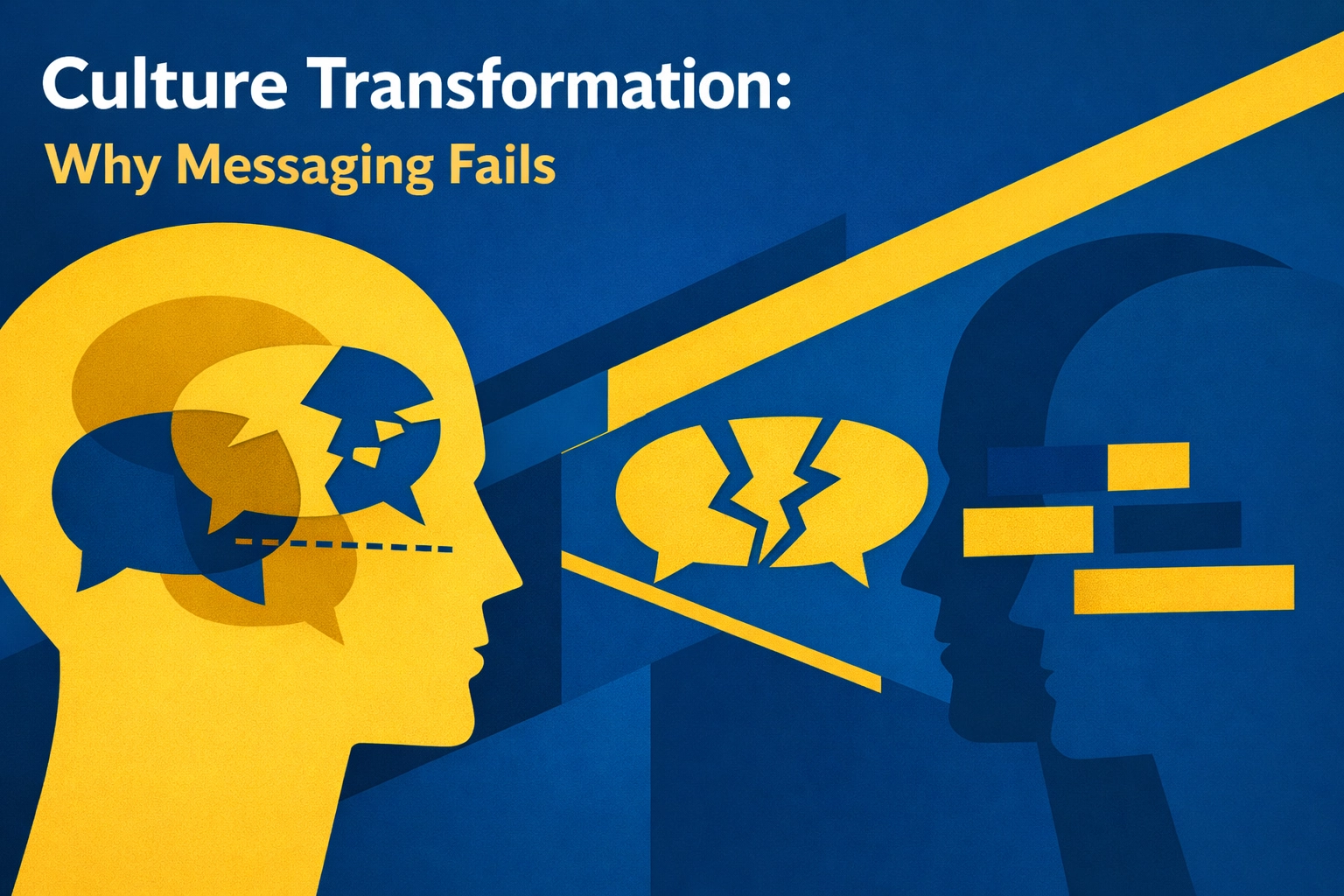
It won't. Messaging doesn't change culture. Systems do.
The Credibility Gap: Employees Have Long Memories
The primary reason culture messaging fails is that it is often one-directional and entirely disconnected from observable organizational behavior.
When a CEO stands on a stage and talks about "radical transparency" while the executive team continues to make secret decisions that impact thousands of employees, the message doesn't just fail, it backfires. It creates cynicism. Employees don’t listen to what you say; they watch what you do. They remember last quarter’s budget cuts that targeted the very "innovation" teams you’re now praising. They remember the high-performer who was promoted despite being a known "brilliant jerk" who violates every value on your new poster.
Culture isn’t what you announce. Culture is the sum of the behaviors you reward and the behaviors you tolerate. If your messaging says one thing and your compensation structure rewards another, the compensation structure wins every single time.
The Trap of Vague Adjectives
Most culture initiatives rely on abstract concepts. We tell people to be "customer-obsessed" or "empowered." But what does that actually mean on a Tuesday morning when a mid-level manager has to decide whether to skip a process to satisfy a client request?
Without behavioral translation, these words are empty. A leader told to be "more empowering" might think they’re doing a great job by delegating more tasks, while their team feels abandoned and unsupported because the underlying systems for decision-making haven't changed.
To move from messaging to transformation, you have to move from adjectives to actions. You need to define the specific, observable behaviors that characterize the new culture. Instead of "Collaboration," define it as "Sharing project data across departments without being asked." Instead of "Agility," define it as "Reducing the approval layers for expenditures under $10k from five people to one."

Why PR Agencies Can’t Fix Your Culture
When a growth-stage company hits a wall, the instinct is often to hire a creative agency to "rebrand the internal culture." They’ll give you a beautiful color palette, a catchy manifesto, and maybe some branded swag.
The problem is that these agencies are experts in perception, not operation.
Culture transformation is a structural issue. If your organization is slow, it’s likely because your Operating Model is designed for risk-aversion rather than speed. No amount of "Agility" messaging will fix a 15-step procurement process. If your teams aren't collaborating, it’s probably because your P&L structure forces them to compete for resources.
This is where the disconnect becomes fatal. When leadership treats culture as a "soft" HR initiative divorced from the "hard" reality of the business, the CHRO is set up for failure. True renewal requires an audit of the systems that drive behavior.
The RQ™ Lens: Moving from Talk to Structure
At Rinnovare, we approach this through a specific framework designed to bridge the gap between intent and reality. We look at the organization through the RQ™ system, not as a series of slogans, but as a functioning machine that needs alignment.
- The RQ Diagnostic™: We don’t start with what you want the culture to be. We start with what it is. This isn't a "pulse survey" about how happy people are. It’s an evidence-based assessment of how work actually gets done, where the bottlenecks live, and where the "unwritten rules" are contradicting your stated values.
- The RQ Operating Model™: This is where the real work happens. We look at the structures, the roles, and the decision rights. If you want a culture of accountability, we have to ensure the operating model actually gives people the authority to be accountable. Messaging fails when you give people responsibility without the power to execute.
- The RQ Roadmap™: Transformation is a marathon, not a sprint. The roadmap ensures that the "drumbeat" of communication is backed by a sequence of structural changes. You don't just announce a new culture; you roll out the systemic changes that make that culture possible.
The Role of Leadership Debt
Many CEOs want the "culture" to change without having to change their own behavior. This is "leadership debt."
If the Founder still insists on approving every hire in a 500-person company, no "Empowerment" campaign will work. If the CHRO is seen as a "police officer" rather than a strategic advisor, the culture will remain one of compliance rather than contribution.
For culture transformation to take hold, the executive team must be the first to adopt the new behavioral standards. They must be willing to dismantle the very structures they built if those structures now stand in the way of the organization's next phase of growth. This is the essence of Rinnovare's approach to professional services, providing the senior-level judgment necessary to navigate these uncomfortable transitions.

The "One-Way" Communication Fallacy
Modern culture transformation requires a dialogue, not a broadcast. Messaging often fails because it’s delivered from the top down as a finished product. "Here are our new values. Please start living them."
Employees need to be enlisted as change agents. They are the ones who see where the systems are broken. They know exactly why "Innovation" is impossible in their department. By bypassing their input and delivering a polished PR package, leadership signals that they aren't actually interested in the reality of the work: only the appearance of change.
From Messaging to Renewal
If you are a CEO or a CHRO looking at a culture that feels stagnant, stop looking at your communications plan. Look at your Operating Model.
Ask yourself:
- What behaviors are we currently rewarding (even if we say we value something else)?
- Which of our current processes make it impossible for an employee to live our "values"?
- Where is the gap between our boardroom discussions and the "water cooler" reality?
Renewal isn't about finding better words. It’s about building a better structure. It’s about ensuring that when an employee hears a message from leadership, they look around and see a business that actually supports that message.
When the systems, the rewards, and the leadership behaviors all point in the same direction, you don't actually need much messaging. The culture will speak for itself.
If you’re ready to move beyond the posters and start the hard work of structural alignment, let’s talk. Clarity and evidence-based judgment are the only ways through the maze of organizational complexity.
