The Moment That Matters
You are six months into a carve-out. The investment thesis was airtight. The market conditions are favorable. On paper, the new leadership team is a "dream team" of industry veterans. Yet, during the monthly portfolio review, the numbers tell a different story. The 24-month lift plan is starting to wobble. Decisions made in the boardroom aren’t hitting the front line. The high-energy "Day One" momentum has been replaced by a subtle, pervasive fog.
This isn't a market problem or a product problem. It is a System Drift problem.
In Private Equity, we often focus on the financial and operational levers of value creation while treating the leadership system as a "soft" variable. But the leadership system is actually the "hard" infrastructure through which all capital flows. When that system drifts, enterprise value leaks through the cracks.
The CEO Test: A Pattern Recognition Check
Before we dive into the diagnostic, take 60 seconds to run this pattern-recognition check on your current portfolio company or leadership team:
- The Circular Debate: Are you spending board meetings re-litigating decisions that were supposedly "finalized" six weeks ago?
- The Velocity Gap: Is there a visible, frustrating lag between the moment a strategic decision is made and the moment it results in action on the ground?
- The Founder’s Ghost: If it’s a founder-to-PE transition, is the organization still waiting for "permission" to move, even though the founder has stepped back?
If you answered "yes" to any of these, your leadership system is misaligned. You are experiencing the friction of an outdated or broken operating model.

Introducing The RQ Diagnostic™
At Rinnovare, we look at the organization through the lens of the RQ System™. This isn't about personality tests or "culture" in the abstract sense. It is about the structural and emotional mechanics of how work gets done.
The RQ System™ consists of three canonical stages: the RQ Diagnostic™, the RQ Operating Model™, and the RQ Roadmap™. Today, we are focusing on the diagnostic phase: identifying the signals that indicate your leadership system is quietly destroying the very value you are trying to create.
The 12 Signals of System Drift
1. Re-litigation
The most expensive activity in a company is the meeting after the meeting. If decisions are being questioned, tweaked, or ignored once the formal session ends, you don't have a communication problem; you have a decision-rights problem.
2. Shadow Decisions
When the real strategy is decided in the hallway, at the coffee machine, or via private DMs rather than in the designated leadership forum, alignment is impossible. Shadow decisions create silos and breed resentment among those left in the dark.
3. The CHRO Firewall
In many struggling portfolio companies, the CHRO is relegated to a tactical firewall: handling compliance, payroll, and firefighting. If your CHRO isn't a strategic architect of the leadership system, your "people strategy" is just a cost center, not a value driver.
4. Information Asymmetry
Does the data in your HR reports match the "vibe" you feel when you walk the floor? If there is a gap between the formal reporting and the emotional reality of the team, leadership has lost its connection to the engine of the business.
5. Execution Lag
Execution is a function of clarity. When milestones are missed, it’s rarely because people are lazy; it’s because the "how" was never as clear as the "what." This lag is a direct tax on your IRR.
6. The Over-functioning CEO
Is your CEO doing the work of three people? If the top leader is stuck in the weeds because they don't trust the system below them, the company cannot scale. This creates a single point of failure that is a massive risk during an exit.

7. Cultural Drift
In the 12 months following a deal, does the culture feel more like "Corporate Fog" than "High-Performance Energy"? Cultural drift happens when the structural layers of the business (roles and accountabilities) don't support the emotional layers (trust and belonging).
8. The Accountability Vacuum
When a milestone fails, is it clear who owned it? If the answer is "the team," then nobody owned it. An accountability vacuum is the silent killer of deal velocity.
9. Middle-Management Flight
High-potential middle managers don't leave companies; they leave broken systems. If your "A-players" are exiting despite competitive compensation, your leadership system is toxic or inefficient.
10. TSA Friction
In carve-outs, the Transitional Service Agreement (TSA) can become a drag on speed. If the parent company’s shared services are slowing down the new entity’s ability to pivot, you are losing the agility that the deal was predicated on.
11. EBITDA Stall
Financial performance is a lagging indicator. If EBITDA is stalling, look back six months at the leadership alignment. The "hard" numbers are almost always a reflection of the "soft" system’s failure.
12. The "Silent" CEO
When a leader becomes overwhelmed by systemic complexity, they often stop providing clarity. They go silent. This creates a vacuum that is quickly filled by rumors, fear, and stagnation.
The Rinnovare Logic: The Three-Layer Stack
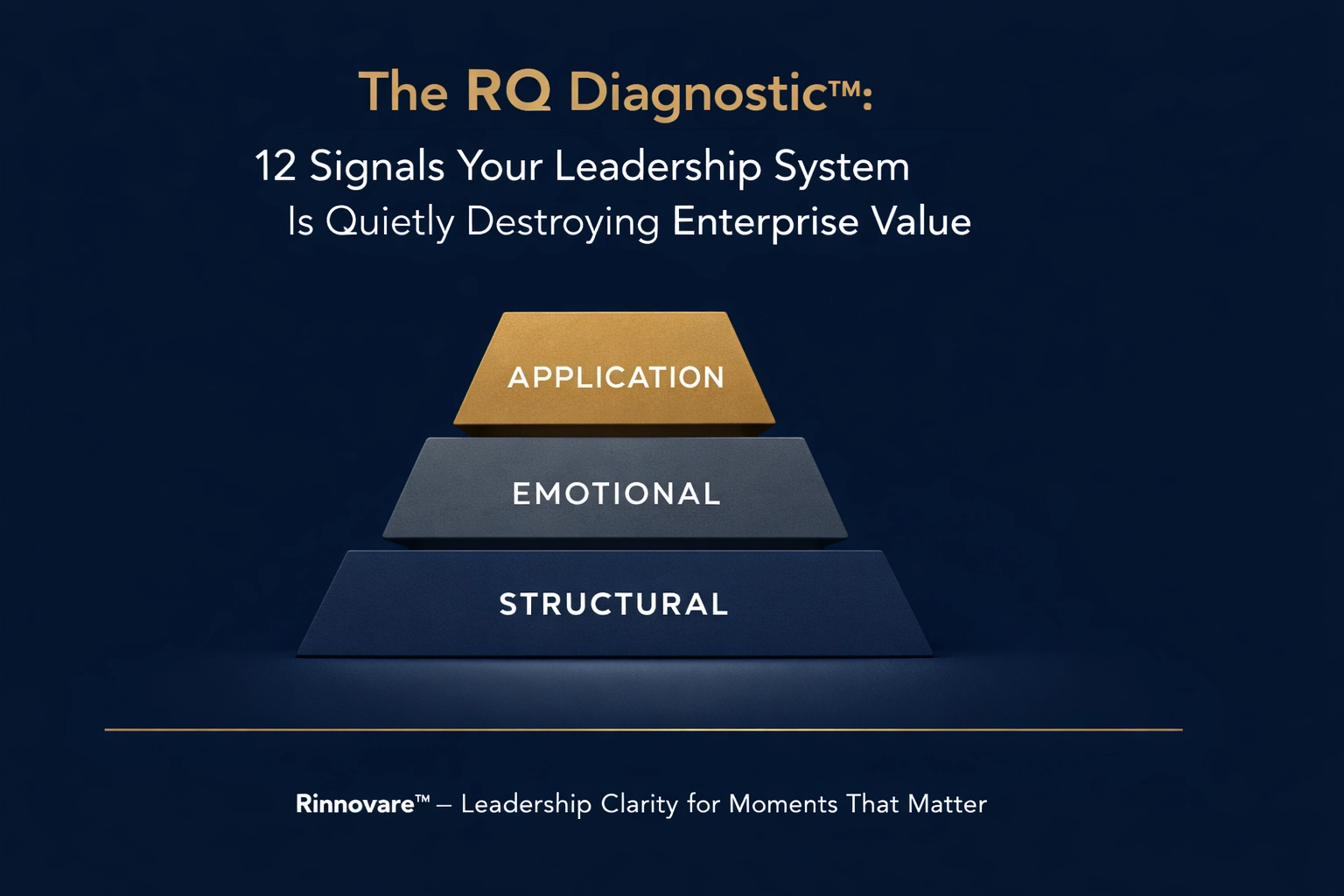
Why do these signals occur? At Rinnovare, we solve this by addressing the Three-Layer Stack. Most consultants only look at the Application Layer (the tactical HR work). We go deeper.
- The Structural Layer (The Hard System): This is the RQ System™. We fix the operating model, redefine decision rights, and ensure role clarity. If the structure is broken, talent is wasted.
- The Emotional Layer (The Soft System): We address The Hidden Emotional Contract™. This includes trust, dignity, fairness, and belonging. You can have a perfect org chart, but if people don't feel safe or valued, they won't execute.
- The Application Layer: Only once the structural and emotional layers are aligned do we deploy interim CHRO advisory or HR transformation.

Transformation fails when leadership is misaligned on operating models and talent philosophy. We differentiate by fixing both the structural (RQ) and emotional (The Hidden Emotional Contract™) issues simultaneously. This isn't just "fixing HR": it's stabilizing the leadership system to protect and grow enterprise value.
Protecting the Exit
For Private Equity partners, these 12 signals are the early warning lights on the dashboard. Ignoring them doesn't just make the work environment unpleasant; it actively erodes the multiple you expect at exit. A company with a "clean" leadership system: one with high RQ: is significantly more attractive to the next buyer because it is perceived as a low-risk, high-velocity machine.
You can learn more about our approach to value creation on our Services page or read more about our philosophy on Organizational Drift.
The Next Step
If you are seeing these signals in your portfolio, the time to act is now, before the drift becomes a permanent drag on performance. We don't believe in long, bloated consulting engagements. We believe in diagnostic clarity and rapid intervention.
If you’re facing this moment, the next step is a 30-minute clarity call.
Let's run the RQ Diagnostic™ on your leadership system and identify exactly where the value is leaking.