For many CEOs and CHROs, "culture" is a word that triggers a subtle, internal eye-roll. It’s often relegated to the "soft" side of the business: something handled by a committee, printed on high-gloss posters, or distilled into a set of "values" that everyone memorizes but few actually live.
But if you are leading an enterprise with 500 or 1,500 employees, or if you are a Private Equity partner looking at a post-close integration, viewing culture as a soft HR initiative is a dangerous financial oversight.
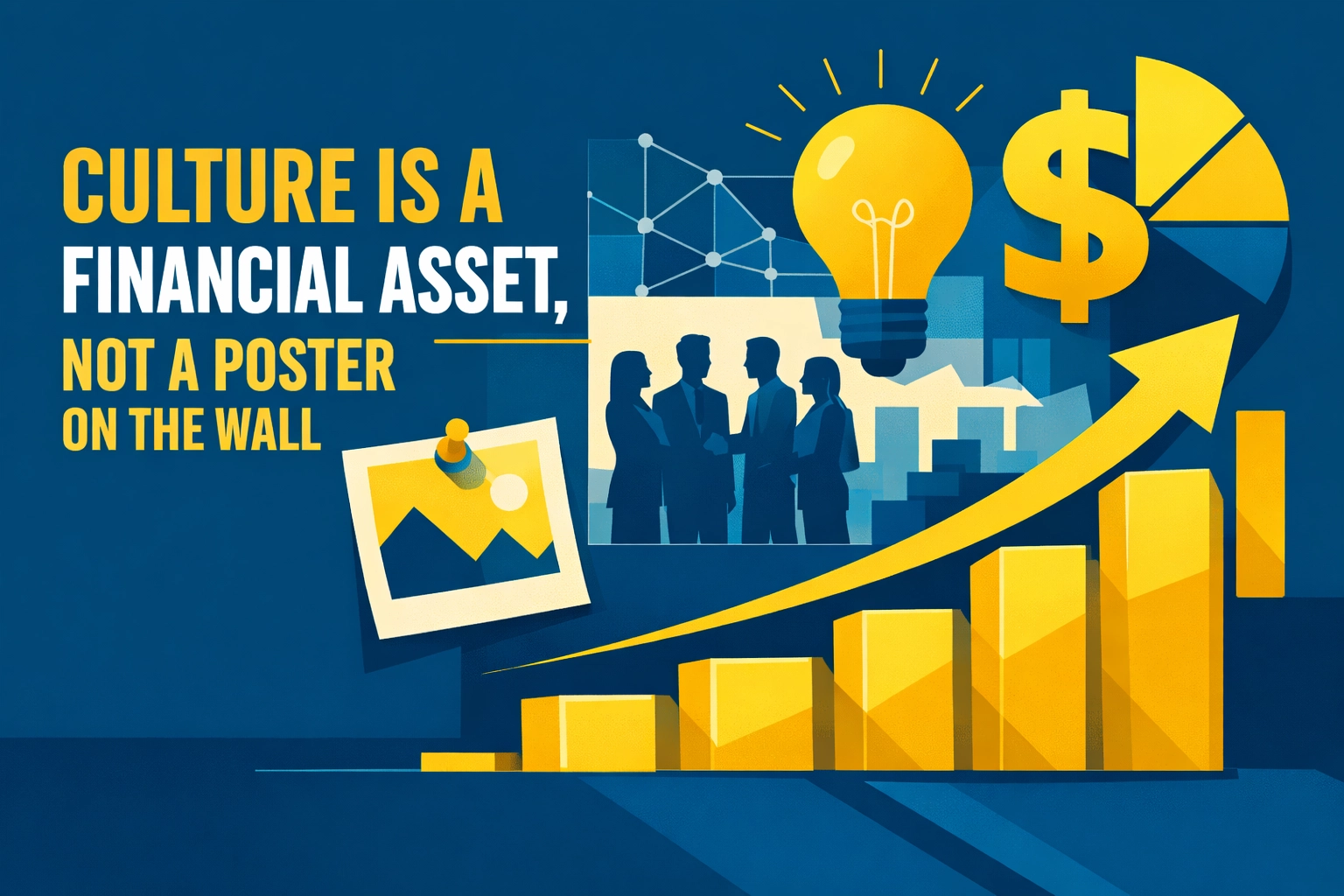
Culture isn't a poster. It’s not a "vibe." It is a tangible financial asset that either appreciates or depreciates based on the quality of your leadership and the clarity of your operating model. When culture is misaligned, it shows up as a "cultural tax" on every transaction, every decision, and every project within your firm. When it’s aligned, it acts as a force multiplier for EBITDA and enterprise value.
At Rinnovare, we don't look at culture as a separate stream of work. We look at it as the engine of Renewal.
The Depreciation of Performance: The "Cultural Tax"
Every leader has felt the weight of the "cultural tax." You see it when a simple strategic pivot takes six months to gain traction because of internal friction. You see it when your best talent leaves because they are tired of navigating a labyrinth of "politics" just to get their jobs done.
In financial terms, a dysfunctional culture is a liability. It manifests in:
- Volatility in Returns: Research shows that companies with weak or toxic cultures experience significantly higher volatility in their financial performance.
- Decision Inertia: When people are unclear about their "Decision Rights," they hesitate. In a fast-moving market, hesitation costs money.
- Talent Attrition: The cost of replacing a senior leader can be 2x–3x their annual salary. If your culture is driving people out, you are literally bleeding cash.
The problem is that most HR departments are still fighting the "Perk Wars." They think "culture" means better coffee, "unlimited" PTO, or a pool table in the breakroom. These are theatrics. They don't drive performance, and they certainly don't create enterprise value.

Culture as a Practical Operating System
If we stop thinking about culture as a set of feelings and start thinking about it as an Operating Model, everything changes.
As our research indicates, culture is "the practical experience of how an organization operates top-to-bottom and front-to-back to deliver operating and financial outcomes." It is the "glue" that holds an organization together, enabling coordinated action that formal policies alone cannot achieve.
At Rinnovare, our Founder and Principal, Philip Curran, emphasizes that culture must be integrated into the business strategy, not disconnected from it. We use the RQ™ system to turn this abstract concept into a measurable strategic asset.
1. The RQ Diagnostic™: Measuring the Asset
Before you can improve an asset, you have to value it. The RQ Diagnostic™ moves beyond simple engagement surveys. We aren't asking "How do you feel?" We are asking "How does work get done?" We measure the alignment between your stated strategy and the actual behaviors of your leadership team. If there is a gap, that gap is where your profit is leaking.
2. The RQ Operating Model™: Designing for Clarity
Culture fails when there is a lack of clarity. If your team doesn't know who owns which decision (Decision Rights), they will default to consensus-seeking, which is the death of speed. The RQ Operating Model™ defines the structures, behaviors, and rhythms required to sustain performance. It moves culture from the breakroom to the boardroom.
3. The RQ Roadmap™: The Path to Renewal
Transformation is not a one-time event; it is a process of renewal. The RQ Roadmap™ provides the step-by-step execution plan to close the gap between your current state and the high-performance culture required to hit your financial targets.

The Private Equity Lens: Post-Close Value
For Private Equity partners, the cultural health of a portfolio company is a critical risk factor. We often say that HR Due Diligence is Not an Operating Model. Knowing that a company has a high turnover rate is one thing; understanding the structural and behavioral reasons why and fixing them post-close is where the value is created.
When a PE firm acquires a mid-market company, the goal is growth. But growth puts immense pressure on existing structures. If the culture is built on the "heroics" of a few founders rather than a scalable operating system, the company will stall at the 150-employee mark or the 500-employee mark.
By treating culture as a financial asset during the first 100 days post-close, PE partners can ensure that the "human" element of the business is ready to support the financial thesis of the deal.
To dive deeper into why tactical HR often fails in these high-stakes scenarios, read our piece on The Renaissance of the Human.
The Moral Obligation of Leadership
There is a final, often overlooked dimension to culture: the moral obligation.
As a CEO or Founder, you have a financial responsibility to your shareholders, but you also have a moral obligation to the people who give their time and talent to your vision. To lead a company where the culture is toxic, unclear, or stagnant is to fail in that obligation.
Renewal is about more than just "fixing" HR. It is about elevating the human experience within the workplace. When you provide clarity, when you assign decision rights fairly, and when you build a culture based on judgment rather than theatrics, you aren't just improving the bottom line: you are honoring the people who make that bottom line possible.

Moving Beyond the Poster
If you are looking at your organization and seeing "theatrics" instead of "judgment," it’s time to stop the cycle of superficial fixes.
- Stop investing in perks that don't drive performance.
- Stop rewriting values statements that no one believes.
- Start looking at your culture as a risk and performance accountability for the entire executive team: not just HR.
Culture is the only sustainable competitive advantage you have left. Your competitors can copy your product, they can underbid your pricing, and they can poach your tech. But they cannot easily replicate a high-performing, aligned, and resilient culture that is baked into your RQ Operating Model™.
A Call for Renewal
As we approach the end of the first quarter, ask yourself: Is your culture an asset that is growing in value, or is it a liability you're simply trying to manage?
If you are a CEO or CHRO at a growth-stage firm and you need senior judgment to help navigate this transition, let's talk. We specialize in the "complex people challenges" that sit at the intersection of strategy and execution.
Whether you need a full RQ Diagnostic™ or a strategic partner to help you design a post-close operating model, Rinnovare is here to help you turn your culture into your greatest financial asset.

The posters can stay on the wall if you like them. But the real work: the work of renewal: happens in the operating model.
Let’s get to work.
For more insights on transforming HR into a competitive advantage, visit our About page or explore our full range of services.
