My maternal grandparents arrived in the United States as immigrants, bringing with them a culture of profound resilience and deep relational ties. My mother and her siblings grew up in a household where Italian was the primary language; they didn't speak English until they stepped into their first American classrooms. I grew up at the intersection of these two worlds: the warmth and nuance of my Italian-American family and the relentless, structured pace of American commerce.
To be clear: I am American. My Italian-American roots don’t make me Italian — they give me context. The strategic advantage comes from my professional work as a senior Consultant and Interim CHRO, where I’m brought in when organizations are under pressure and leaders need fast clarity. Layered on top of that is years of lived exposure to Italian business culture in both the U.S. and Europe, which lets me act as a true “cultural translator” when an Italian HQ is trying to build (and keep) traction in the U.S. market. I’ve seen, firsthand, that the greatest threat to a successful transatlantic expansion isn’t a lack of capital or a poor product. It is what I call the “Invisible Drift.”
The Invisible Drift is the subtle, quiet divergence that occurs between an Italian headquarters and its U.S. operation during the first 180 days. It is not a sudden crash; it is a slow pulling apart that, if left uncorrected, leads to leadership paralysis, talent turnover, and stalled growth.
The Diagnostic: Why the First Six Months Are Decisive
For an Italian firm, the U.S. market often represents the pinnacle of "Scale." The technical capability is usually world-class. The craftsmanship is undeniable. But the leadership bandwidth required to manage an American team is almost always underestimated.
During the first 180 days, Italian leadership often assumes a "cultural proximity" that doesn’t exist. They assume that because the U.S. team is professional and enthusiastic, they are aligned. In reality, several failure points are usually beginning to fester beneath the surface.
1. The Authority Gap (Days 1–60)
In many Italian organizations, decision-making is founder-centric or driven by informal, high-trust pathways. Authority is often "felt" rather than documented. In the U.S., however, clarity is the primary currency of leadership. American executives expect explicit delegation and clear role authority.
When an Italian CEO retains final approval on minor tactical decisions from an office in Milan, the U.S. team feels disempowered and slows down. Conversely, when the CEO gives "broad" instructions, the American team may take liberties that HQ perceives as a loss of control. Without a structured RQ Operating Model™, this gap widens into a chasm before the first quarter is over.

2. The Communication Lag (Days 60–120)
Italian business culture often relies on "consensus-driven" dialogue and relationship-based trust. Decisions are often refined through iterative conversations. In the U.S., the expectation is for speed, clarity, and "radical transparency."
By day 90, the U.S. team often feels they are operating in a vacuum, waiting for "the Italians" to make a move. Meanwhile, HQ feels the U.S. team is "too aggressive" or "demanding." This is where the drift becomes dangerous. Instead of resolving conflict, both sides retreat into their cultural defaults. Conflict escalation slows down, and small misunderstandings regarding performance expectations become entrenched resentments.
3. The Performance Narrative (Days 120–180)
By the six-month mark, the "honeymoon" phase is over. This is the decisive window for coherence. If the leadership team hasn't established a shared performance narrative: one that bridges the Italian focus on craftsmanship and long-term relationships with the U.S. demand for repeatability and explicit accountability: the U.S. operation will begin to "drift" toward its own independent culture.
When the U.S. office begins to feel like a "satellite" rather than an integrated part of the global brand, you lose your best talent. High-performing American leaders will not stay in an environment where the path to success is obscured by a "cultural delta" they cannot navigate.
The Role of the Cultural Translator
As a Founder at Rinnovare, I serve as the architect who prevents this drift. My job is to provide the senior-level judgment that Italian CEOs and Private Equity firms need to ensure their U.S. investment doesn't just survive but matures.
We don't just provide "HR support." We provide coherence.
The bridge between Milan and New York cannot be built on "good vibes" or a shared love for the product. It must be built on a leadership system that respects the Italian identity while adopting U.S.-grade organizational discipline. This is where the RQ™ System becomes essential.
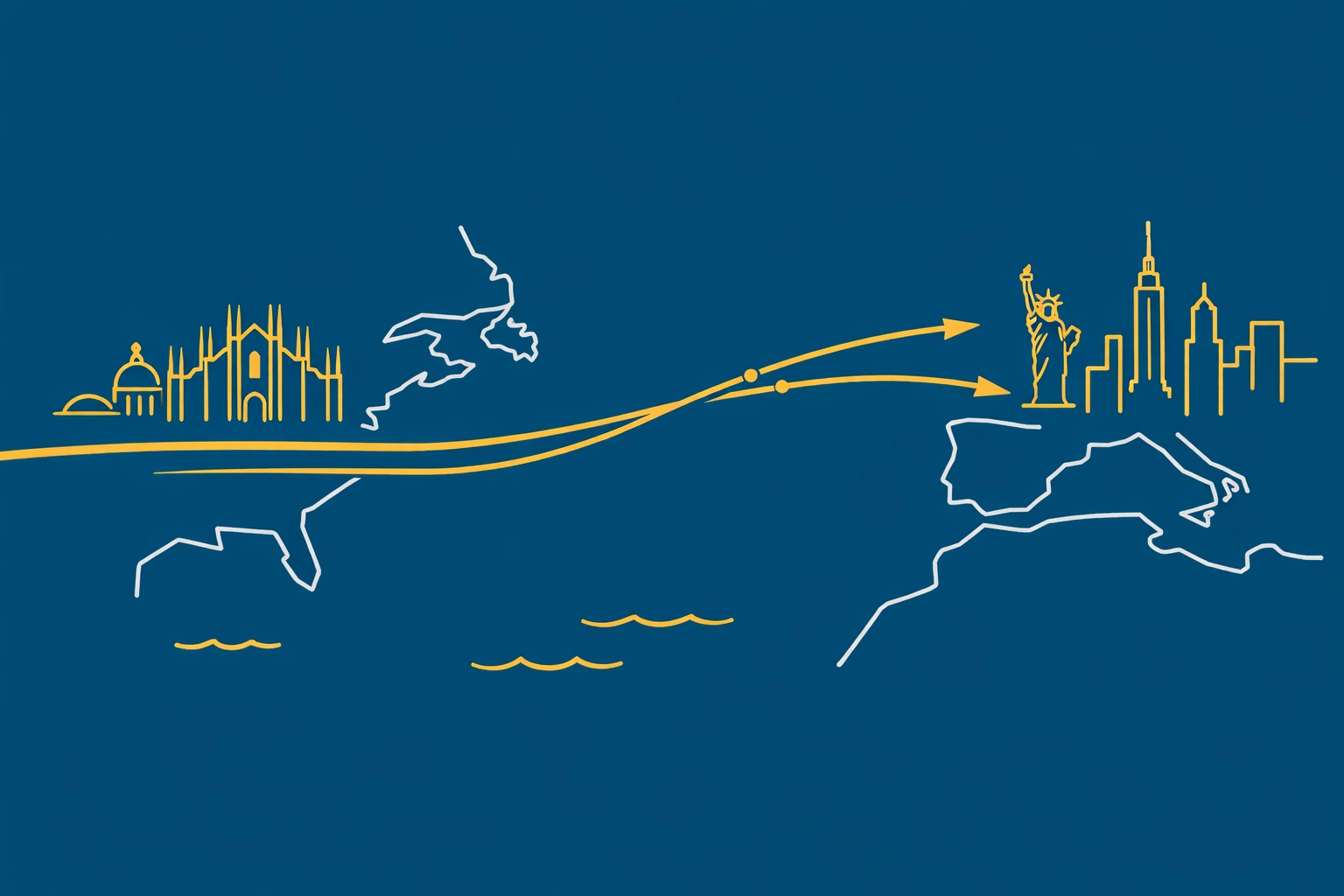
 A conceptual diagram showing the RQ™ System (Diagnostic, Operating Model, Roadmap) bridging two distinct landmasses representing Italy and the US.
The RQ™ Solution for Transatlantic Coherence
To solve the Invisible Drift, we deploy a three-phased intervention designed for the specific pressures of an international expansion:
- RQ Diagnostic™: This is our forensic tool. We look beyond the spreadsheets to diagnose the hidden misalignments in authority, communication, and trust. We identify where the "drift" is already happening and why.
- RQ Operating Model™: We design the "Rules of the Road." This defines exactly how decisions are made across the Atlantic, who has the "D" (Decision) in the U.S. market, and how the Italian identity is preserved within a scale-driven American structure.
- RQ Roadmap™: This is the execution plan. It provides the U.S. leadership team and the Italian HQ with a shared calendar of accountability, ensuring that the next 180 days are spent on growth, not on translating intentions.
From Craft to Scale: The Italian Identity in America
Italian companies lead with engineering depth and a relational leadership style that is a genuine competitive advantage. However, the U.S. market is a "scale-driven" environment. It demands operational rigor and explicit accountability structures.
The most successful Italian CEOs I have advised are those who realize that "becoming more American" in their U.S. operations doesn't mean losing their Italian soul. It means upgrading their leadership system to be "culturally bilingual."
They recognize that trust is built differently in the U.S. In Italy, trust is often built through familiarity and continuity. In the U.S., trust is built through clarity, responsiveness, and role competence. When you fail to provide an American executive with a clear reporting structure, you aren't just being "informal": you are actively eroding their trust in your leadership.

Avoiding the "Invisible Drift"
If you are an Italian CEO or a PE firm overseeing an Italian portfolio company in the U.S., ask yourself these three questions:
- Do our U.S. leaders truly know what they have the authority to decide without calling Italy?
- Is our communication cadence designed for transatlantic speed, or are we relying on "informal" updates that lead to delays?
- Does our U.S. team feel like they are part of our culture, or are they just a "sales office" struggling to understand the HQ mindset?
The first 180 days are the decisive window. If you sense the "drift" starting, it is time for a structured reset. At Rinnovare, we specialize in the leadership recalibrations necessary to bridge this delta. We don't just help you expand; we help you integrate, align, and scale without losing the craftsmanship that made you successful in the first place.
Leadership integrity across distance is not a given; it is an architectural achievement. Let's build that bridge together.
Contact Rinnovare to discuss an RQ Diagnostic™ for your transatlantic operations.
