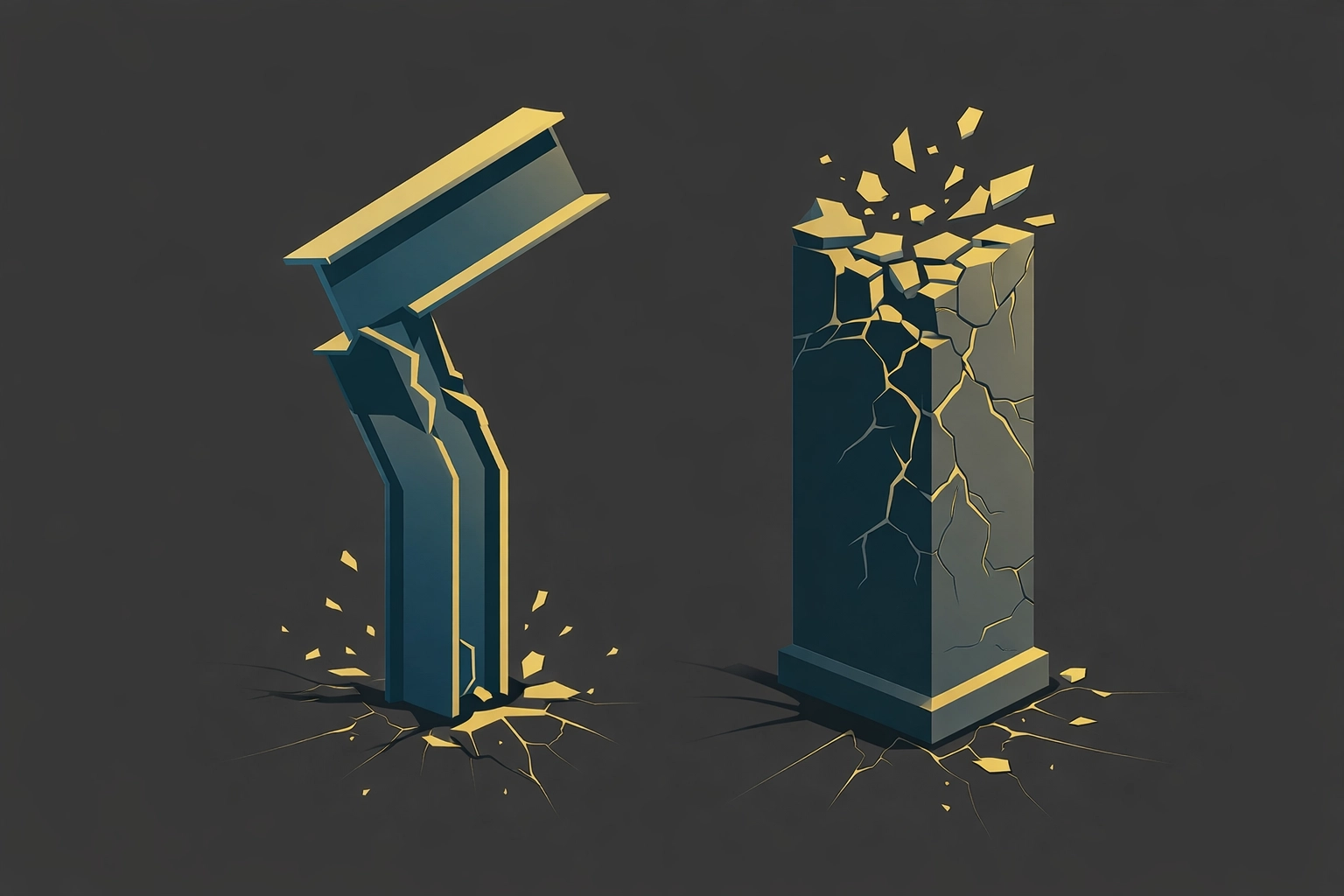
A load-bearing beam does not fail all at once. It fractures under pressure, then gives way when stress hits the frame.
That is how leadership teams collapse in portfolio companies. Not from bad luck. Not from market timing. From structural failure under velocity stress.
Sponsors misread the signal. They call it culture. They call it grit. They call it execution discipline. The diagnosis is wrong.
The issue is architecture. When a leadership team is misaligned before the investment thesis accelerates the cadence, the business is already carrying a structural defect. One bad quarter does not create the problem. It exposes it.
Portfolio companies do not fail because the targets are ambitious. They fail because the leadership system was never built for the speed required to hit them.
Before close, teams operate on habit — tenure, trust, and unspoken workarounds. That is the base condition for Organizational Drift. Once a PE firm increases the pace, those informal bonds start to crack.
Without an RQ Operating Model™, decisions get relitigated. Priorities blur. Cadence rises, but throughput does not. Drift Tax™ slows alignment. Speed Tax slows execution. Together, they suppress the multiple.
Executive teams are misaligned before close. They confuse personal compatibility with operating coherence. They agree on the number. They disagree on the sacrifices required to produce it.
That gap stays hidden until pressure arrives. Leaders interpret the same mandate through different rules. The CFO protects margin. The COO protects continuity. The CHRO protects stability. The CEO assumes alignment because no one is openly fighting.
That is not alignment. That is deferred structural conflict.
Under load, the cracks widen fast. Resource allocation gets reopened. Meetings produce decisions that do not hold. Side conversations replace operating rhythm. Accountability becomes selective. The leadership team stops acting as a load-bearing system and starts acting as a set of independent survival units.
This is where the RQ System™ matters. Renewal Quotient is not an HR overlay. It is the structural discipline underneath execution. The RQ Diagnostic™ identifies where decision rights, role clarity, operating cadence, and accountability are already failing. The RQ Roadmap™ then sequences the repair.
The structural layer is only half the problem. The second failure point sits in The Hidden Emotional Contract™.
Every executive team operates inside an unwritten agreement about trust, safety, dignity, fairness, and consequence. In stable conditions, that agreement goes untested. Under investor pressure, it gets stress-tested immediately.
If the CEO demands transparency but punishes bad news, the contract breaks.
If the sponsor demands urgency but changes the rules midstream, the contract breaks.
If the team is told to take risk but learns that misses are career-ending, the contract breaks.
When the emotional contract breaks, the leadership team stops telling the truth.
Once that break happens, behavior changes. Leaders become defensive. Information gets managed. Risk tolerance collapses. The system slows down exactly when the business needs velocity.
That is why Rinnovare fixes both layers at the same time: the structural layer through the RQ System™, and the emotional layer through The Hidden Emotional Contract™. If you repair one and ignore the other, the architecture still fails.

The CEO Test
Re-litigation
Are decisions made in the room being reopened 48 hours later in side channels?
Velocity Stress
Has meeting volume increased since close while real throughput stays flat?
Split Logic
Do the CFO, COO, and CHRO describe the value-creation plan in different terms?
Risk Retreat
Is the team managing exposure more aggressively than it is pursuing outcomes?
If the answer to any of these is yes, the system is carrying structural weakness.
Punchline
Velocity does not create fragility. It reveals it.
The first bad quarter is not the cause of collapse. It is the moment the existing architecture can no longer carry the load. The cost is enterprise-value erosion driven by drag, confusion, and leadership deceleration.
Verdict Close
Fix the leadership architecture before the quarter breaks it.
If you’re facing this moment, the next step is a 30-minute clarity call.
Primary Category: Enterprise Value
Secondary Category: Organizational Drift
Leave a Reply