Walk into any high-stakes boardroom, and you’ll see the same ritual. The slides are crisp. The EBITDA projections are aggressive. The CAPEX strategy is mapped out to the third decimal point. But there is often a deafening silence regarding the one variable that actually determines whether those slides become reality: the alignment of the people in the room.
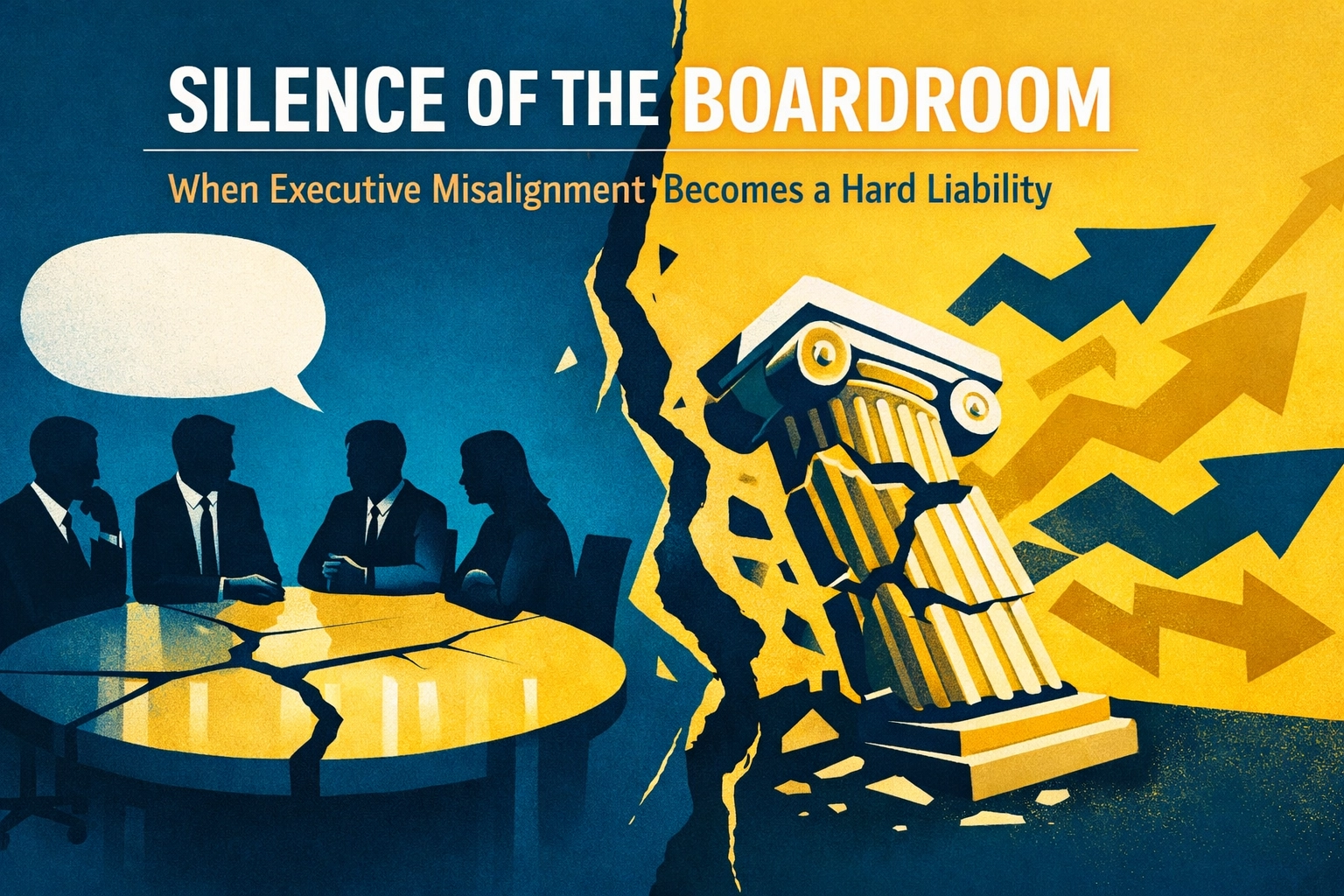
We call it the "Silence of the Boardroom." It’s that palpable tension where everyone knows the CEO and the CFO haven't spoken a meaningful word to each other in three weeks, or that the Head of Sales is running a shadow organization that ignores the product roadmap.
In most board meetings, these issues are treated as "soft" problems: unfortunate personality clashes or "cultural quirks" to be managed later. But here is the hard truth: executive misalignment is not a soft issue. It is a hard liability. It is a quantifiable drag on enterprise value that, if left unchecked, leads to M&A failure, CEO exits, and strategic paralysis.
At Rinnovare, we’ve seen this play out in the private equity space and mid-market firms more times than we can count. When the board stays silent on leadership health, they aren't being polite. They are being negligent.
Why Boards Struggle to Quantify "Human Risk"
Boards are traditionally composed of masters of the "hard" sciences: finance, law, and operations. They have an incredible vocabulary for discussing debt-to-equity ratios or supply chain disruptions. They have the tools to audit a P&L until it screams.
However, when it comes to "human risk," the vocabulary disappears.
Human risk is the probability that leadership dysfunction will prevent the execution of a strategic plan. It’s the risk that your top talent will exit because of a toxic executive culture, or that a $100M merger will fail because the two leadership teams are playing a game of "us vs. them."
Because boards don't have a standardized way to measure this, they ignore it until the damage is visible on the balance sheet. They wait for the "event": the high-profile resignation or the missed quarterly target: before they address the rot. By then, the "Dysfunction Dividend" has already been paid out in lost productivity and wasted capital.

The Strategic Drag: How Misalignment Erodes Value
Misalignment doesn’t just make for an awkward holiday party; it creates a "decision backlog." When the executive team is out of sync, every strategic choice gets deferred. One leader wants to push innovation; another wants to hoard cash. The result? The organization stalls.
Research shows that aligned executive teams are more than twice as likely to exceed performance expectations. Conversely, misaligned teams create the single biggest drag on growth. This damage cascades downward. When the board displays inconsistency or emotional reactivity, the CEO shifts into protection mode. Instead of leading, they start "managing the board": curating information, over-scripting presentations, and avoiding any conflict that might make them look weak.
Middle management, sensing the vacuum at the top, becomes paralyzed. They chase priorities they don't understand because the signals from the C-suite are mixed. Trust erodes, and the culture becomes performative rather than purposeful. People stop trying to win; they just try to survive.
From HR as a "Cost Center" to a "Value Driver"
A major reason the Silence of the Boardroom persists is the legacy view of Human Resources. For decades, HR was built as an administrative trap: a cost center designed for compliance, benefits administration, and "policing" behavior.
If your HR function is a cost center, it’s because you built it that way.
In a high-performance organization, HR must transition into a strategic multiplier. It’s the difference between "keeping the lights on" and "fueling the engine." When we work with clients on their Operating Cadence Audit, we often find that the "people strategy" is completely disconnected from the "business strategy."
A Value-Driving HR function doesn't just manage headcount; it manages capability. it identifies where the executive team is misaligned and provides the board with the data they need to intervene before a crisis occurs.

Giving the Board a Language: The Renewal Quotient (RQ™)
The primary reason boards stay silent is that they lack a common language to discuss people performance. At Rinnovare, we solved this by developing the Renewal Quotient (RQ™).
RQ™ provides the analytical rigor of a financial audit but applies it to the human architecture of the business. It allows boards to stop guessing and start measuring. The RQ™ system consists of three canonical products:
- RQ Diagnostic™: A deep-dive assessment that uncovers the hidden friction points within the leadership team and the broader organization. It identifies the "Denial Gap" between what leaders think is happening and what is actually happening.
- RQ Operating Model™: A customized blueprint for how the organization should function. This moves beyond the org chart to define how decisions are made, how information flows, and how accountability is enforced.
- RQ Roadmap™: A clear, actionable path to bridge the gap from current dysfunction to future-state performance.
By using RQ™, boards can finally discuss "culture" in the same way they discuss "capital." It turns the "soft" stuff into a set of hard metrics that can be tracked, managed, and improved.
The Moral Obligation of Leadership
There is a final element that rarely gets discussed in the boardroom: the moral obligation of leadership.
When you sit at the top of an organization, you are responsible for the livelihoods, well-being, and professional growth of hundreds or thousands of people. Allowing executive misalignment to persist isn't just a business failure; it's a failure of stewardship.
High-performance culture is not a luxury; it is a requirement for sustained success. Elevating people and ensuring leadership alignment is the only path to long-term value creation. When leaders are aligned, the organization hums. People feel a sense of agency, purpose, and clarity. This isn't just "nice to have": it’s the foundation of excellence.

Breaking the Silence
If you are a board member or a CEO, it’s time to ask the uncomfortable questions:
- Do we have a shared definition of success, or are we all running different races?
- Is our HR function a bureaucratic hurdle or a strategic asset?
- What is the cost of the "Silence" in our boardroom?
Executive misalignment is a liability, but alignment is a competitive advantage. It’s the one thing your competitors can’t easily replicate.
Don't wait for the exit interview or the failed merger to address the health of your leadership team. Break the silence. Give your board the language of performance.
If you’re ready to move from dysfunction to delivery, contact us today. Let’s stop talking about "soft issues" and start building a high-performance architecture that actually works.
For more insights on transforming your HR strategy into a competitive advantage, visit our blog or learn more about our approach.
