In the high-stakes world of Private Equity and transatlantic business expansion, there is a ghost in the machine that rarely shows up on a balance sheet. It’s a cultural phenomenon that, while elegant in a social setting, is absolutely lethal to an P&L.
In Italy, they call it Bella Figura. Literally translated, it means "beautiful figure," but it goes far deeper than wearing a well-tailored suit or knowing which wine to pair with the secondi. It’s a philosophy of presentation, the art of making a good impression, maintaining dignity, and, above all, saving face.
In a social context, Bella Figura is what makes Italy one of the most charming places on earth. In a corporate context, specifically when a firm is trying to scale, integrate an acquisition, or pivot, it becomes the Bella Figura Fallacy. It is the drive to keep things looking "good" on the surface while the engine room is taking on water.
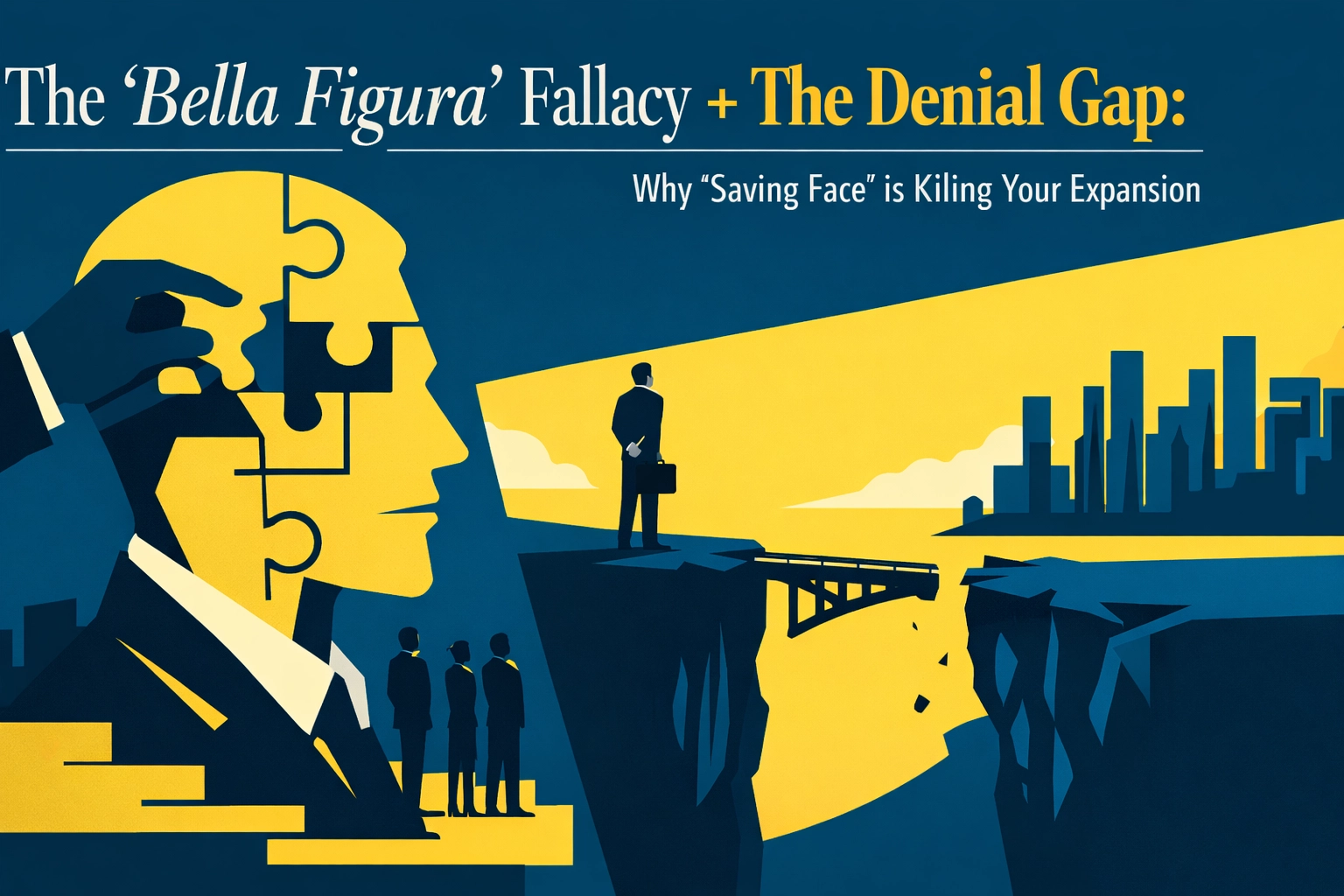
When this fallacy takes root, it creates what I call the Denial Gap. And if you’re a CEO or a Board member, this gap is where your enterprise value goes to die.
The Anatomy of the Denial Gap
The Denial Gap is the distance between the "All systems go" report you receive in the boardroom and the "We are drowning" reality shared by the middle management team at the water cooler.
In firms where Bella Figura dominates, the culture implicitly forbids "ugly" truths. To admit that a new software implementation is failing, or that a key leadership hire is a toxic disaster, is to make a Brutta Figura (a bad impression). Because the cultural cost of "losing face" is perceived as higher than the operational cost of the mistake, the mistake is hidden.
It’s not necessarily a conscious lie. It’s a slow, collective editing of reality.
I’ve sat in boardrooms in New York and London looking at subsidiaries in Milan or Paris where the KPIs look… fine. They aren't great, but they aren't screaming. But when you look closer, you realize the targets have been moved, the definitions of "success" have been massaged, and the structural friction is being overcome by pure, unsustainable heroics from a few burned-out managers.

The ‘Drift Tax’: The High Cost of Silence
In the world of Rinnovare, we often talk about the Drift Tax.
When a problem is identified on Day 1 but isn't addressed until Day 180 because everyone was busy trying to "save face," the cost of the fix doesn't just double. It compounds.
The Drift Tax manifests in:
- Talent Attrition: Your "A-Players" aren't fooled by the facade. They see the dysfunction and they leave because they refuse to work in a hall of mirrors.
- Strategic Paralysis: You can’t pivot if you don’t know where your feet are planted.
- Integration Failure: In M&A, the first 90 days are critical. If the acquired leadership team is practicing Bella Figura, the cultural integration never actually happens; it just becomes a cold war of polite emails.
The longer the Denial Gap persists, the heavier the Drift Tax. Eventually, the gap becomes so wide that no amount of "face-saving" can bridge it. That’s when you see the "sudden" collapse of a business unit that everyone thought was doing "okay."
Why PE-Backed Firms are Especially Vulnerable
Private Equity is a game of velocity. You buy, you optimize, you exit. There is no time for a two-year cultural "unfreezing" process.
However, PE firms often inadvertently encourage the Bella Figura Fallacy. When a Board demands aggressive growth and shows zero tolerance for "noise," they inadvertently signal to the CEO that truth is secondary to the narrative. The CEO, wanting to maintain their own Bella Figura with the Board, suppresses the reality from the ground.
This creates a feedback loop of denial. The Board thinks everything is on track for a 3x exit, while the actual operating model is held together by duct tape and prayers.

Breaking the Facade (Without the Meltdown)
So, how do you close the Denial Gap? You can’t just walk in and demand everyone "be more honest." In cultures where saving face is deeply ingrained, a blunt approach usually just causes people to dig their heels in further.
You need a way to surface the "ugly" data points without making the leadership feel like they are being put on trial. This is where discreet, senior HR advisory becomes a strategic weapon rather than an administrative function.
At Rinnovare, we don't do "kumbaya" sessions. We use our RQ Diagnostic™ to map the actual human and operational architecture of the firm. Because the RQ™ system is data-driven and evidence-based, it removes the personal "shame" of failure. It’s not "You are a bad manager"; it’s "The data shows a misalignment in the RQ Operating Model™ that is slowing your delivery."
The goal is to provide a "safe exit" for the truth. By using a senior external advisor who understands the cultural nuances of both the US market and the European "face-saving" mindset, you can address structural issues without causing a total leadership meltdown.
The Role of the Interim CHRO as a Truth-Teller
Sometimes, the internal HR team is too close to the Bella Figura culture to be effective. They are often part of the facade, whether they want to be or not.
This is where an Interim CHRO or a dedicated project lead: someone who doesn't have a 20-year career trajectory at the firm to protect: can do the heavy lifting. They can be the one to say, "The Emperor has no clothes, but here is a very nice suit we can build for him."
They provide the Board with the unvarnished truth while providing the CEO with the tools to fix it before the "Drift Tax" bankrupts the strategy. It’s about moving from "Looking Good" to "Being Great."

A New Era for Rinnovare
As we move through our own rebrand, we’ve spent a lot of time thinking about this exact tension. Our new identity isn't just a fresh coat of paint: it’s a reflection of our commitment to cutting through the noise.
The name Rinnovare (to renew) was chosen intentionally. Renewal isn't about covering up the old; it's about stripping away the layers of dysfunction and building something structurally sound. We are moving away from the "HR as a Cost Center" mindset and focusing entirely on Transforming HR into Competitive Advantage.
Our services, from the RQ Roadmap™ to our standalone Operating Cadence Audits, are designed for the CEO who is tired of the facade. If you suspect there is a Denial Gap in your organization: if the reports look too perfect but the results aren't hitting: it’s time to stop worrying about Bella Figura.
The Bottom Line
A "beautiful figure" is worth nothing if the body underneath is failing. In the current global economy, the companies that win are the ones that can process the "ugly truth" the fastest.
Closing the Denial Gap requires courage, but it also requires a system. Whether you use the RQ™ system or a highly targeted Operating Cadence Audit, the objective is the same: stop paying the Drift Tax.
Don't let the desire to save face cost you the business.
If you’re ready to see what’s actually happening behind the curtain, let’s talk. No judgment, no "meltdowns": just the clarity you need to actually scale.

Philip Curran is the CEO and Consultant at Rinnovare, specializing in high-stakes HR advisory for PE-backed firms and organizations in transition. To learn more about how we help leaders bridge the gap between strategy and execution, visit rinnovarehr.com.