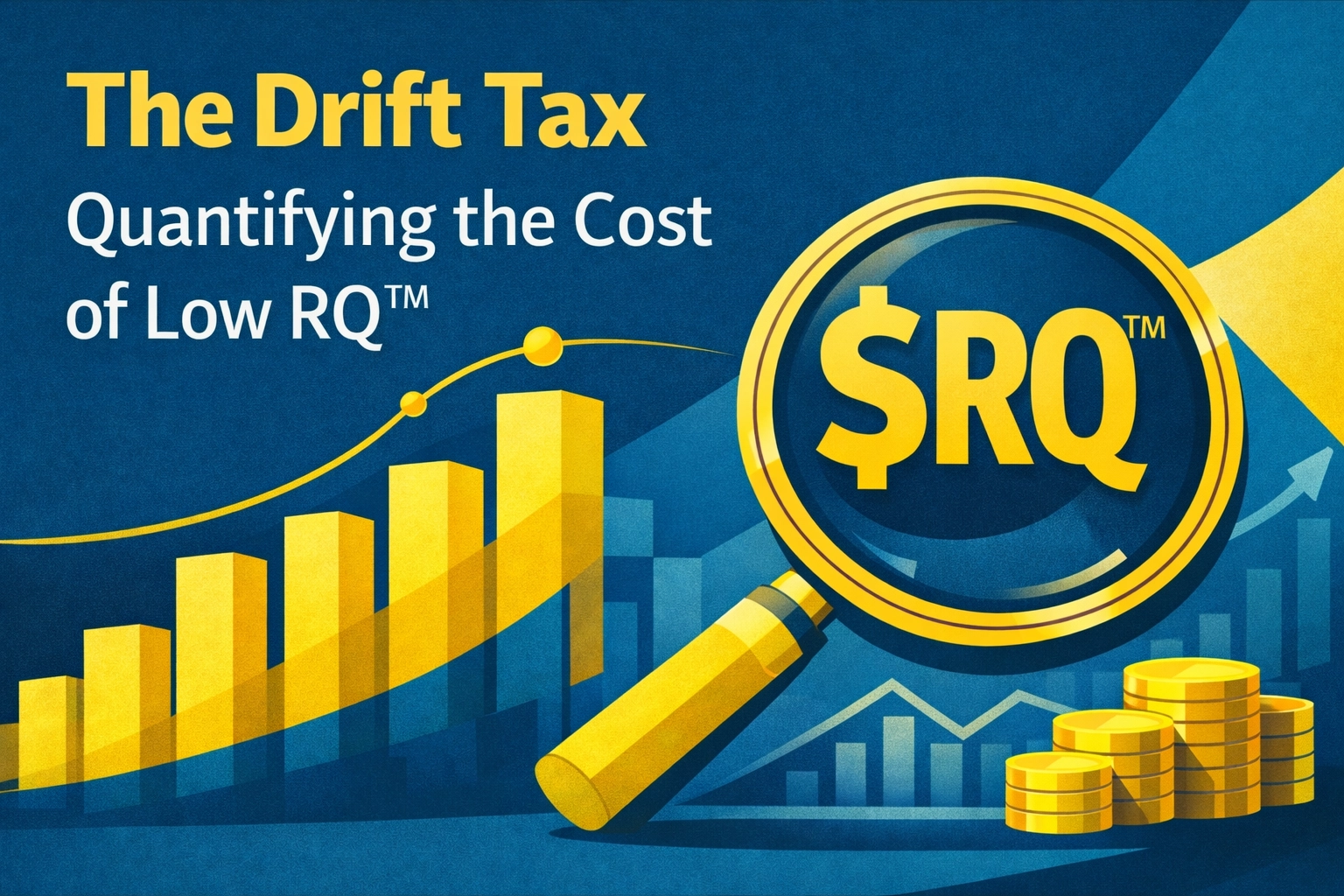
In the high-stakes environment of Private Equity and growth-stage leadership, the greatest threat to enterprise value is rarely a competitor or a market shift. It is a silent, internal erosion of momentum known as the Drift Tax.
The Drift Tax is the cumulative cost of leadership misalignment, cultural incoherence, and operational ambiguity. It’s what happens when a leadership team agrees on strategy in the boardroom but operates from different assumptions in the field. For CEOs and PE operators, that tax shows up daily as delayed decisions, wasted capital, and avoidable attrition.
At Rinnovare, we have developed a proprietary product system to quantify this drag and convert it into a disciplined recovery plan: the Renewal Quotient (RQ™) — including the RQ Diagnostic™, the RQ Operating Model™, and the RQ Roadmap™.
The Anatomy of Drift
Most organizations don’t suffer from a lack of intelligence or a “bad” strategy. They suffer from drift. Drift starts when the initial clarity of a mission or investment thesis frays under execution pressure.
Leaders begin interpreting goals through their own functions instead of the enterprise. Middle management starts guessing priorities because the signal from the top gets noisy. Eventually culture—the foundation of how work gets done—loses coherence.
When drift takes hold, the organization pays the tax.
- Decision Drag: It takes three meetings to decide what used to take one.
- Resource Leakage: Capital is deployed toward initiatives that don’t move the needle on the core thesis.
- Cultural Decay: High performers leave because they no longer understand the "why" behind the "what."
For a Private Equity firm, drift is the primary reason why deals fail within the first 90 days. If the leadership team is not operating in lockstep, the investment thesis is essentially a theory without an engine.
A quick micro-case: a PE-backed services platform launches a “cross-sell” growth plan, but Sales is measured on new logos, Ops is staffed for steady-state delivery, and Finance freezes hiring to protect margin. No one is “wrong,” but the operating system is misaligned—pipeline quality drops, delivery misses climb, and the company pays the Drift Tax in churn, rework, and a slipping value-creation timeline.

Introducing RQ™: The Renewal Quotient
The Renewal Quotient (RQ™) is Rinnovare’s proprietary product system for measuring and improving an organization’s capacity to execute through complexity. If the Balance Sheet measures financial health and the P&L measures operational performance, RQ™ measures the leadership-and-organization conditions that determine whether strategy becomes results. RQ™ is quantified as a 0–100 score.
RQ™ doesn’t look at HR metrics in a vacuum. It translates human dynamics into measurable enterprise value by assessing five dimensions:
1. Leadership Coherence
Do the senior leaders operate as a single system — aligned on priorities, decision logic, and what “good” looks like? When coherence is low, you don’t just get disagreement; you get competing centers of gravity that fragment execution.
2. Organizational Clarity
Do people have clear roles, decision rights, and an operating cadence that matches the strategy? Organizational clarity is where ambiguity becomes expensive: handoffs break, escalation paths multiply, and decisions default to politics or delay.
3. Cultural Integrity
Culture is not perks or posters; it is the consistency of behavior under pressure. Cultural integrity measures whether stated values actually govern choices, especially when tradeoffs get real. When integrity is high, execution is fast. When it is low, every transaction requires oversight.
4. Execution Discipline
Can the organization translate priorities into accountable commitments — with follow-through, clean metrics, and rapid course correction? Execution discipline is the difference between “busy” and “progress.”
5. Renewal Capacity
Can the system adapt without thrashing — learning, resetting, and re-aligning before drift becomes damage? Renewal capacity is what allows a leadership team to evolve strategy, structure, and behavior without losing momentum.
RQ™ is delivered as a complete system:
- RQ Diagnostic™: Establishes a baseline RQ™ and pinpoints where drift is forming (and what it’s costing).
- RQ Operating Model™: Defines how the leadership team will run the business — decision rights, cadences, interfaces, and accountabilities.
- RQ Roadmap™: A sequenced plan to raise RQ™ and reclaim execution capacity in a way boards and CEOs can sponsor with confidence.

Why RQ™ is an Early-Warning System (and a Performance Accelerator)
Private Equity is a natural use case for RQ™ — but it’s not the only one. RQ™ is designed for the moments when complexity spikes and the organization’s “execution engine” is at risk.
In HR due diligence, the focus is often on compliance, benefits, and payroll. Necessary — but defensive. RQ Diagnostic™ is an offensive tool: it surfaces the leadership and organizational conditions that determine whether the investment thesis can actually be executed, and it identifies the hidden “human debt” that slows integrations, turnarounds, and scale-ups.
Beyond diligence, RQ™ applies directly to:
- CEO transitions: when the mandate is clear but the system hasn’t caught up.
- Stalled growth: when product/market fit exists, but execution capacity is capped by internal friction.
- Leadership resets: when the team needs realignment without blowing up the enterprise.
- Value-creation acceleration: when the board wants speed, but speed requires coherence and clarity.
Once the baseline is established, RQ Operating Model™ and RQ Roadmap™ turn insight into action — giving CEOs, boards, and operating partners a practical path to:
- Restore Leadership Coherence: Identify where leaders are out of sync and facilitate the conversations required to realign.
- Increase Organizational Clarity: Tighten decision rights and operating cadence so the organization stops guessing.
- Rebuild Cultural Integrity: Reinforce the behavioral standards that make execution reliable under pressure.
- Strengthen Execution Discipline: Create accountability and follow-through without bureaucracy.
- Raise Renewal Capacity: Build a system that adapts early — before drift becomes damage.
The ROI of Renewal
We treat organizational health as a hard asset. When a company increases its RQ™, the financial impact is immediate — because the Drift Tax is the quantifiable cost of low RQ™.
Low RQ™ shows up as measurable loss: slower cycle times, duplicated work, decision churn, missed handoffs, rework, avoidable attrition, delayed integrations, and “initiative spend” that doesn’t compound. It’s not vague culture talk. It’s execution capacity leaking out of the system.
Consider a growth-stage company preparing for an exit. By identifying and reducing the Drift Tax, the leadership team can demonstrate a track record of disciplined execution and organizational reliability. This doesn’t just improve the bottom line; it improves confidence—and confidence improves the multiple. Buyers pay a premium for organizations that are “tuned”: where leadership coherence is high, the operating model is clear, and culture is an engine, not a weight.
Conversely, a persistently low RQ™ is a red flag. It suggests future growth will be expensive and fragile, and that even strong leaders will eventually be constrained by the system. As we’ve noted in our analysis of why the system eventually rejects the leader, when coherence and clarity break down, the enterprise starts to resist the very change it claims to want.

Moving Beyond Tactical HR
The traditional HR model is failing because it remains tactical. It focuses on the administration of people rather than the optimization of performance. At Rinnovare, we believe in the renaissance of the human: the idea that in an era of AI and automation, the ultimate competitive advantage is a highly aligned, high-clarity human leadership team.
RQ™ is the bridge between the “soft” side of leadership and the “hard” side of finance. It turns qualitative reality into a quantified view of execution capacity — and then into a plan.
It allows a CEO, board, or operating partner to say, “Our RQ™ is low in Organizational Clarity and Execution Discipline. Here is the Drift Tax we’re paying — and here is the RQ Roadmap™ to reclaim it.”
Conclusion: Stop Paying the Tax
The Drift Tax is not an inevitable cost of doing business. It’s the quantifiable cost of low RQ™ — and it compounds quietly until the organization can’t hide it anymore.
Leaders who ignore the signs — repetitive meetings, conflicting priorities, decision churn, cultural “off-gassing” — eventually find themselves funding friction instead of funding growth.
The Renewal Quotient (RQ™) offers a different path: measure what’s real, name the Drift Tax, and raise RQ™ with a system that actually holds — the RQ Diagnostic™, the RQ Operating Model™, and the RQ Roadmap™.
Whether you’re in PE value creation, a CEO transition, a leadership reset, or a stalled-growth moment that needs acceleration, the objective is the same: build a leadership-and-organization system that executes as one cohesive force.
Are you ready to measure your RQ™?

To learn more about how Rinnovare helps leadership teams regain clarity and accelerate enterprise value, visit our services page or contact us for a consultation.