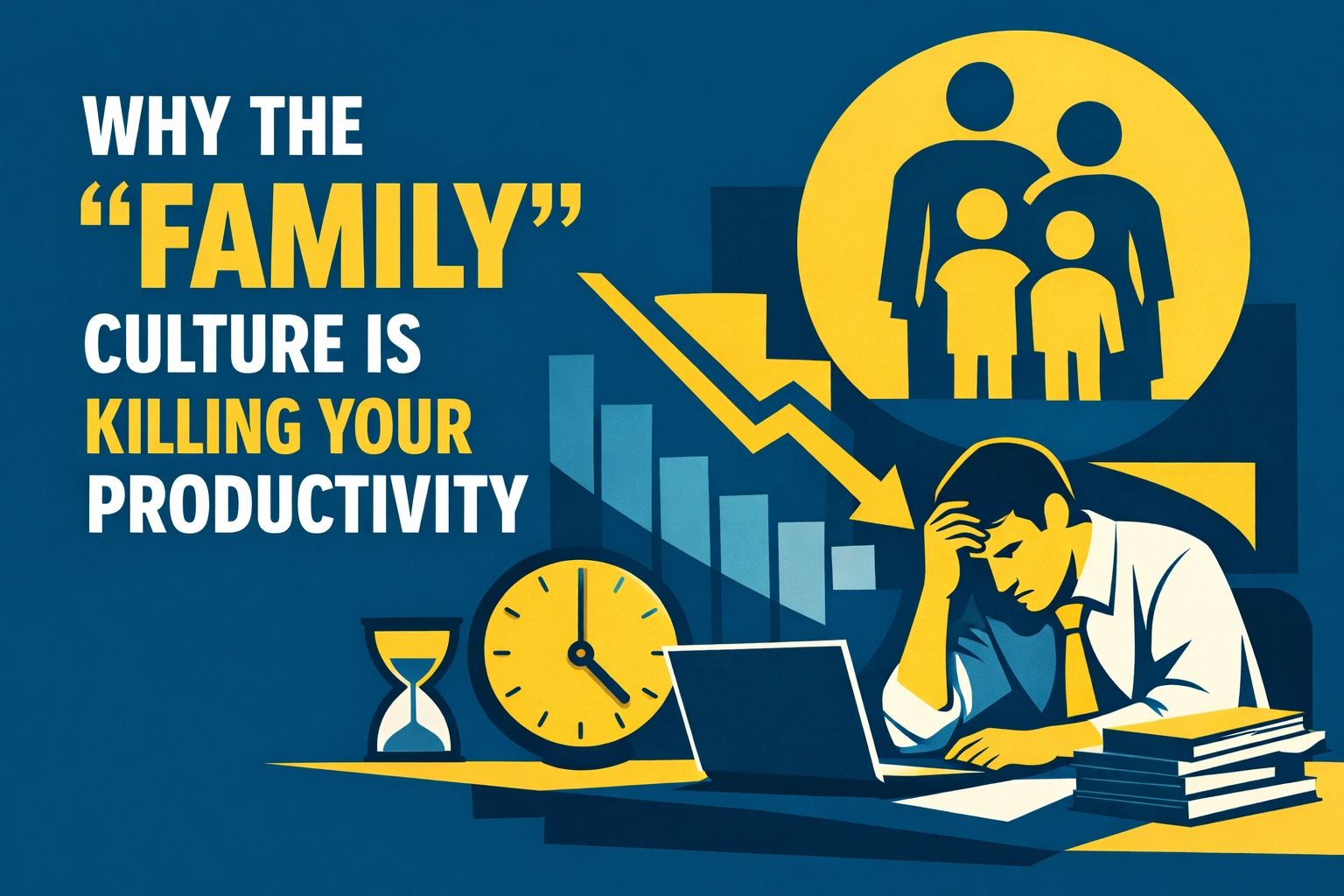
If you’ve spent more than five minutes in a corporate town hall, you’ve heard it. The CEO stands up, hands in pockets, looking earnestly at the crowd, and says the words: "We aren’t just a company. We’re a family."
It sounds warm. It sounds inclusive. It sounds like a great place to work.
It’s also a lie that is systematically dismantling your company’s productivity.
At Rinnovare, we spend a lot of time in the trenches of culture transformation consulting. We see the aftermath of the "family" metaphor every single day. While the intention behind the sentiment is usually positive, aiming for loyalty and belonging, the actual execution often results in a high-friction, low-accountability environment where "loyalty" is used as a shield against performance standards.
If you want to build a high-performing enterprise, you need to stop acting like a family and start acting like a professional sports team. Here is why the family trope is toxic to your bottom line and how you can pivot toward a model that actually creates value.
The Unconditional Trap
The fundamental problem with the family metaphor is that family relationships are (ideally) unconditional. You don’t fire your brother because he’s bad at managing his calendar. You don’t put your cousin on a Performance Improvement Plan (PIP) because he missed his sales targets for three quarters in a row.
In a family, membership is a birthright. In a high-performing business, membership is a privilege earned through consistent contribution.
When a CEO calls the company a family, they inadvertently send a message: Once you’re in, you’re safe. This creates a "safety" that breeds complacency. When underperformance is met with the "but they’ve been with us since the beginning" or "they’re part of the fabric of the family" excuse, the high-performers in the room start looking for the exit.
Nothing kills executive team effectiveness faster than watching a leader tolerate mediocrity in the name of loyalty.

Loyalty as a Shield
In "family" cultures, loyalty is often weaponized. It becomes a currency that people trade to avoid accountability. We see this frequently in founder-led organizations or Private Equity-backed firms where the original team is still in place.
The narrative goes like this: "Sure, Dave hasn’t adapted to the new CRM, and his reports are consistently late, but he was there when we were working out of the garage. He’s family."
By protecting "Dave," you are effectively taxing every other person in the organization. You are asking your A-players to work harder to compensate for Dave’s friction. Eventually, those A-players realize that the reward for high performance is just more work, while the reward for "being family" is total job security regardless of output.
This is the moment a leader loses the room. We’ve written about this specific tipping point in our insight piece, I Ain’t Your Daddy: The Moment a Leader Lost the Room. When you prioritize family vibes over professional standards, you aren't being kind; you're being weak.

Emotional Stewardship vs. Toxic Comfort
At Rinnovare, we advocate for a concept we call Emotional Stewardship.
Many leaders confuse being a "good person" with providing a comfortable environment. But comfort is the enemy of growth. A steward is someone who manages something of value on behalf of another. As a leader, you are a steward of your employees' careers and the company's capital.
True emotional stewardship isn't about coddling people; it’s about elevating them through clarity. It’s about being honest enough to tell someone they aren't meeting the bar and being professional enough to provide the path to get there, or the exit if they can’t.
Families tolerate dysfunction. Enterprises shouldn't. If you care about your people, you owe them a culture where they can actually win. You don’t win in a family; you just exist. You win in a professional environment designed for excellence.
The Alternative: The Professional Sports Team
Think about a high-stakes surgical unit or a championship-winning NFL team.
Is there a deep bond? Absolutely. Is there mutual respect? Essential. Is there loyalty? To the mission and the team, yes. But is it a "family"? No.
In a professional sports team:
- Roles are crystal clear: Everyone knows what they are responsible for.
- Performance is public: You can’t hide a 0-for-10 shooting streak behind "loyalty."
- The goal is the win: The mission (the Super Bowl, the successful surgery, the successful exit) is the primary driver.
- Coaching is constant: Feedback isn't an annual HR event; it's a real-time necessity.
When you shift from a family mindset to a sports team mindset, the culture changes from "How do I keep everyone happy?" to "How do we put the best people in the best positions to succeed?" This is the core of transforming HR into a competitive advantage.

Why "Family" Kills Productivity
When the lines between professional and personal become blurred, productivity takes a hit in three specific ways:
1. Decision-Making Paralysis
In a family, everyone wants a seat at the table and everyone wants their feelings considered. This leads to the "consensus trap." Decisions that should take ten minutes take ten weeks because the CEO doesn't want to "hurt anyone’s feelings" or "make them feel left out of the family."
2. High Friction, Low Velocity
Productivity is about velocity: moving the right things forward quickly. Family cultures are riddled with friction because they prioritize "how we feel" over "what we achieved." You spend more time navigating egos and historical grievances than you do shipping product or closing deals.
3. The Rejection of New Talent
Families are insular. They have "the way we do things." When a high-performing outsider joins a "family" company, the system often rejects them like a foreign organ. The "family" sees the new hire’s drive for accountability as a threat to their comfortable equilibrium. We often see this during M&A integrations where the "family" culture of the acquired company grinds the value creation plan to a halt.

Navigating the Transition
So, how do you fix it? You don’t have to become a cold, heartless machine. In fact, professional teams are often more supportive than families because the support is targeted and intentional.
Step 1: Audit your language. Stop using the F-word (Family). Start talking about the Team, the Mission, and the Standards.
Step 2: Define Decision Rights. Be clear about who owns what. If you've been following our work on matrix management, you know that accountability dies in the shadows of "shared responsibility." Use single-threaded ownership to bring clarity back to the work.
Step 3: Elevate the Standard. Make it okay to talk about performance. In a professional environment, a PIP isn't a death sentence; it's a coaching tool. If someone isn't a fit for the team, helping them find a "team" where they can be an A-player is the most respectful thing you can do.
Step 4: Focus on the "Human Side" of Transformation. Culture change is hard. It requires a Renaissance of the Human, moving away from tactical HR and toward strategic leadership.

The Bottom Line
A business is a commercial enterprise designed to create value for customers, shareholders, and employees. Calling it a family is a shortcut that avoids the hard work of building a real culture based on performance, respect, and mutual goals.
If you want a family, go home. If you want to build a world-class organization, build a team.
Your high-performers are waiting for you to make the distinction. They don’t want another "family dinner" in the breakroom; they want a leader who provides the clarity and the resources to let them do the best work of their lives.
At Rinnovare, we help leaders navigate these exact transitions: moving from the friction of the "family" model to the high-velocity output of an elite team. Whether you are dealing with a post-merger integration or simply trying to scale beyond your founder roots, we provide the executive advisory needed to turn your culture into your greatest asset.
Ready to stop being a "dad" and start being a CEO? Let’s talk.