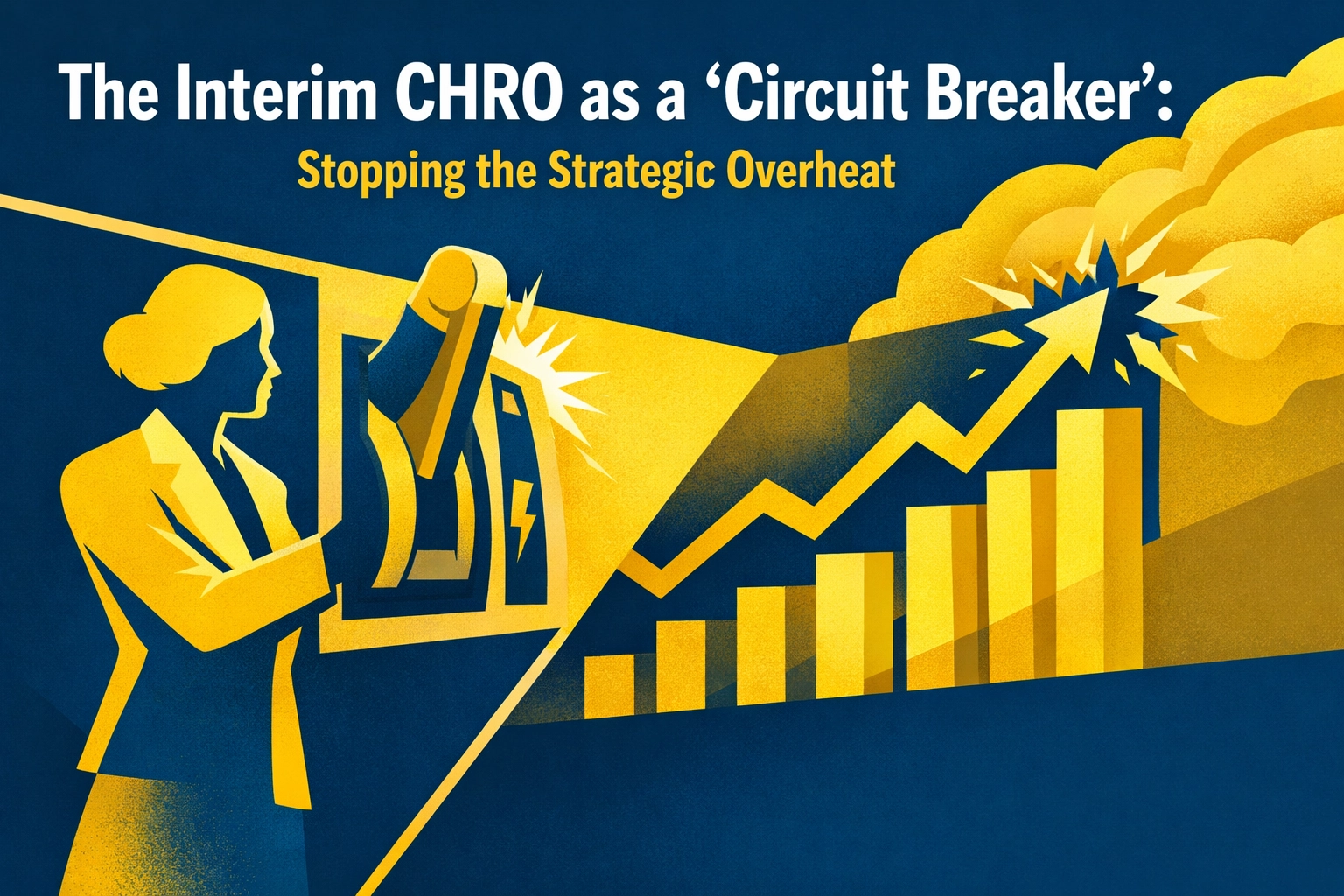
In the high-pressure environment of Private Equity, rapid scaling, or complex M&A, your HR function isn't just a support department, it is the electrical grid of your entire operation. When it functions correctly, it powers growth. When it malfunctions, it doesn't just flicker; it blows a fuse, "tripping" your entire business strategy and bringing progress to a grinding halt.
Most CEOs think of an Interim CHRO as a seat-filler, a temporary placeholder to keep the lights on while a search firm spends six months hunting for a permanent executive.
That approach is a mistake when you are in the middle of a strategic overheat.
When your HR function is actively damaging your enterprise value, through attrition of key talent, paralyzed decision-making, or cultural friction that stalls integration, you don't need a placeholder. You need a Circuit Breaker.
The Anatomy of a Strategic Overheat
A "Strategic Overheat" occurs when the demands placed on an organization’s human capital infrastructure exceed its capacity to process them. It’s a systemic failure.
You see it in the data before you feel it in the culture. The symptoms are unmistakable:
- Execution Paralysis: Initiatives are launched but never land because the "people" side of the equation was never solved.
- Leadership Friction: The boardroom spent more time arguing about "how" things are done than actually doing them.
- Talent Leakage: Your high-performers, the ones you need for the next phase of growth, are the first to exit because they sense the lack of stability.
- Compliance Red Flags: In the rush to scale or integrate, basic governance is ignored, creating a ticking time bomb for the next audit or due diligence round.
When these "trips" happen, the organization’s natural instinct is to push harder. But pushing harder on a broken circuit only leads to a fire. You need someone to step in, cut the power to the dysfunctional processes, and reset the system.

What is a "Circuit Breaker" Interim CHRO?
A Circuit Breaker is a specialized type of interim leadership. Unlike a traditional interim who aims for "continuity," the Circuit Breaker aims for stabilization and surgical intervention.
Their job is to stop the damage.
At Rinnovare, we define this role through three specific actions:
1. Decoupling the Dysfunction
In a crisis, the HR function often becomes entangled with the personal anxieties of the leadership team. The Circuit Breaker steps in to decouple the business strategy from the emotional static. They provide an objective, external perspective that can say "No" to bad habits that have become institutionalized.
2. Stopping the "Strategic Trip"
When an HR process, like a botched payroll integration or a toxic performance review cycle, trips the business strategy, the Circuit Breaker identifies the root cause immediately. They don't just fix the symptom; they re-route the organizational "current" so the business can keep moving while the long-term fix is engineered.
3. Triage Before Transformation
You cannot implement an RQ Operating Model™ while the building is on fire. The Circuit Breaker performs the triage. They stabilize the patient (the organization) so that when a permanent CHRO eventually arrives, they aren't inheriting a catastrophe, they are inheriting a clean, functional slate.
The 14-Day Reset: Crisis Stabilization in Action
When we enter a firm in "overheat" mode, we don't start with a 90-day plan. We start with a 14-day reset. This is often informed by our standalone Operating Cadence Audit, a rapid-fire assessment designed to find where the "wires are crossing."
Days 1-3: The Current Map
We map the flow of information and decision-making. Where are the bottlenecks? Who is holding onto power they shouldn't have? Why is the HR team failing to support the P&L leaders?
Days 4-7: Killing the "Noise"
We identify the 20% of HR activities that are causing 80% of the friction. Often, this involves stopping unnecessary meetings, pausing half-baked initiatives, and clarifying immediate reporting lines.
Days 8-14: Resetting the Psychological Contract
We engage with the key stakeholders to reset trust. In a crisis, the "hidden emotional contract" in the boardroom is usually broken. The Circuit Breaker acts as the bridge, restoring the baseline of professional stewardship required to function.

Why Now? The 2026 Reality
In 2026, the speed of business doesn't allow for "settling in" periods. Whether you are dealing with a PE-backed firm that needs to hit its first-year milestones or a founder-led company struggling with European inbound expansion, the HR function is usually the first place where the strain shows.
As Philip Curran often notes, "Employee Engagement" is a weak metric when your house is on fire. You don't need your team to be "engaged" in a dysfunctional system; you need them to be operating within a stable one. This requires Analytical Stewardship, the ability to use data to diagnose the overheat and the senior "hand" to stop it.
Stabilization is the Pre-Requisite for Growth
Too many CEOs rush to hire a permanent CHRO during a crisis. They want a "savior." But bringing a permanent leader into a chaotic environment is a recipe for a "failed hire" statistic within 18 months. The new leader gets bogged down in the mess, loses credibility, and eventually burns out.
The smarter move is to use a Circuit Breaker to:
- Define the actual problem: Is it a talent problem, a process problem, or a leadership problem?
- Clean the environment: Fix the glaring compliance and operational issues.
- Define the profile: Based on the stabilization phase, what does the permanent leader actually need to look like?
By the time you use our RQ Diagnostic™ to map the long-term path forward, the Circuit Breaker has already ensured that the path is clear.

When to Call for a Circuit Breaker
How do you know if you need this level of intervention? Ask yourself these three questions:
- Is HR "tripping" the strategy? (e.g., Are you missing M&A targets or product launches because of people issues?)
- Is there a "Trust Deficit" between the C-Suite and the HR function?
- Are your best people leaving for reasons other than money?
If the answer to any of these is "Yes," your HR function is likely overheating.
At Rinnovare, we specialize in this type of high-stakes, high-impact interim leadership. We don't just fill a seat; we reset the system. We move from "managing risk" to "Value Acceleration" by ensuring your organizational infrastructure can actually handle the current you’re running through it.
Don't wait for the fire. If the fuses are blowing, it’s time to call in the professionals who know how to handle the heat.
For more insights on stabilizing your leadership team and optimizing your HR operating model, explore our latest articles or contact us to discuss a Cadence Audit for your organization.
