For the better part of two decades, the corporate world has been obsessed with a single, often misunderstood number: the employee engagement score. Human Resources departments have lived and died by annual surveys, "Great Place to Work" certifications, and the pursuit of organizational happiness.
But as we navigate 2026, the cracks in this approach have widened into canyons. We are seeing a phenomenon that should be impossible according to old-school HR logic: companies with record-high engagement scores are experiencing stagnant productivity, "value leakage," and a total lack of strategic agility.
At Rinnovare, we believe the era of chasing engagement as a primary metric is over. To lead in the current landscape, especially within the high-stakes environments of Private Equity and complex organizational transitions, leaders must shift their focus to a more rigorous, impact-oriented philosophy: Analytical Stewardship.
The Engagement Mirage: Why Motion Isn't Value
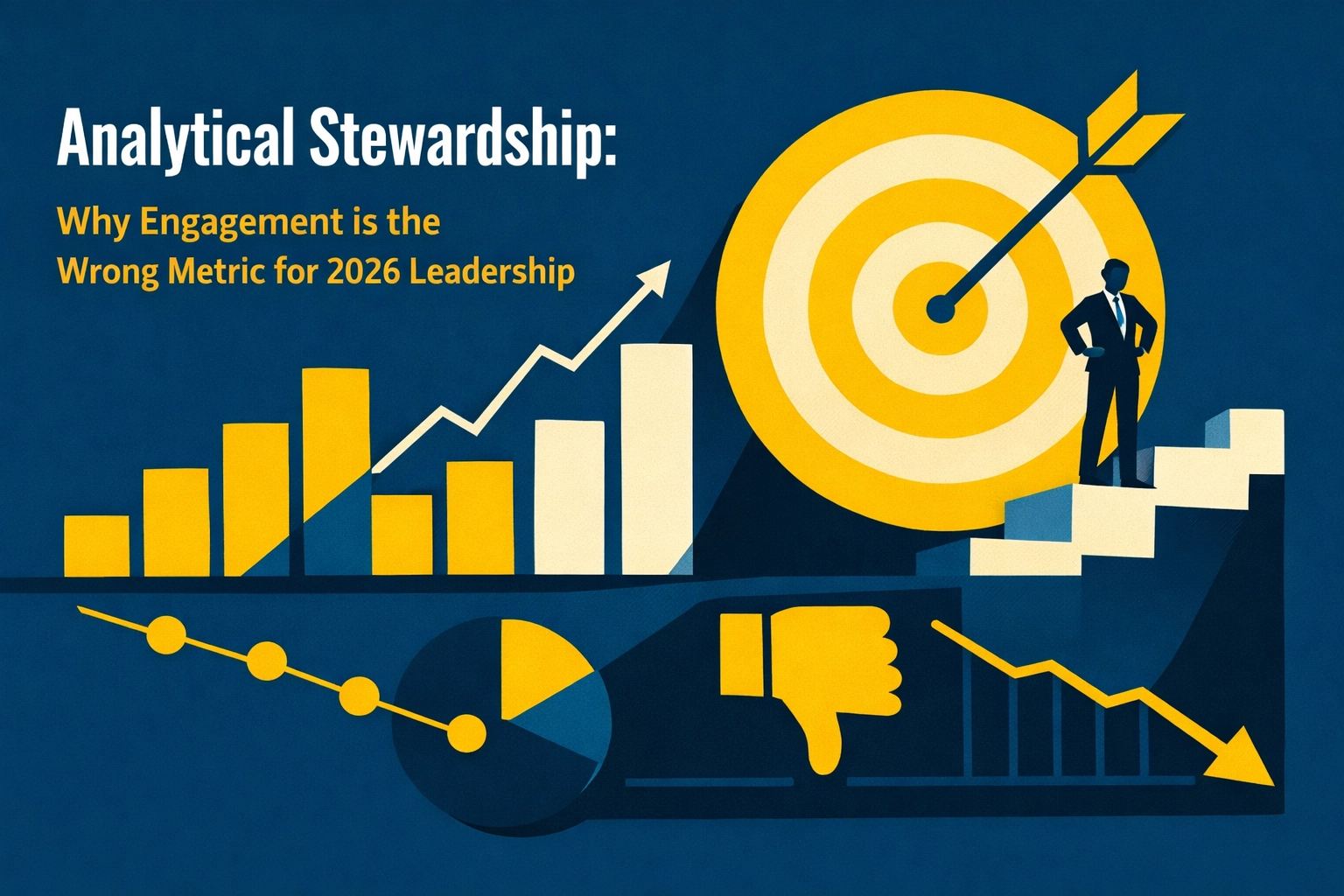
The fundamental problem with engagement metrics is that they measure motion and sentiment, not outcomes. In 2026, outcomes are the only management unit that matters.
Research indicates that engagement alone is a weak indicator of organizational health because it is often disconnected from measurable impact. A team can be highly "engaged": they enjoy their perks, they like their colleagues, and they feel connected to the culture: while simultaneously producing zero meaningful change in business results. This is what we call "happy stagnation."
When leadership focuses solely on engagement, they are playing defense. They are trying to prevent turnover or "quiet quitting" rather than playing offense: engineering the organization for Value Acceleration.

Defining Analytical Stewardship
If engagement is the wrong metric, what is the right one? At Rinnovare, our manifesto is built on Analytical Stewardship. It is the blending of deep human insight (Emotional Stewardship) with hard, uncompromising data (Analytical Rigor).
1. The Stewardship Mindset
Management is about oversight; stewardship is about responsibility for the long-term health and value of an asset. In our context, that asset is the human capital and the operating model of the firm. A steward doesn't just ask, "Are people happy?" They ask, "Is this human system generating the intended impact, or is it just moving numbers?"
2. Emotional Stewardship (The "Human" Insight)
This is not "fluff." Emotional stewardship is the tactical management of the psychological contract between the leadership and the workforce. It’s about trust, alignment, and clarity. When a CEO realizes the hidden emotional contract in the boardroom is broken, they don't need an engagement survey; they need a reset of trust and alignment. We look at the "human equity" of a firm: the intangible qualities that allow a team to execute a strategy without friction.
3. Analytical Rigor (The "Hard" Data)
This is the "Analytical" part of the equation. We move beyond leading indicators (like sentiment) to lagging indicators (like error reduction, cycle time, and exit multiples). Every HR initiative must be framed through the lens of decision quality. Does this change in the operating model drive value? If we cannot measure the impact on the bottom line or the strategic goal, the initiative is discarded.

The Shift from Sponsorship to Judgment
In the past, a successful leader was often seen as a "sponsor": someone who approved budgets for HR initiatives and showed up to celebrate the launch. In 2026, that is no longer enough.
Modern leadership capacity centers on judgment. This is the ability to frame decisions clearly and understand their real-world consequences. Analytical Stewardship requires leaders to develop judgment as a skill. They must be able to look at a dashboard and see past the green "engagement" lights to identify where the organizational "circuit breakers" are tripping.
When a Private Equity-backed firm is preparing for an exit, the "Human Equity Multiplier" is not found in a survey score. It is found in the efficiency of the leadership team, the clarity of the operating model, and the ability of the workforce to adapt to change without losing momentum.
The Rinnovare Approach: Evidence-Based Renewal
We don’t believe in "fixing" HR. We believe in renewing the organization from the ground up using the RQ™ system. Our approach is designed to eliminate the fluff and replace it with a high-performance framework that drives enterprise value.
The RQ™ system consists of three canonical products that facilitate Analytical Stewardship:
- RQ Diagnostic™: A deep-dive assessment that identifies the gap between your current human capital performance and your strategic goals. It’s the "offense" version of HR due diligence.
- RQ Operating Model™: Designing the actual structure and cadence of the organization to ensure that work produces value, not just activity.
- RQ Roadmap™: A tactical, data-driven plan to bridge the gap and prepare the organization for its next phase of growth or exit.
By using these tools, we move HR from a support function to a "Circuit Breaker": an intervention that stops value leakage and resets the organization for performance.

Moving from "Managing Risk" to "Value Acceleration"
In the realm of M&A and Private Equity, HR has traditionally been about risk mitigation: checking for compliance, labor issues, and culture fit. While necessary, this is purely defensive.
Analytical Stewardship is about playing offense. It’s about engineering the HR operating model to actively boost the exit multiple. When you have a leadership team that operates with zero "friction" and 100% "operational clarity," you aren't just managing a business; you are creating a high-performance machine that is attractive to investors and resilient in the face of market shifts.
This requires a move away from "Employee Engagement" as a primary KPI. Engagement is a byproduct of a healthy, high-performing organization: it is not the cause of it. If you build an organization where people understand their impact, where the operating cadence is clear, and where leadership alignment is ironclad, high engagement will follow naturally. But the focus must remain on the stewardship of value.
The 2026 Leadership Protocol
To implement Analytical Stewardship, CEOs and Boards must adopt a new protocol for organizational health:
- Audit the Cadence: Stop looking at annual surveys. Look at your Operating Cadence. Is the rhythm of your business facilitating decision-making or hindering it?
- Redefine Metrics: Replace "satisfaction" metrics with "impact" metrics. How does HR performance correlate to the strategic roadmap?
- Reset the Psychological Contract: Ensure the leadership team is aligned on the "why" and the "how" before worrying about the "who."
- Embrace Analytical Stewardship: Stop chasing the "frown-to-smile" conversion and start focusing on the "input-to-impact" conversion.
At Rinnovare, we specialize in this transition. We help firms move beyond the "Engagement Trap" and into a state of evidence-based renewal. Whether you are navigating a complex succession, a US expansion for a European firm, or a high-stakes PE exit, the goal is the same: transform HR from a cost center into a competitive advantage.

The future of leadership isn't about making people feel good; it’s about making people feel effective. It’s about stewardship, rigor, and the relentless pursuit of organizational clarity.
If you are ready to move beyond the vanity metrics and start building a high-impact organization, contact us today to discuss an RQ Diagnostic™ for your leadership team. Let’s stop measuring motion and start measuring what matters.