It usually starts with a feeling in the gut rather than a red cell on a spreadsheet.
You’re sitting in an executive committee meeting, and you realize you are having the exact same debate you had six weeks ago. The terminology is slightly different, and the slide deck has a fresh coat of paint, but the underlying friction is identical. You leave the room wondering why a team of highly compensated, incredibly intelligent adults can’t seem to make a decision stick.
This is not a market problem. It is not a talent problem. It is Organizational Drift.
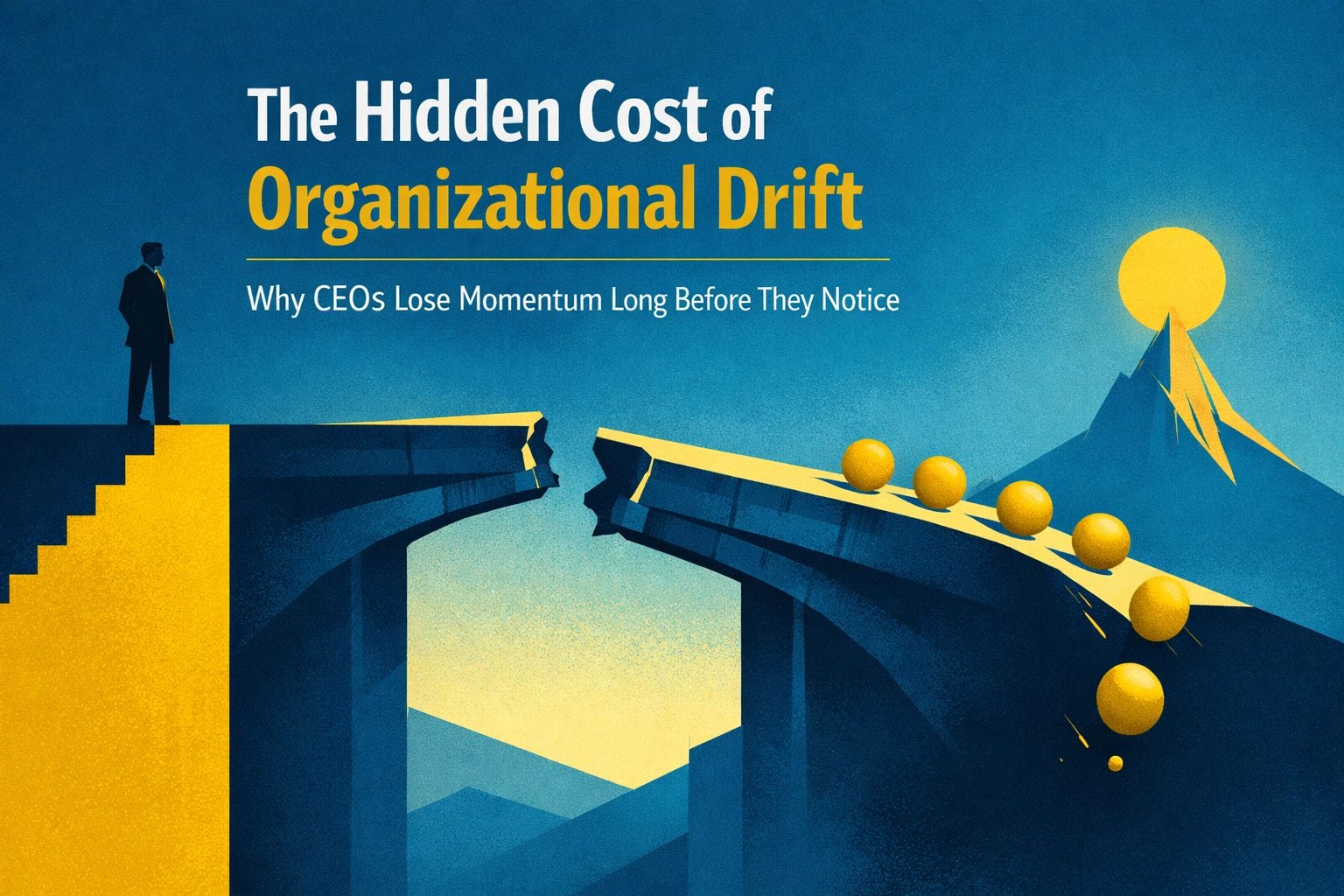
For a CEO, drift is the silent killer of momentum. It is the gradual erosion of directional integrity: the widening gap between what the leadership team says and what the organization actually does. By the time it shows up in your quarterly performance metrics or a dip in the stock price, the behaviors causing it have already become part of your corporate DNA.
At Rinnovare, we’ve spent years diagnosing this phenomenon. We’ve found that CEOs lose momentum long before they notice it because drift doesn’t arrive with a bang; it arrives with a sigh.
The Invisibility of the "Heavy" Organization
In the early stages, drift is invisible because it hides behind effort. Your people are working harder than ever. Your calendar is packed. Everyone is "busy." But movement feels heavy.
Progress requires more explanation than it used to. Alignment feels thinner. Decisions take three meetings instead of one. In high-performing companies, this is often misdiagnosed as "the complexity of scale." It isn't. It’s the result of an organization losing its decisional memory.
When an organization is aligned, a decision made at the top carries forward with enough velocity to anchor behavior three levels down. When drift sets in, that velocity drops. Leaders begin to revisit decisions informally, or they soften expectations to avoid immediate conflict. They allow "just this once" exceptions to accumulate.
The organization, which is smarter than we often give it credit for, notices. It learns that your direction is provisional rather than durable. It stops acting and starts guessing.
The Decisional Memory Leak
Think of your organization as having a "decisional memory." This is the collective understanding that a commitment made today remains true tomorrow. Drift occurs when this memory begins to leak.
In many Italian-to-U.S. expansions, for example, we see this manifest as the Bella Figura Fallacy. The desire to maintain a "good face" leads to a softening of feedback and a blurring of accountability. Roles become suggestions. Priorities become a "top ten" list where everything is equally important: which means nothing is.
When decisional memory leaks, the CEO becomes the only person capable of making a choice that stays made. This leads to the most common: and most dangerous: reaction to drift.

The CEO Trap: Diving Into the Weeds
When a CEO senses momentum stalling, the natural instinct is to get closer to the work. You attend more meetings, you review more line items, and you intervene more frequently in the day-to-day operations.
From your perspective, you are protecting outcomes. From the organization’s perspective, you are teaching them that they don’t need to be accountable because you will eventually step in and fix it.
This behavioral response is rational for the employees, but it’s a disaster for the enterprise. You create a dependency loop. By trying to solve the drift through sheer force of will, you actually accelerate it. You become the bottleneck, and the leadership team below you stops acting like owners and starts acting like advisors to your decision-making.
The result? You aren't just losing momentum; you are paying a Drift Tax.
The Three Warning Signs of Drift
How do you know if your organization is drifting before the P&L tells you? Look for these three signals:
- The Persistence of "The Same Conversations": If you find yourself re-litigating the same strategic priorities every quarter, your clarity is failing.
- The Escalation of the Mundane: When minor operational issues are consistently landing on the desks of the C-suite, your operating model has lost its "filter."
- Role Blur: When you ask three different executives who is responsible for a specific outcome and you get three different answers (or, worse, three fingers pointing at each other), drift has reached a critical level.
Measuring the Immeasurable: The RQ Diagnostic™
The reason drift is so hard to fight is that most traditional HR metrics are lagging. They tell you how people felt three months ago (engagement surveys) or what happened last year (attrition rates). They don't tell you how much friction exists in your leadership system right now.
This is why we developed the RQ Diagnostic™.
At Rinnovare, we don't believe in "fixing culture" through posters and town halls. We believe in strengthening the Human Equity Multiplier by identifying the structural breaks in your leadership system. The RQ Diagnostic™ acts as an early-warning system. It reveals where clarity has eroded, where roles have blurred, and where decision rights have become muddy.
It provides a data-driven "blood test" for your organization. Before you embark on a massive restructuring or hire a new fleet of consultants, you need to know exactly where the drift is occurring. Is it a failure of the RQ Operating Model™, or do you simply lack a clear RQ Roadmap™ to the next stage of growth?

Reclaiming Your Momentum
Reversing drift is not about working harder. It’s about restoring consistency. It requires a clinical look at where you have allowed exceptions to accumulate and a disciplined effort to re-establish which commitments are durable.
It often requires an outside perspective: someone who isn't entangled in the internal politics or the "way we've always done it." This is where the Silence of the Boardroom usually breaks down; when an external advisor can point to the misalignment that everyone else is too polite (or too tired) to mention.
If you feel like you’re pushing a boulder uphill, it’s time to stop pushing and start looking at the ground. You might find that the "boulder" is actually your own organization, and it's drifting in the wrong direction.
About Rinnovare
Rinnovare is a premium HR advisory firm that helps CEOs and Enterprise CHROs transform human resources into a competitive advantage. Through our proprietary RQ™ system, we provide the clarity and discipline required to scale, expand, and exit with confidence.
Whether you are navigating a U.S. expansion, preparing for a Private Equity exit, or simply trying to stop the drift, we provide the diagnostic precision and interim leadership necessary to reset your momentum.
Is your organization drifting? Contact us to learn how the RQ Diagnostic™ can provide the clarity you need to move forward.
