
Primary Category: Cross-Border Leadership | Secondary Category: CEO Advisory
When an Italian CEO enters the U.S. market, they often bring a leadership style honed in a culture of deep relationships, nuance, and "high-context" communication. In Milan or Rome, a missed deadline is rarely just a failure of output; it is a conversation, a negotiation, or a reflection of shifting circumstances that everyone "understands."
In New York, Chicago, or Silicon Valley, that same missed deadline is a breach of contract.
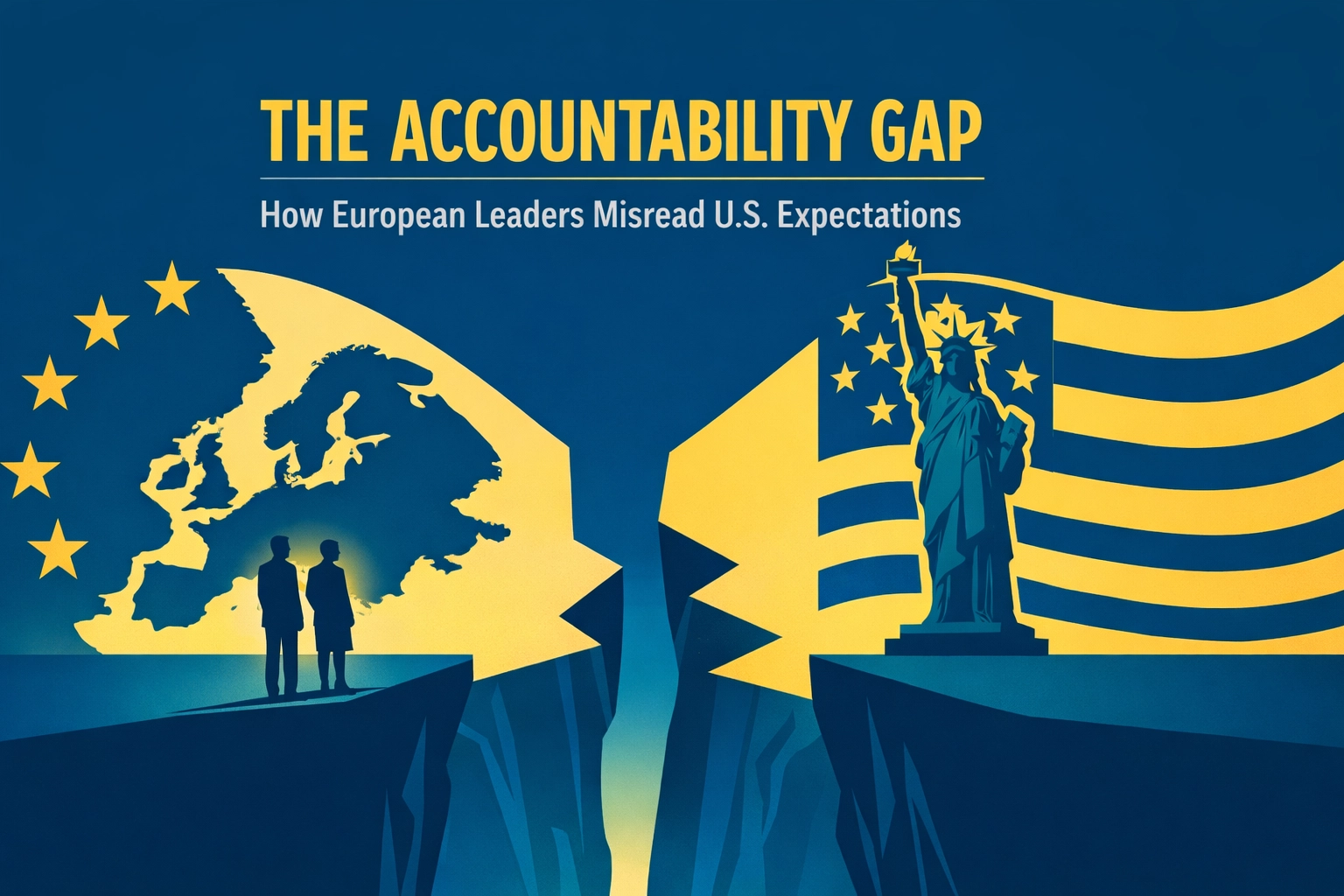
This is the Accountability Gap. It is the silent killer of U.S. expansions. It sits right between what the CEO thinks they’ve communicated and what the U.S. leadership team believes they are responsible for. If you don’t bridge this gap early, you will pay the "Drift Tax" we’ve discussed previously, and your U.S. venture will stall before it ever truly scales.
The "I Understand" Fallacy
One of the most dangerous phrases in a transatlantic boardroom is "I understand."
For a European leader, "I understand" often signifies empathy. It means, "I see the complexity of the situation, I recognize the hurdles you are facing, and I agree that the context matters." It is the beginning of a collaborative adjustment.
For a U.S. executive, "I understand" is simply a confirmation of receipt. It means, "I have heard the words you said." It does not mean they agree with your logic, and it certainly doesn't mean they are taking ownership of the outcome in the way you expect.
This misread leads to a catastrophic loss of momentum. The CEO leaves the meeting thinking a pivot has been agreed upon. The U.S. leader leaves the meeting thinking they’ve been given "feedback" but are still expected to hit their original numbers, or worse, they believe the CEO is "soft" and doesn't hold people to their word.

Relationship-Based vs. Outcome-Based Accountability
In many European business cultures, accountability is relational. If you have a strong relationship with your boss, there is a level of "give and take." The process matters. The effort matters. The why matters.
In the United States, accountability is transactional.
This isn't to say Americans don't value relationships, they do, but the relationship is often a result of performance, not a buffer for it. In the U.S., the social contract of the workplace is built on the "Deliverable." You are what you produce.
When a European leader fails to set hard, binary "Yes/No" expectations, the U.S. team loses its North Star. Without the friction of strict accountability, the team begins to drift. They interpret the CEO’s "understanding" as a lack of urgency.

Visual Suggestion: A split-screen graphic showing a European "Relationship Mesh" (interconnected circles) versus a U.S. "Linear Result" (a straight arrow hitting a target).
The Geopolitical Lesson for the C-Suite
Recent shifts in global diplomacy offer a stark warning for business leaders. As we’ve seen in international relations, European leaders often miscalculate by assuming their counterparts share their same commitment to long-term ideological or strategic norms. They expect "normalcy" and "consensus."
However, many U.S. systems: both in government and in the private sector: have shifted toward a purely transactional "America First" (or "Results First") model.
If you are leading a U.S. expansion in 2026, you cannot manage based on how things "used to be" or how they "should be." You must manage based on the transactional reality of the U.S. labor market. Your U.S. executives aren't looking for a mentor or a "patron" in the traditional sense; they are looking for clear KPIs, the resources to hit them, and the reward for doing so.
Why U.S. Teams Break During Scale
The Accountability Gap is most visible during the transition from "Market Entry" to "Scale."
During market entry, the CEO is usually hands-on. Communication is frequent, and the "Italian way" of managing via direct, high-touch relationships works because the team is small. But as you move toward enterprise scale, you cannot be in every room. You have to rely on systems.
This is where the RQ Operating Model™ becomes critical.
Without a formal operating model that defines how decisions are made and how accountability is tracked, the U.S. team will revert to their default setting: individualistic, short-term gain. If the CEO is still managing through "understanding" and "nuance," the U.S. leadership team will interpret that lack of structure as an opportunity to build their own silos.
This is the "Silence of the Boardroom" phase. The CEO thinks silence means everything is running smoothly. In reality, the U.S. team has stopped reporting the "nuance" because they realized the CEO doesn't have the systems to catch the deviations.
Closing the Gap: Three Practical Steps
If you are an Italian CEO leading a U.S. organization, you must adapt your "Accountability Language."
1. Move from Context to Binary
Stop asking, "Do you see where we are going with this?" or "Is this clear?"
Instead, ask: "What are the three binary outcomes we will achieve by Friday?" In the U.S., accountability must be measurable in a spreadsheet, not just felt in a conversation.
2. Define the "Consequence Cadence"
In Europe, the consequence of a missed target might be a "difficult conversation." In the U.S., the cadence must be faster. If a KPI is missed, the "Why" is secondary to the "How we fix it by tomorrow." Ensure your Operating Cadence reflects this speed.
3. Use the RQ Diagnostic™
You cannot fix what you cannot measure. Most CEOs sense there is a "gap" but they can't put their finger on it. The RQ Diagnostic™ identifies exactly where the alignment is breaking down between your strategic intent and your team’s execution. It turns the "gut feeling" of leadership drift into hard data.

The Truth About U.S. Accountability
The most successful European leaders in the U.S. are those who realize that strict accountability is actually a form of respect.
U.S. executives want to know where the goalposts are. They want to know exactly how they are being measured. When you provide that level of clarity, you eliminate the anxiety of "reading the CEO’s mind." You replace the Bella Figura Fallacy: the desire to look good regardless of the underlying reality: with a culture of performance.
At Rinnovare, we specialize in helping transatlantic leadership teams find this middle ground. We don't just "fix HR"; we build the RQ Operating Model™ that ensures your U.S. expansion doesn't fall victim to the Accountability Gap.
The U.S. market is too expensive for "misunderstandings." It’s time to move from relationship-based management to outcome-based leadership.

Visual Suggestion: A professional dashboard showing green and red performance indicators, symbolizing the shift to clear, data-driven accountability.
Are you experiencing "Leadership Drift" in your U.S. operations?
Don't let the Accountability Gap drain your enterprise value. Philip Curran and the Rinnovare team help European CEOs and Private Equity partners bridge the cultural divide and build high-performing U.S. leadership teams.
Contact Rinnovare today to schedule an RQ Diagnostic™ and ensure your U.S. team is actually delivering what you think they are.