
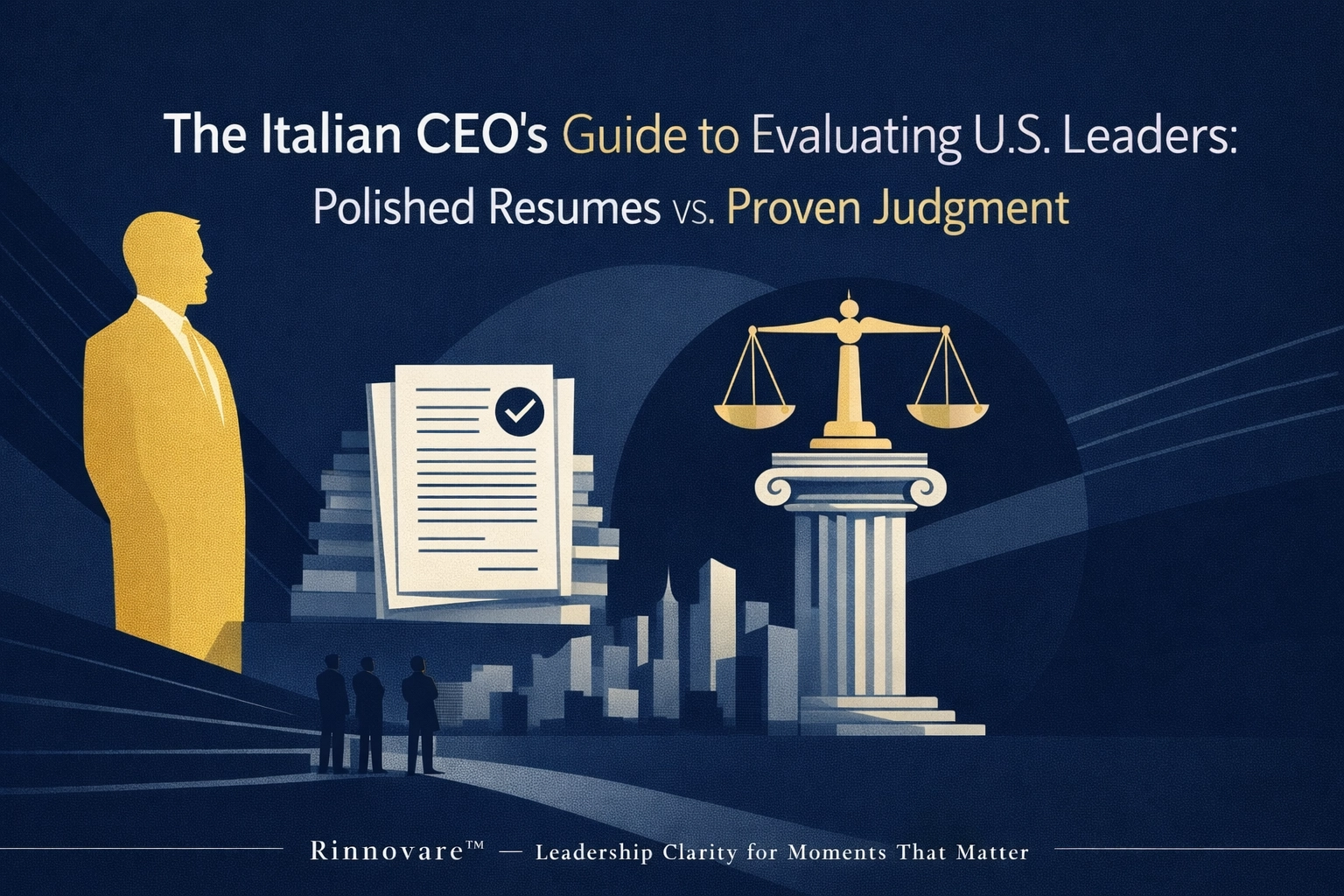
For an Italian CEO expanding into the United States, the talent pool can feel like a revelation. The candidates appearing in your inbox often possess resumes that read like a "who’s who" of Fortune 500 companies. They are articulate, high-energy, and possess a level of "polish" in their presentation that is world-class.
However, this is where the danger lies.
In our previous entries in The Italian CEO’s Guide to U.S. Leadership, we discussed the "Drift Tax" and the "Bella Figura Fallacy." We explored how cultural misalignments can quietly drain enterprise value. Nowhere is this more apparent than in the hiring of senior U.S. leaders.
The U.S. executive market is highly commoditized. Candidates are trained from an early stage to sell their "personal brand." For a European leader, it is easy to mistake this polished salesmanship for actual execution capability. To succeed, you must look past the gloss and evaluate for proven judgment and cultural fit.
The "Big Logo" Fallacy
Many European firms believe that hiring a leader from a massive, well-known U.S. corporation is a shortcut to success. They see a background at Google, Amazon, or Goldman Sachs and assume that the candidate brings the "secret sauce" of American efficiency.
This is the Big Logo Fallacy.
Success in a 50,000-person organization with infinite resources and established processes does not translate to success in a mid-market U.S. expansion or a lean Rinnovare client environment. In a large corporation, the system carries the leader. In an expansion, the leader must build the system.
When evaluating U.S. talent, a "polished" resume often masks a lack of "zero-to-one" experience. You aren’t looking for someone who can manage a pre-existing machine; you need someone who can forge the parts and assemble them while the plane is in flight.
The Framework: Evaluating RQ™ (Renewal Quotient)
At Rinnovare, we focus on the RQ Diagnostic™ as a primary tool for assessing leadership health. For the European CEO, evaluating a U.S. leader through the lens of RQ™ (Renewal Quotient) is essential.
RQ™ (Renewal Quotient) is the measure of a leader’s ability to navigate organizational complexity and build high-trust relationships that drive financial results. In the U.S. market, technical skills are a baseline requirement. The differentiator: the factor that determines whether a leader will scale or fail: is their RQ™.

Image Prompt: A sophisticated infographic showing three pillars: IQ (Technical), EQ (Emotional), and RQ™ (Relational). The RQ™ pillar is highlighted as the bridge to enterprise value, with a minimalist, clean aesthetic.
When interviewing, move beyond what they did and focus on how they interacted with the system:
- Managing Up: How did they handle conflict with a distant headquarters? (Crucial for an Italian parent company).
- Managing Across: How did they influence peers who didn't report to them?
- Managing Down: How did they build a culture of accountability during a period of rapid change?
A leader with high RQ™ doesn't just "hit their numbers"; they build the organizational infrastructure that makes hitting those numbers repeatable.
The Hidden Emotional Contract (HEC)
The most common cause of failure for U.S. leaders hired by European firms is a breach of the Hidden Emotional Contract (HEC).
The HEC represents the unwritten expectations between the CEO and the leader. In Italy, leadership often involves a high degree of "familial" loyalty and centralized decision-making. In the U.S., top-tier leaders expect a high degree of autonomy, a clear "path to win," and a compensation structure heavily weighted toward performance.
If the HEC is not aligned during the hiring process, the leader will eventually feel micromanaged, and the CEO will feel the leader is "going rogue."
To evaluate for HEC alignment, ask the candidate: "Under what conditions do you do your best work, and under what conditions do you quit?"
Their answer will tell you more about their fit than any line item on their CV. You are looking for leaders who value transparency over "Bella Figura" and who are comfortable operating within the unique rhythm of a European parent company while maintaining the speed of the U.S. market.
![[IMAGE] Navigating Complexity](https://cdn.marblism.com/IFr3dFF7LMl.png)
Resumes vs. Proven Judgment: The "Stress Test"
How do you distinguish between someone who is good at talking about leadership and someone who has proven judgment? You must introduce friction into the evaluation process.
1. The "Backdoor" Reference Check
Standard references provided by the candidate are largely useless in the U.S. market. They are curated. Instead, leverage your network or an advisory firm like Rinnovare to perform "backdoor" checks. Speak to former subordinates and peers. Ask: "What happens when this person is under extreme pressure? Do they pivot, or do they paralyze?"
2. The Problem-Solving Simulation
Instead of a standard interview, present a real-world scenario your U.S. expansion is currently facing. Give them 48 hours to prepare a high-level response. You aren't looking for the "right" answer; you are looking for their process. Do they ask about cultural nuances? Do they focus on the "how" of execution, or just the "what" of the goal?
3. Accountability Misreads
In the U.S., accountability is often transactional. In Europe, it is often relational. A "polished" U.S. leader might promise the world to secure the role, but if they lack the proven judgment to navigate the internal politics of a global firm, they will fail to deliver. Use the RQ Roadmap™ principles to ensure they understand the reporting cadences and expectations from day one.
Building the Bridge
Evaluating U.S. talent requires a shift in perspective. You are not just hiring a functional expert (CFO, COO, Head of Sales); you are hiring a bridge-builder. This leader must translate the vision of the Italian headquarters into the language of the U.S. market.
The "polished" candidate might look the part on a Zoom call, but if they lack the RQ™ to handle the friction of a cross-border expansion, they will become an expensive mistake.
![[IMAGE] Trust and Alignment](https://cdn.marblism.com/0T-Mif2vPCt.png)
Red Flags to Watch For
As you vet candidates, keep an eye out for these "American" red flags that often confuse European CEOs:
- The "We" vs. "I" Trap: If a candidate consistently says "we did this" at a massive company, probe for what they specifically owned. Many U.S. executives are experts at taking credit for the momentum of a large team.
- Over-Reliance on Jargon: If they use buzzwords (synergy, disruption, pivot) without being able to explain the underlying financial mechanics, they are selling "polish" over "judgment."
- Lack of Curiosity about Italy: If they show no interest in the culture or history of the parent company, they will struggle to navigate the HEC. They will view headquarters as an obstacle to be managed rather than a partner to be aligned with.
Conclusion
Hiring the right U.S. leader is the single most important lever for the success of your expansion. By moving beyond the resume and focusing on RQ™, the Hidden Emotional Contract, and proven judgment, you can build a leadership team that doesn't just look good on paper: it delivers enterprise value.
If you are currently evaluating your U.S. leadership team or preparing for an expansion, Rinnovare provides the Professional Services and diagnostic tools necessary to ensure your human capital is a competitive advantage, not a liability.
Don't let a polished resume lead to a fractured expansion. Evaluate for judgment. Hire for RQ™.
For a deeper dive into how we evaluate leadership health, contact Rinnovare today.