
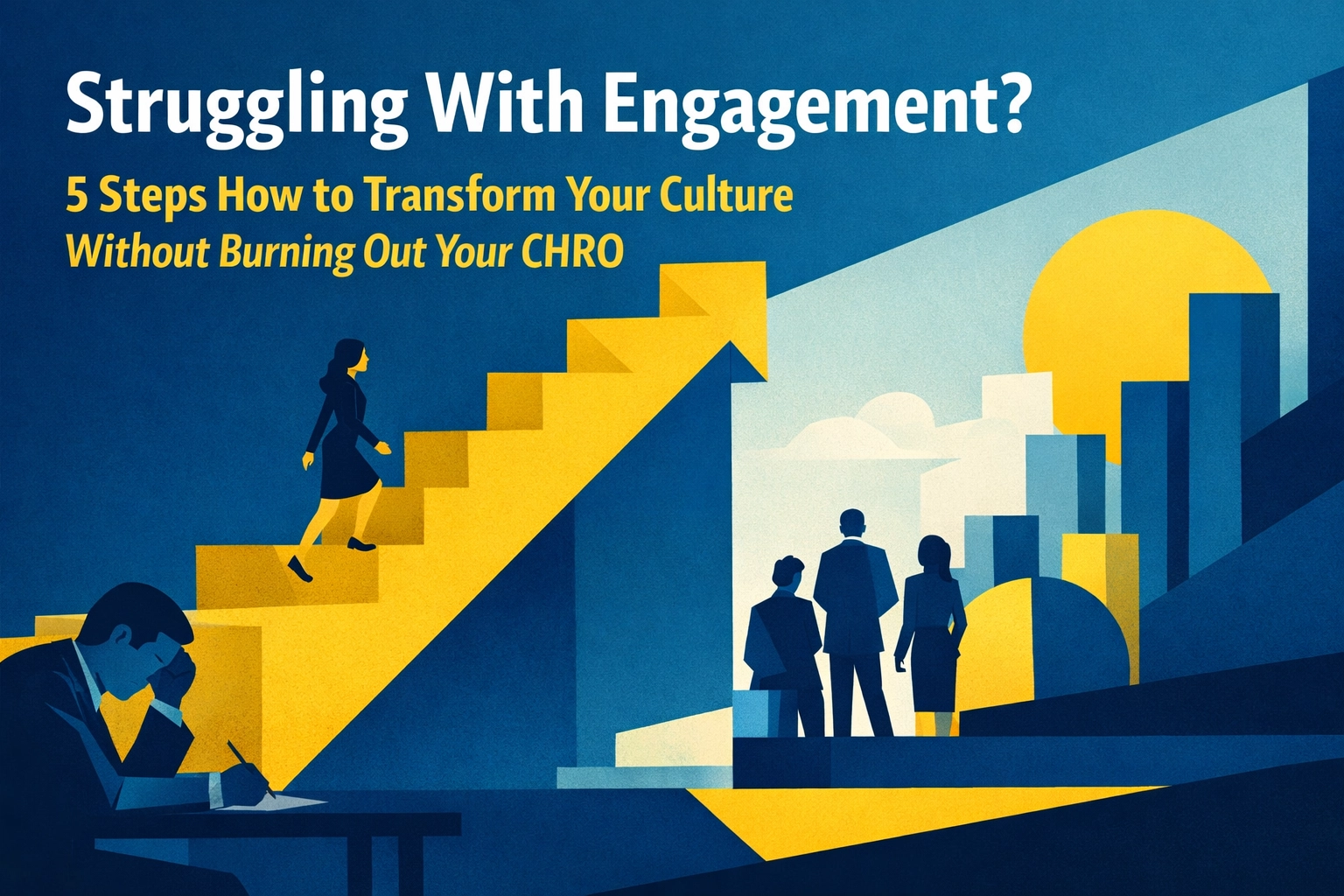
Your CHRO just sent you the latest engagement scores. They're down. Again. Turnover is climbing. Your best people are quietly checking out. And now there's talk of a "culture transformation initiative."
Here's the problem: Your CHRO is already running on fumes. They've been firefighting for months: backfilling critical roles, managing layoffs, rebuilding broken systems, and sitting in every leadership meeting where "people issues" come up. Which is every meeting.
Now you want them to lead a company-wide culture overhaul?
That's not a strategy. That's a burnout recipe.
Culture transformation is necessary. But it doesn't require your CHRO to work 80-hour weeks or burn through what's left of their emotional reserves. What it requires is a different approach: one that treats your CHRO as a strategic partner, not a miracle worker.
Here's how to drive real culture change without destroying the people leading it.
The CEO-CHRO Partnership: Shared Ownership, Not Delegation
Let's start with the hard truth: Culture change isn't an HR project. It's a CEO project. And when CEOs treat transformation as something they can delegate entirely to HR, two things happen. First, the CHRO becomes the single point of failure. Second, the effort fails.
Research shows transformation programs are four times more likely to succeed when leaders actively model the cultural shifts they're asking others to make. That means you, the CEO, have to be visibly, consistently, and authentically engaged in the work. Not just sponsoring it. Leading it.

Your CHRO should be your strategic partner: designing the approach, providing insight, and ensuring alignment: but they can't carry the emotional and operational load alone. When the CEO and CHRO operate as true partners, with shared accountability and distributed effort, transformation becomes sustainable. When they don't, your CHRO burns out and your culture stays broken.
Step 1: Start With One High-Impact Behavior, Not a Comprehensive Overhaul
The instinct during a culture crisis is to fix everything at once. New values. New performance systems. New rituals. New everything.
Stop.
That approach overwhelms your organization and exhausts your HR team. Instead, identify one behavior: just one: that has disproportionate influence on engagement and performance.
Maybe it's how leaders respond to failure. Maybe it's how decisions get made and communicated. Maybe it's whether senior leaders actually listen in meetings or just wait to talk.
Pick the behavior that, if changed, would send the strongest signal that things are different now. Then make that behavior visible, measurable, and non-negotiable at the top.
This approach does two critical things. First, it creates early wins. When people see leadership actually changing, it builds credibility and momentum. Second, it keeps the workload manageable. Your CHRO can focus on supporting one high-leverage shift instead of trying to orchestrate a dozen initiatives simultaneously.

Quick wins matter. They prove that change is possible. And they buy your team the psychological and operational breathing room to tackle what comes next.
Step 2: Establish a Guiding Coalition and Distribute Leadership Responsibility
If transformation lives entirely inside HR, it will fail. Period.
Culture change requires a cross-functional coalition of leaders who share ownership for embedding new behaviors and norms. That means pulling in your CFO, your COO, your business unit heads, and key managers who have credibility with their teams.
This isn't about creating more meetings. It's about making transformation a shared leadership responsibility, not an HR solo act.
When you distribute ownership, two things happen. First, the workload gets spread across multiple leaders, which takes pressure off your CHRO. Second, the change becomes more authentic. Managers become champions within their own teams, which accelerates adoption and reduces the need for HR to police every conversation.
Your CHRO should facilitate and guide the coalition. But they shouldn't have to drag it forward alone. Make it clear to your leadership team: this is everyone's job now.
Step 3: Communicate Transparently and Frequently: But Strategically
Transparency is essential during transformation. Employees need to know why things are changing, what success looks like, and how progress will be measured. Without that clarity, rumors fill the void and trust erodes fast.
But here's the balance: Excessive communication causes fatigue. If every day brings another all-hands meeting, another email update, another Slack announcement, people tune out. And your CHRO, who's likely drafting most of that content, burns out trying to keep the message machine running.

The solution? Establish a deliberate communication cadence. Weekly leadership updates. Biweekly team check-ins. Monthly open Q&A sessions. Use multiple channels: email, video, town halls: but do it with intention, not desperation.
Keep the message consistent: Here's why we're changing. Here's what we're measuring. Here's how you'll see it show up in your day-to-day work. Then follow through.
Your CHRO should own the messaging strategy, but execution should be distributed. Leaders at every level need to be communicating the same narrative in their own voices. That's how you build trust without exhausting your HR team.
Step 4: Implement Formal and Informal Interventions in Phases
One of the biggest mistakes in culture transformation is trying to change all systems at once. New performance reviews. New incentive structures. New onboarding. New team rituals. New everything, all at the same time.
It's chaos. And chaos doesn't transform culture. It just creates more work for HR while confusing everyone else.
Instead, sequence your interventions. Roll out formal changes: policy updates, compensation adjustments, performance metrics: in carefully planned phases. Pair those with informal actions: leadership storytelling, peer recognition programs, team-level rituals: that reinforce the new behaviors you're trying to embed.
Phased implementation allows teams to adapt gradually. It prevents the resource drain of simultaneous upheaval. And it gives your CHRO room to monitor what's working, adjust what isn't, and course-correct before rolling out the next phase.
This isn't slow. It's disciplined. And disciplined change is sustainable change.
Step 5: Build Continuous Learning and Feedback Loops, Not One-Time Initiatives
Culture transformation isn't a project with a start date and an end date. It's a continuous process of learning, adapting, and reinforcing new norms.
Too many organizations treat transformation like a campaign: launch it, run it for six months, declare victory, and move on. Then, predictably, everything slides back to the old way of doing things.

The alternative? Embed transformation into your regular operations. Establish ongoing coaching for leaders. Build feedback loops that allow teams to surface issues and suggest improvements in real time. Use "kaizen events": short, focused improvement cycles: to keep momentum without creating massive new workstreams.
When transformation becomes part of how you operate, rather than something extra you do, two things happen. First, the work becomes sustainable. Second, your CHRO stops having to carry the entire effort on their shoulders.
Integrate cultural alignment into hiring, onboarding, leadership development, and performance management. Make it part of the normal rhythm of business. That's how you avoid the burnout trap.
The Sustainability Principle: Transformation as Partnership, Not Heroism
Here's the bottom line: Culture transformation doesn't require your CHRO to be a hero. It requires you, as CEO, to be a partner.
When you share ownership, distribute effort, and focus on high-leverage changes instead of wholesale reinvention, transformation becomes sustainable. Your CHRO can lead strategically instead of operationally. Your leadership team can model the behaviors that matter. And your organization can actually change: without burning out the very people responsible for making it happen.
Engagement issues are real. Culture problems are real. But the solution isn't to pile more work onto HR and hope for the best. The solution is to treat transformation as a CEO-led, leadership-owned, organization-wide effort: with your CHRO as the strategic architect, not the sole builder.
That's how you rebuild culture. And that's how you protect the people leading the work.
If your organization is facing a culture crisis and your CHRO is running on empty, it's time to rethink the approach. Visit Rinnovare to explore how senior HR transformation advisory can help you rebuild people systems, leadership capability, and operating cadence( without burning out your team.)