Your CHRO just resigned. Or your HR function imploded during a rapid acquisition. Or the Board just discovered compliance gaps that could sink the next funding round.
Whatever the trigger, you're now staring at an HR crisis with no senior leader in the seat.
The standard playbook says: launch a search, hire a recruiter, wait 4–6 months, and hope the finalist accepts the offer.
But here's the problem with that approach: crises don't wait for search committees.
If your organization is bleeding talent, facing regulatory exposure, or navigating a high-stakes transition, you can't afford to operate without senior HR leadership for half a year. You need someone in the seat now: not next quarter.
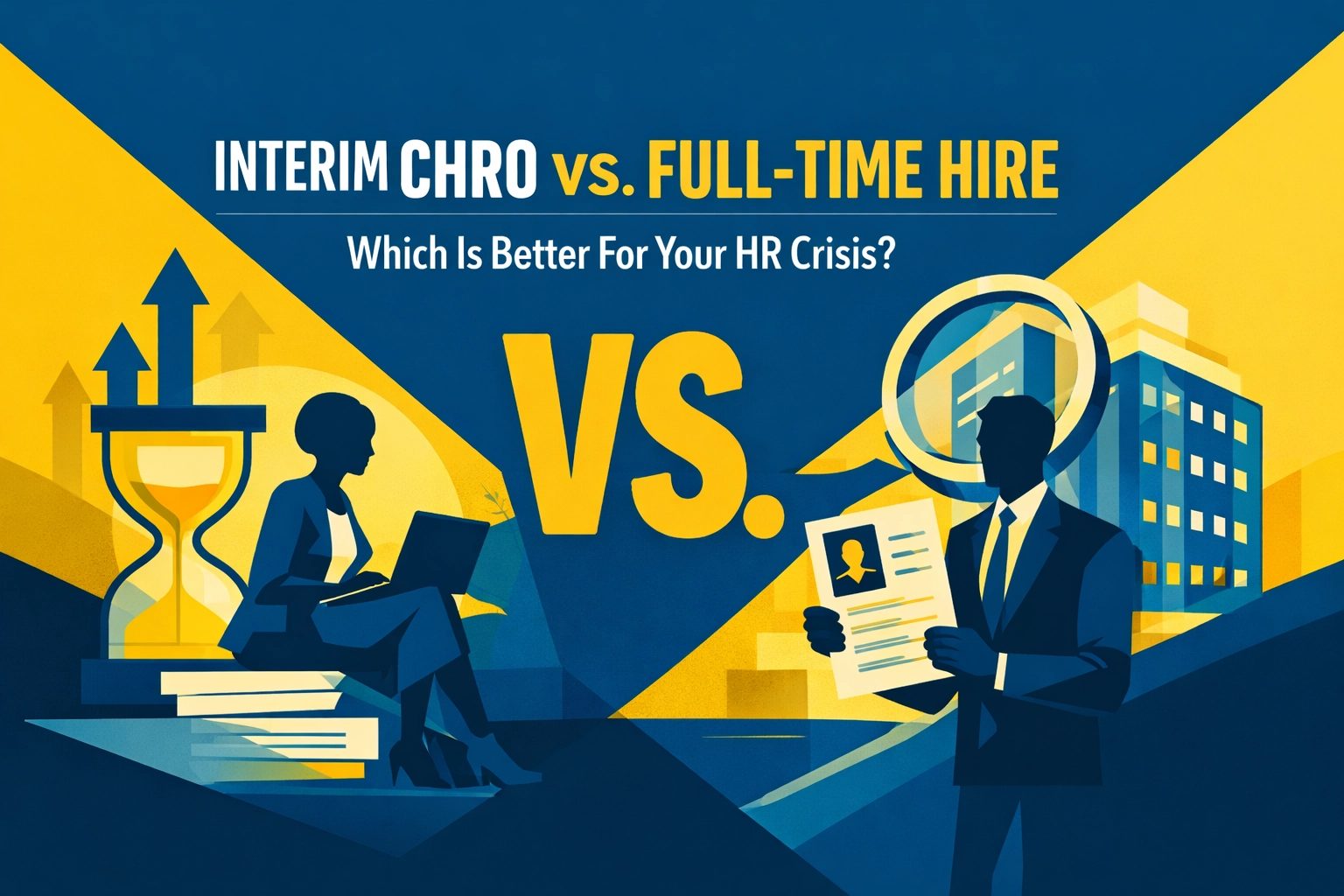
This is where the interim vs. full-time decision gets real. And it's not just about speed. It's about what kind of crisis you're actually facing, what trade-offs you're willing to make, and whether you need a tourniquet or a transplant.
Let's break it down.

The Speed Problem (And Why It Matters More Than You Think)
A traditional CHRO search takes 4–6 months on average. Sometimes longer if you're in a competitive market or dealing with a niche industry.
That timeline includes:
- Defining the role and compensation structure
- Engaging a search firm
- Building a candidate pipeline
- Multiple rounds of interviews with the executive team and Board
- Reference checks, background screenings, offer negotiation
- Notice periods with the candidate's current employer
Meanwhile, your HR function is running on fumes. Critical decisions are stalled. Compliance issues are piling up. Your leadership team is making it up as they go.
An interim CHRO can start in days, not months. They're available immediately, they know the playbook, and they're built for rapid stabilization. If your crisis involves sudden leadership departures, operational disruptions, or urgent risk management, that speed is the entire game.
What an Interim CHRO Actually Does
This isn't a consultant who shows up twice a week to run workshops. An interim CHRO steps into the full scope of the role: just with a defined timeline.
That means:
- Managing the entire HR operation (talent acquisition, compensation, compliance, L&D)
- Driving organizational design and workforce planning
- Overseeing employee relations and performance management
- Advising the CEO and Board on people strategy
- Leading critical projects like restructures, integrations, or cultural transformation
The difference is focus. A permanent CHRO is building the long game: five-year talent strategies, multi-year culture initiatives, succession planning for the next decade. An interim CHRO is fixing what's broken right now and stabilizing the ship so it doesn't sink before you find permanent leadership.

The Three Strategic Advantages of Interim Leadership
1. Immediate Availability and Crisis Discipline
Interim CHROs are built for high-stakes environments. They've done this before: often multiple times: and they know how to quickly diagnose problems, prioritize the critical few actions, and deliver measurable results under pressure.
They're not figuring out "how HR works" or learning your industry from scratch. They bring pattern recognition from previous transformations, and they apply it fast.
2. Objectivity Without Politics
An interim executive doesn't have a decade of internal baggage, unspoken alliances, or career preservation instincts to navigate. They walk in, see what's actually happening (not what people say is happening), and make the hard calls that insiders avoid.
That objectivity is especially valuable when the crisis itself was caused by internal dysfunction: whether it's a toxic culture, a leadership team that can't align, or an HR function that's been neglected for years.
3. Cost Efficiency and Flexibility
Hiring a permanent CHRO means salary, bonus, equity, benefits, relocation, and severance protection. You're committing to a multi-year relationship before you even know if the fit is right.
An interim CHRO is hired on a project or contract basis. You pay for what you need, when you need it, and you're not locked into a long-term employment agreement. If the crisis resolves faster than expected, you're not stuck. If it takes longer, you extend the engagement.
For PE-backed portfolio companies, growth-stage startups, or organizations in transition, that flexibility matters.
When You Actually Need a Full-Time CHRO
Let's be clear: interim leadership isn't the answer to every problem.
If your crisis is really a symptom of deeper, structural HR failures: broken systems, outdated compensation models, a leadership culture that needs multi-year transformation: you don't need a tourniquet. You need a rebuild.
That requires a permanent CHRO who will:
- Deeply understand your culture, values, and long-term strategic goals
- Build the HR infrastructure from the ground up
- Invest in relationships across the organization
- Own the five-year roadmap, not just the 90-day fix
Permanent leaders develop the institutional knowledge and continuity that interim executives, by definition, can't provide. They're there for the long haul, and they build accordingly.
The trade-off is time. If you can afford to wait 4–6 months while the crisis simmers, then go run the search. But if the house is on fire, you need someone with a hose before you start interviewing architects.

The Hybrid Approach (And Why It Works)
Here's the move that a lot of high-performing organizations are making: use an interim CHRO to stabilize the crisis while you run the permanent search in parallel.
This approach gives you:
- Immediate senior leadership to manage the urgent issues
- A fully functioning HR operation while the search plays out
- Time to actually define what you need in a permanent leader (because you'll learn a lot about the real problems in the first 90 days)
- A smoother transition, since the interim can brief the incoming CHRO and stay on in an advisory capacity if needed
It's not either/or. It's both/and.
The interim executive handles the fire drill. The search process runs on its own timeline. And when the permanent CHRO joins, they're walking into a stabilized environment instead of inheriting chaos.
How to Decide What You Actually Need
Here's the framework:
Go interim if:
- You need leadership in the seat within days or weeks, not months
- The crisis involves urgent risk, compliance exposure, or operational disruption
- You're in the middle of a transition (acquisition, restructure, leadership change) and need someone to guide you through it
- You're not sure what the permanent role should look like yet, and you need to learn more about the real problems first
- Budget flexibility matters more than long-term continuity right now
Go permanent if:
- The crisis reveals systemic, multi-year problems that require deep rebuilding
- You have 4–6 months to wait and the organization can function without senior HR leadership during that time
- Long-term culture transformation, leadership development, and strategic HR infrastructure are the priority
- You've already stabilized the immediate issues and now need someone to own the long game
Go hybrid if:
- You need both immediate stabilization and long-term leadership, and you're willing to manage a transition between the two

The Bottom Line
If your HR crisis is urgent, you can't afford to wait for a traditional search process to play out. The cost of delay: lost talent, compliance exposure, stalled growth, leadership dysfunction: is almost always higher than the cost of interim leadership.
An interim CHRO gives you speed, objectivity, and senior judgment when you need it most. They stabilize the situation, fix what's broken, and give you the breathing room to make the right long-term hire.
The question isn't whether interim leadership is "better" than a full-time hire. The question is: what does your crisis actually require, and how fast do you need it solved?
If the answer is "now," you already know what to do.
Need an interim CHRO or fractional HR leadership during a transition? Rinnovare provides senior-level HR advisory for PE firms, enterprise CHROs, and growth-stage CEOs navigating high-stakes organizational change. Learn more at rinnovarehr.com.