You've noticed it for months now.
HR meetings that end without decisions. Requests that disappear into a black hole. Questions that loop back to you, again, because no one knows who actually owns the answer.
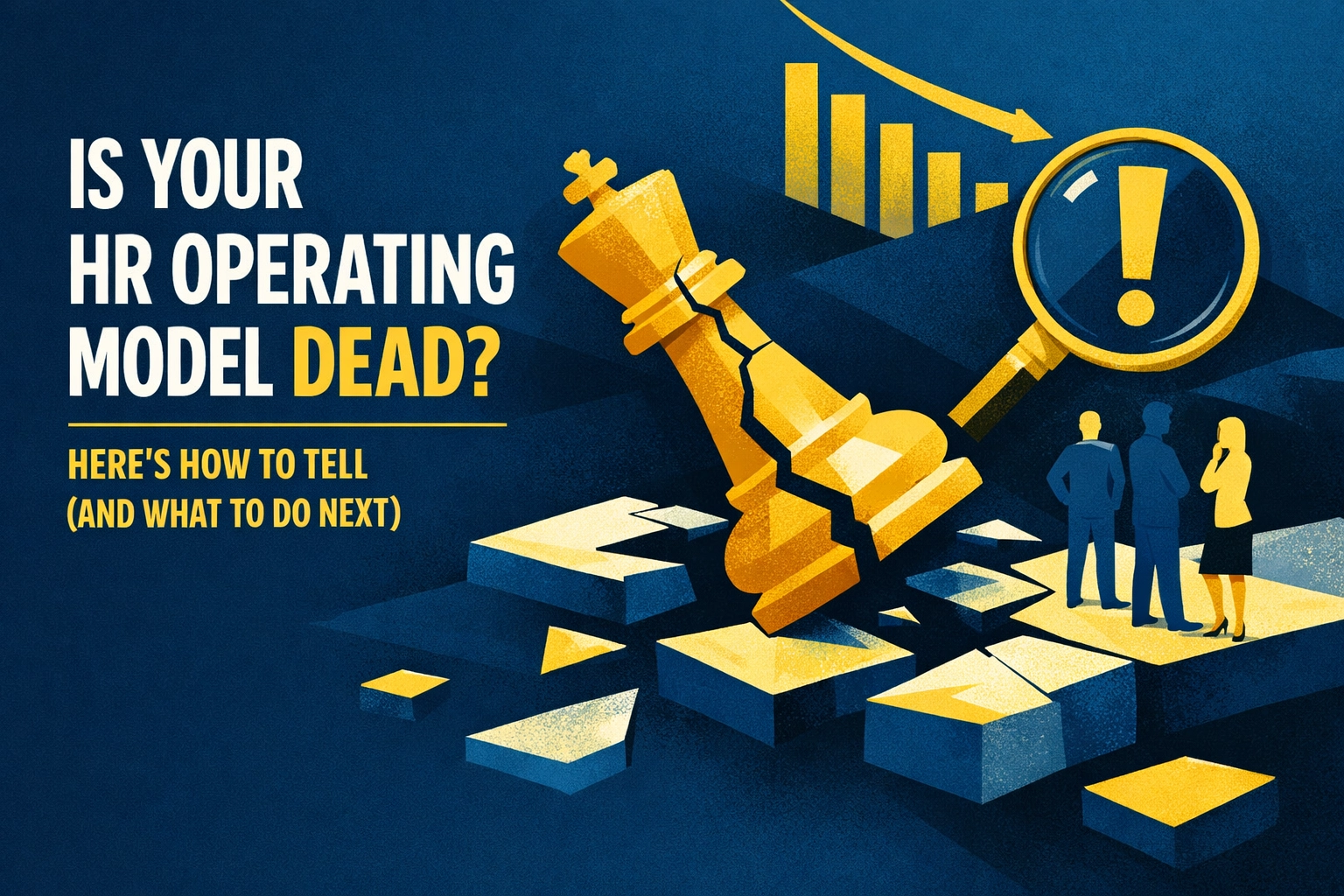
Your HR operating model might not be broken. It might be dead.
And if you're a CEO, CHRO, or PE operator, that's not a metaphor. It's a liability.

The Three Symptoms of a Dead Operating Model
Most leaders don't realize their HR model has flatlined until it's too late. The signs aren't dramatic. They're cumulative. Here's what to watch for:
1. Decision Paralysis
You've got smart people. But decisions take weeks. Approvals ping-pong between HR Business Partners, COEs, and the CHRO. Nobody wants to be the one who "got it wrong," so nothing moves.
This isn't caution. It's structural gridlock.
When your operating model doesn't clarify who decides what, everyone defers. The result? Talent decisions that should take days take months. Compensation structures that need updating sit in limbo. Critical hires get delayed because no one knows who has final say.
2. Noise vs. Signal
Your HR team is drowning in activity. HRIS updates. Compliance audits. Open enrollment prep. Town halls. Engagement surveys. Performance review cycles.
But when you ask, "What's our retention risk in the commercial team?" or "Are we building bench strength in ops leadership?", crickets.
Activity isn't the same as impact. A dead operating model optimizes for tasks, not outcomes. It confuses motion with progress.
If your HR leaders can tell you what they're doing but not what they're solving, that's noise. Not signal.

3. Lack of Clarity on Ownership
Here's the diagnostic question: Who owns employee experience in your organization?
If the answer is "HR," you've already lost.
If the answer is "Well, HRBPs support the business, but COEs set policy, and managers execute, and…": you've really lost.
Dead operating models create accountability gaps. Everyone is responsible. Which means no one is.
The result? Finger-pointing when things go wrong. Duplication of effort when things go right. And leaders who stop asking HR for help because it's faster to just figure it out themselves.
Why Operating Models Die
Operating models don't collapse overnight. They erode.
Most HR structures were built for a different era. Centralized functions. Predictable growth. Stable workforce planning. Annual cycles.
Then the world changed.
Private equity portfolio companies need HR to move at deal speed. Growth-stage companies need scalable people infrastructure before they have the budget for a full HR team. Enterprise organizations need agility in a function historically built for control.
Legacy models can't adapt. They were designed around activities (recruiting, comp, L&D) instead of outcomes (speed to hire, retention of top performers, leadership bench strength).
According to recent research, nearly two-thirds of organizations have redesigned their HR operating model in the past few years. That's not a trend. That's a survival response.
If your model still looks like it did five years ago, it's already obsolete. You just haven't admitted it yet.

The Diagnostic: Is Your Model Dead or Just Sleeping?
Run this quick audit. Answer honestly.
Decision Speed:
- How long does it take to approve a Director-level hire? (If the answer is more than two weeks, you've got a problem.)
- How many people need to sign off on a compensation structure change?
Outcome Clarity:
- Can your CHRO tell you the top three people risks in the business right now: without looking at a slide deck?
- Does your executive team view HR as a strategic partner or a service function?
Accountability:
- If turnover spikes in a critical department, who owns the fix? (If the answer is "it depends," your model is dead.)
- Can an HR Business Partner make a hiring decision without escalating to the CHRO?
Technology and Data:
- Do your managers have real-time access to their team's performance and engagement data?
- Or does every question require an HR ticket and a three-day turnaround?
If you answered "it depends" or "I'm not sure" more than once, your operating model isn't serving you. It's slowing you down.
The Framework for Renewal
Rebuilding an HR operating model isn't about org charts. It's about outcomes.
Here's the framework I use with PE-backed portfolio companies and enterprise CHROs who need to move fast.
Step 1: Define the Outcomes You Need
Stop designing around activities. Start with the business results you need HR to deliver.
Examples:
- Speed: Time to fill critical roles under 30 days
- Quality: Regrettable turnover under 5% for top performers
- Capability: Leadership bench strength at 2x coverage for VP+ roles
- Cost: Fully-loaded cost per hire under $X
If you can't measure it, you can't manage it. And if HR can't articulate its outcomes, it's just overhead.
Step 2: Build Around Tiers, Not Silos
Modern operating models use a tiered service delivery structure:
Tier 1: Self-Service
Employees and managers handle routine requests via technology. FAQs, benefits enrollment, time-off approvals, policy lookups. No HR involvement required.
Tier 2: Shared Services
A centralized team handles transactional work at scale. Onboarding coordination, payroll escalations, compliance reporting.
Tier 3: Centers of Excellence (COEs)
Subject matter experts design programs, set policy, and solve complex problems. Compensation strategy. Talent acquisition. Learning & development.
Tier 4: Strategic Partners (HRBPs)
Senior advisors embedded with the business. They don't do transactions. They diagnose problems, shape decisions, and drive outcomes.
This isn't new. But most organizations say they have a tiered model and then let HRBPs get pulled into Tier 1 and 2 work anyway.
If your HRBPs are still processing onboarding paperwork, your model is dead.

Step 3: Clarify the RACI (Who Decides What)
This is where most models break.
You need a decision rights matrix. Not a 47-page governance document. A one-pager that answers:
- Who recommends?
- Who approves?
- Who executes?
- Who gets informed?
For every major HR decision category: hiring, comp changes, promotions, terminations, policy exceptions.
If it takes more than 30 seconds to figure out who decides, your model isn't clear enough.
Step 4: Measure What Matters
Track leading indicators, not lagging ones.
Lagging: Turnover rate, time to fill, cost per hire
Leading: Offer acceptance rate, employee engagement scores, leadership pipeline depth
Lagging indicators tell you what happened. Leading indicators tell you what's coming.
Dead operating models track activity. Renewed models track impact.
What Happens If You Don't Fix It
Let's be clear: a dead HR operating model doesn't just slow you down. It actively damages your business.
You lose top performers because you can't move fast enough to compete for talent.
You make bad people decisions because the data arrives too late to matter.
You burn out your HR team because they're stuck in reactive mode, firefighting instead of building.
And worst of all? Your leadership team stops expecting anything from HR. They route around it. Hire without approval. Promote without structure. Compensate inconsistently.
At that point, HR isn't a function. It's a liability.
What to Do Next
If you've recognized your organization in this post, here's what I'd recommend:
If you're a CEO or PE operator:
Ask your CHRO to walk you through the decision rights for your top five HR processes. If they can't do it in five minutes, you've got a structural problem.
If you're a CHRO:
Run the diagnostic audit above with your leadership team. Then commit to one outcome you'll improve in the next 90 days. Make it measurable.
If you're rebuilding from scratch:
Don't try to design the perfect model. Design the minimum viable operating model that delivers your top three outcomes. Then iterate.
Renewal doesn't require perfection. It requires clarity.
Your HR operating model is either a competitive advantage or a bottleneck. There's no middle ground.
The question isn't whether to rebuild. It's whether you'll do it before or after your competitors do.
Need help diagnosing whether your HR operating model is still viable: or designing a renewed structure that drives measurable outcomes? Let's talk. Rinnovare specializes in rebuilding HR as a strategic lever for private equity firms, enterprise CHROs, and growth-stage CEOs.