
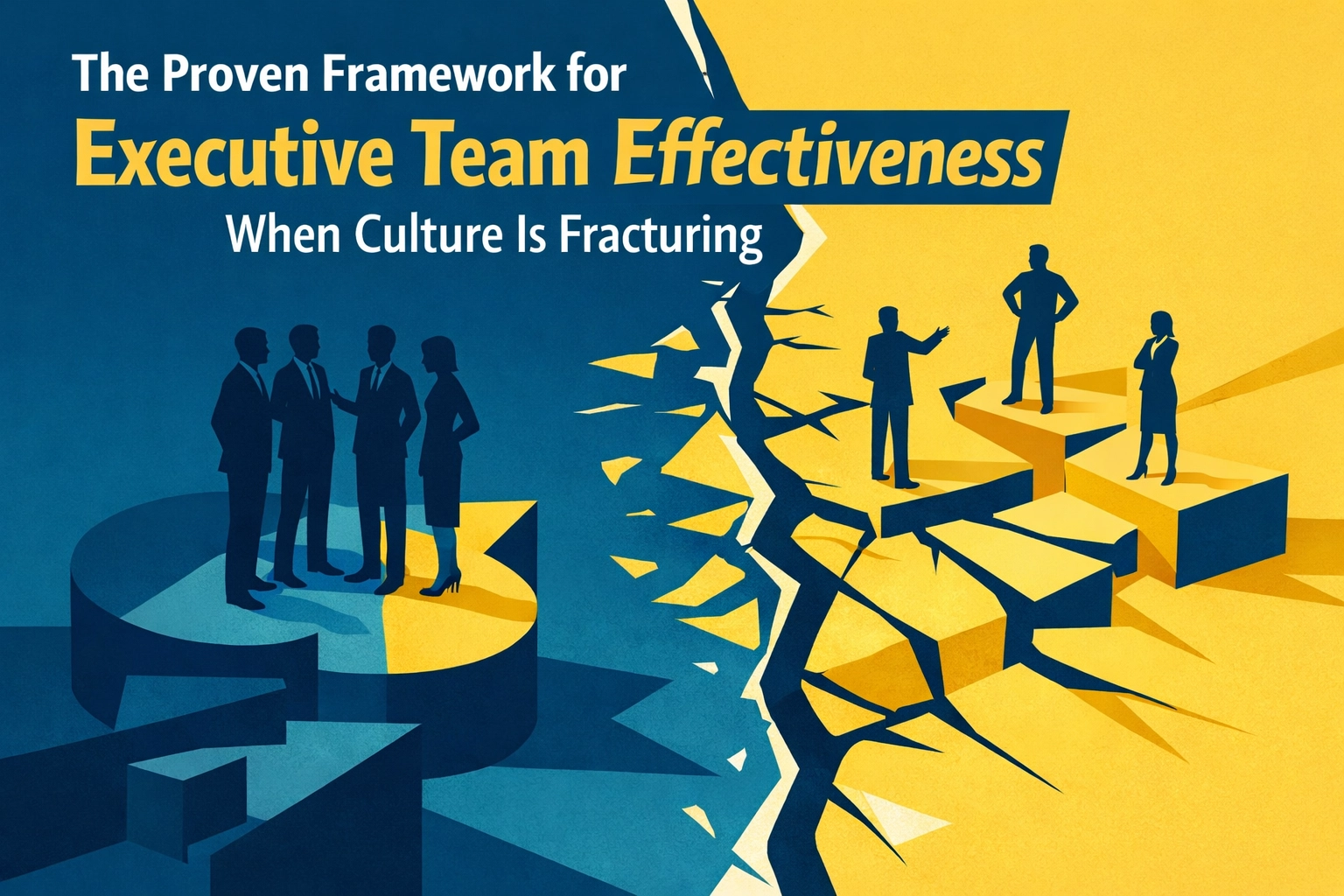
Here's a truth most CEOs won't say out loud: executive team dysfunction is expensive, predictable, and: if you know what to look for: fixable.
When your leadership team fractures, it doesn't just create friction at the top. It cascades. Fast. Middle managers stop making decisions. Teams silo. Strategy becomes theater. And your best people start quietly updating their LinkedIn profiles.
I call this the Dysfunction Dividend: the compound interest you pay when executive misalignment goes unaddressed. It starts as tension in a Monday morning meeting and ends as a full-blown cultural crisis six months later.
The good news? You don't need a consultant-led "culture transformation" that takes 18 months and produces a poster no one reads. You need a framework that rebuilds trust, realigns priorities, and reestablishes executive discipline: quickly.
Here's how.
Why Executive Teams Fracture (And Why It Spreads)
Most leadership breakdowns don't start with a blow-up. They start with silence.
Someone disagrees with a decision but doesn't say it in the room. A leader commits publicly but undermines privately. Two executives stop talking to each other and route everything through the CEO. The team stops debating strategy and starts performing agreement.

And because your organization mirrors your leadership team, that behavior metastasizes. If your executives don't trust each other, your teams won't either. If your C-suite can't have a hard conversation, neither can your managers.
The fracture at the top becomes the culture everywhere else.
This is why "team-building offsites" and "values workshops" don't fix the problem. You're not dealing with a motivation issue. You're dealing with a structural breakdown in how the executive team operates.
The Framework: Five Pillars of Executive Team Effectiveness
When culture is fracturing, you don't need more strategy sessions. You need to rebuild the operating system of the leadership team itself. Here's the framework that works.
1. Reestablish Shared Accountability (Not Individual Heroics)
Most executive teams operate as a coalition of individual leaders managing their own domains. Marketing does marketing. Sales does sales. HR does HR. Everyone shows up to the leadership meeting to report out, not collaborate.
That model breaks when the organization is under stress.
The first pillar is shifting from "my function" to "our company." This means redefining what the executive team is accountable for collectively: not just what each leader owns individually.
In practice:
- Identify the 3-5 most critical enterprise-level outcomes (revenue growth, customer retention, operational efficiency, etc.)
- Assign collective ownership of each outcome to the full team, not a single executive
- Measure executive performance not just on functional KPIs, but on enterprise results
When executives share accountability, they stop optimizing for their silo and start solving for the business.
2. Create the Conditions for Productive Conflict
Here's the paradox: teams that avoid conflict create toxic cultures. Teams that engage in productive conflict build trust.
The difference? Framing.
Dysfunctional teams frame conflict as "me vs. you." High-performing teams frame it as "us vs. the problem."
If your leadership team has become conflict-avoidant: or conflict-toxic: you need to reset the rules of engagement.

In practice:
- Establish a norm that disagreement is expected, not punished
- Require executives to surface concerns in the room, not in the hallway afterward
- Separate debate (exploring options) from decision-making (committing to one)
- Once a decision is made, the team speaks with one voice: even if individuals disagreed
This isn't about "being nice." It's about creating the psychological safety to disagree openly so the team can align genuinely.
3. Rebuild Trust Through Transparency, Not Therapy
When trust erodes in an executive team, the instinct is often to bring in a facilitator for a "trust-building workshop." That's rarely the answer.
Trust isn't rebuilt through vulnerability exercises. It's rebuilt through consistent behavior over time: specifically, through transparency in decision-making and follow-through on commitments.
In practice:
- Make decision-making processes explicit (who decides, how, by when)
- Over-communicate the "why" behind major decisions, especially unpopular ones
- Track commitments publicly in leadership meetings and hold each other accountable
- If someone misses a commitment, address it directly: not passive-aggressively
Trust is earned by doing what you said you'd do, and by explaining what you're doing when it changes.
4. Realign on the Most Important Work
When culture fractures, it's often because the executive team is no longer aligned on what matters most. Leaders are optimizing for different outcomes, pursuing conflicting priorities, and making trade-offs in isolation.
You need to force the conversation: What are the 3-5 things that, if we get them right, everything else becomes easier or irrelevant?

This isn't a strategy offsite exercise. It's a forcing function to identify where the leadership team is misaligned: and to make hard choices about what not to do.
In practice:
- Conduct a "stop doing" audit: What are we currently investing in that doesn't move the needle?
- Align the executive team on the definition of success for the next 12 months
- Cascade those priorities into every team, every meeting, every resource allocation decision
When everyone is rowing in the same direction, friction decreases and momentum builds.
5. Reset the Operating Cadence
The final pillar is often the most overlooked: how the executive team actually works together.
If your leadership meetings are status updates, you're wasting time. If decisions take weeks to make because they require "offline follow-ups," you're creating bottlenecks. If the CEO is the only one driving the agenda, the team isn't really a team: it's an audience.
You need to redesign the operating rhythm of the executive team itself.
In practice:
- Separate strategic discussions from operational updates (different meetings, different cadence)
- Establish clear decision rights: what the CEO owns, what the team decides collectively, what individuals can decide independently
- Create a weekly "commitment tracker" that holds executives accountable to each other, not just to the CEO
- Build in a quarterly "team health check" to surface friction before it metastasizes
The way your executive team operates: the meetings, the decisions, the accountability: is the template for how the rest of the organization will operate.
Why This Framework Works (And Why Most Don't)
Most frameworks for executive team effectiveness assume the team is functional and just needs optimization. They focus on communication styles, personality assessments, and offsite retreats.
This framework assumes the team is fractured: and that the fracture is spreading.
It doesn't try to fix culture from the bottom up. It rebuilds the foundation from the top down. Because if the executive team doesn't model trust, accountability, and alignment, no amount of "culture work" will matter.
The Dysfunction Dividend compounds fast. But so does the opposite.
When your leadership team starts operating as a genuine team: not a collection of individuals: the rest of the organization notices. Decisions get faster. Silos dissolve. People stop waiting for permission and start solving problems.
That's not culture transformation. That's leadership discipline.
And it's the only thing that rebuilds a fracturing culture from the inside out.
If your executive team is showing cracks: or if the cracks are already spreading: this isn't a problem that fixes itself. It requires intentional intervention, clear frameworks, and someone who's rebuilt these teams before.
That's the work Rinnovare does. If this resonates, let's talk.