
I've been in enough boardrooms to know when I'm watching a breakdown in real time.
The CFO is running a parallel analysis because she doesn't trust the COO's numbers. The Chief Product Officer is building roadmaps in isolation because the CRO "doesn't get it." And the CEO? The CEO is spending 60% of their week managing conflict, translating between executives who should already be speaking the same language.
This isn't a structural problem. It's a behavioral one.
And here's the uncomfortable truth: You can't org-chart your way out of a trust deficit.
The Question No One Wants to Ask
When leadership teams are misaligned, the default response is mechanical. Restructure reporting lines. Redefine roles. Run an offsite with trust falls and personality assessments.
But the question that haunts every CEO, and should haunt every board member or PE sponsor watching the drama unfold, is this:
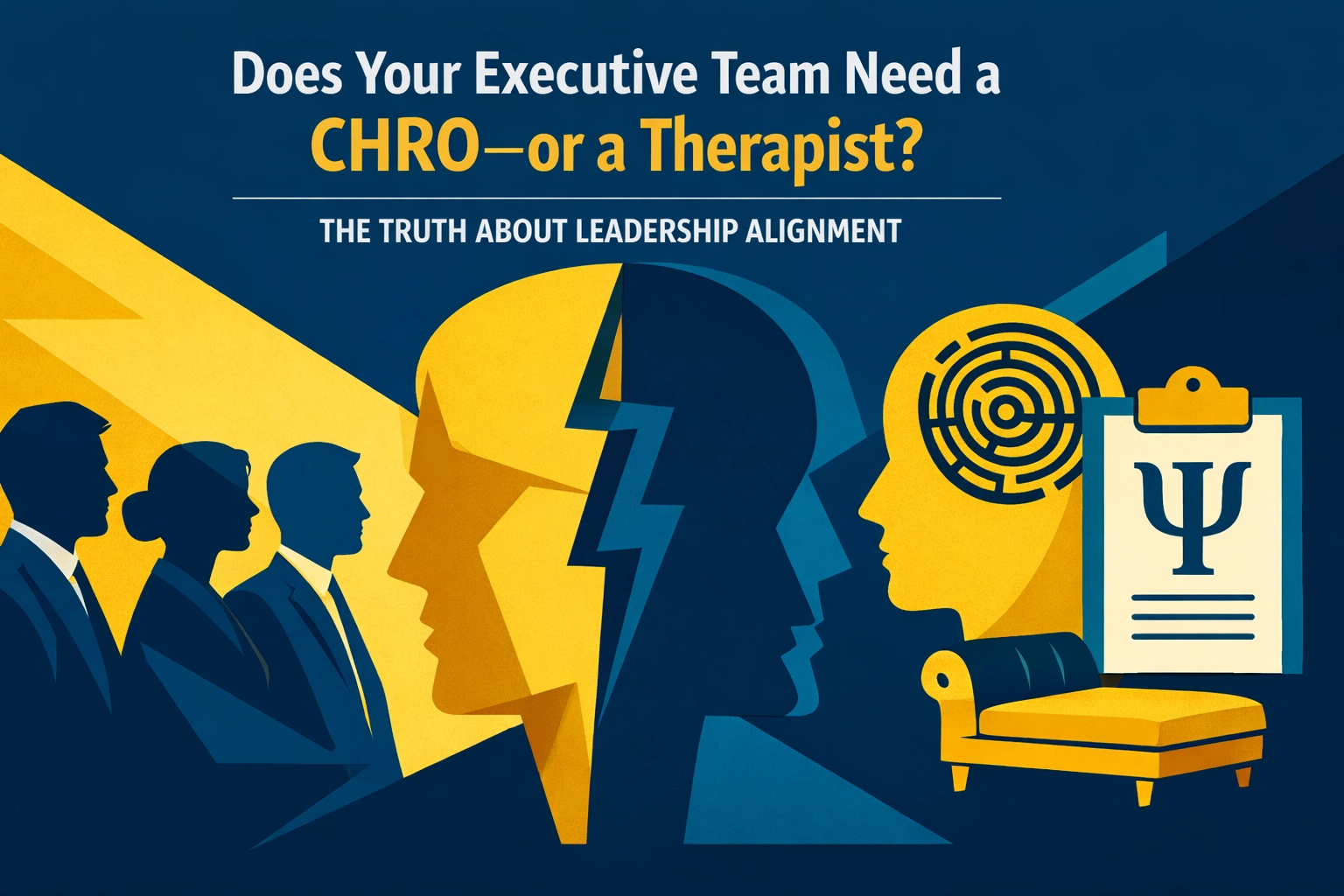
Does my executive team need a CHRO, or do they need a therapist?
It sounds flippant. It's not.
Because leadership misalignment is rarely about competence. It's about behavior. And behavior, especially at the executive level, is where strategy goes to die.

The Symptoms Are Structural. The Disease Is Emotional.
Let me be clear: I'm not suggesting your C-suite needs group therapy (though some might). I'm saying that the challenges you're treating as operational issues are actually relational breakdowns, and you're applying the wrong tools.
Here's what I see play out again and again:
Symptom: Your executive team can't align on priorities.
Real Issue: They don't trust each other's judgment, so every decision becomes a negotiation instead of a collaboration.
Symptom: Information doesn't flow between departments.
Real Issue: Leaders are hoarding data as a form of control because they feel insecure in their role or threatened by a peer.
Symptom: Your offsite produced a beautiful strategic plan that no one is executing.
Real Issue: The plan was performative. No one in that room actually believed the others would follow through.
You can't fix these with better meeting cadences or clearer KPIs. You need to fix the underlying behavioral contract that your leadership team is operating under, even if no one has named it yet.
The Role of the CHRO: Steward, Not Shrink
So where does a CHRO fit into this?
Here's what a CHRO is not: a therapist, a mediator, or the "feelings person" who smooths over conflict so everyone can get back to work.
Here's what a strategic CHRO is: the architect and steward of the systems, culture, and incentives that either enable trust, or erode it.
A great CHRO doesn't fix your executive team's dysfunction by running intervention sessions. They fix it by:
- Designing accountability structures that make passive-aggressive behavior expensive and collaboration rewarding.
- Building talent systems that reinforce the behaviors you say you value (and expose the ones you're accidentally incentivizing).
- Creating clarity around roles, decision rights, and expectations so that misalignment becomes visible, and addressable, before it metastasizes.
- Holding up the mirror when the CEO or the board is enabling dysfunction by rewarding the wrong people or ignoring the wrong behaviors.
This is strategic HR. This is what separates a CHRO from an HR administrator who runs benefits and compliance. Frankly, it requires courage.
And this is why, if your executive team is struggling with alignment, the answer isn't "Do we need a CHRO or a therapist?"
The answer is: You need a CHRO who understands that leadership alignment is an emotional and structural challenge, and knows how to address both.

What Good Leadership Alignment Actually Requires
Let's get practical. If you're a CEO, a board member, or a PE sponsor watching an executive team struggle with alignment, here's what actually moves the needle:
1. Naming the Behavioral Contract
Every leadership team operates under an unwritten set of rules. Some are healthy ("We debate ideas, not people"). Some are toxic ("Whoever yells loudest wins").
A strategic CHRO helps you name the contract you're currently operating under, and decide if it's the one you actually want. This isn't soft. This is the difference between a team that executes and one that spins.
2. Consequences for Misalignment
If your CFO and COO are in open conflict and nothing happens, you've just told the rest of the organization that alignment is optional.
A CHRO ensures there are real consequences, not punitive, but structural, for leaders who prioritize their functional silo over the enterprise. This might mean comp tied to cross-functional goals. It might mean succession planning that explicitly evaluates collaboration. It definitely means the CEO stops rewarding "brilliant jerks" who deliver results but poison the culture.
3. Transparent Decision Rights
Most executive dysfunction stems from ambiguity. Who actually owns pricing strategy, the CRO or the CFO? Who has final say on product roadmap, the CEO or the Chief Product Officer?
A CHRO doesn't make these decisions. But they force the CEO and the board to make them, and document them, so that every conflict doesn't devolve into a power struggle.
4. Psychological Safety (Without the Buzzword Baggage)
Here's the part where it sounds like I'm contradicting myself. Psychological safety matters. A lot.
But it's not about trust falls. It's about creating an environment where executives can admit mistakes, challenge assumptions, and ask for help without career consequences.
A CHRO builds this by modeling it, protecting it, and holding leaders accountable when they violate it. And when psychological safety doesn't exist? That's when you start to see the hoarding, the triangulation, and the passive resistance that kills execution.

The Real Question: Are You Solving for Symptoms or Systems?
Here's the test. If you removed one toxic executive from your leadership team, would the dysfunction disappear, or would someone else step into that role?
If it's the former, you have a people problem. Fire them.
If it's the latter, you have a systems problem. And systems problems don't get solved with executive coaching or offsite facilitators. They get solved by redesigning the incentives, structures, and norms that are enabling the dysfunction.
This is where most CEOs get stuck. They know something is broken. They hire consultants to run leadership assessments. They bring in coaches. They try to "fix" individuals.
But they never address the system that's producing the behavior in the first place.
When the Executive Team Does Need Outside Help
Let me acknowledge the elephant in the room: sometimes, the behavioral issues are deep enough that you do need outside intervention.
If your leadership team is dealing with:
- Unresolved trauma from a previous regime or a botched restructuring
- Interpersonal conflict that has escalated beyond professional boundaries
- A CEO who is part of the problem but can't see it
…then yes, you might need an executive coach, an organizational psychologist, or a facilitated intervention.
But here's the key: that intervention only works if the structural and cultural conditions change afterward. Otherwise, you're just putting a band-aid on a systemic infection.
A great CHRO knows when to bring in outside help, and knows how to translate that work into lasting changes in how the team operates.
The Bottom Line
Your executive team doesn't need a CHRO or a therapist. It needs a CHRO who understands that leadership alignment is both an emotional reality and a structural imperative, and knows how to address both.
Because at the end of the day, misalignment isn't about bad people. It's about bad systems that enable bad behavior. And if you don't fix the system, you'll just keep cycling through executives, hoping the next one will be different.
They won't be.
The system will shape them, just like it shaped the last one.
So the real question isn't "Does my team need a CHRO or a therapist?" The real question is: "Do I have the courage to redesign the system that's creating the dysfunction in the first place?"
If the answer is yes, let's talk. If the answer is no, good luck with your next offsite.
Leadership alignment isn't an HR problem. It's a business problem with HR at the center. If you're ready to stop treating symptoms and start redesigning systems, reach out. We've been in your seat. We know what works.