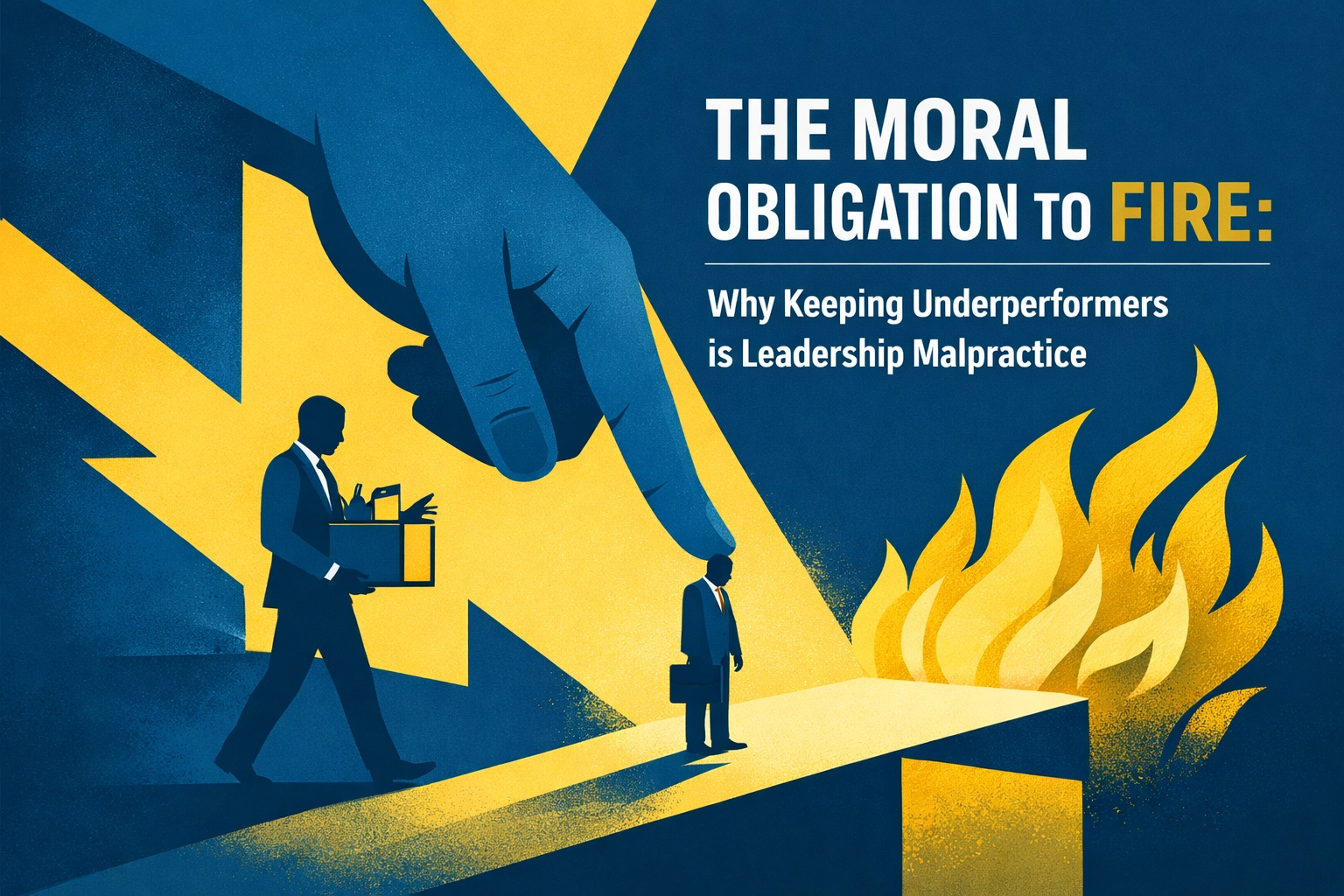
You think you’re being a "good person."
You’ve got a VP or a Director who just isn't hitting the mark. Maybe they’re well-liked. Maybe they’ve been with the company since the early days. Maybe they’re just "going through a rough patch" that has somehow lasted eighteen months. So, you wait. You coach. You "give them another quarter." You tell yourself that being a compassionate leader means being patient.
I’m here to tell you that you’re wrong.
In the world of high-stakes leadership and Private Equity value creation, keeping an underperformer isn't an act of kindness. It is a moral failure. It is an act of cowardice disguised as compassion. When you refuse to make the hard call, you aren't protecting one person; you are actively harming everyone else in the building.
At Rinnovare, we see this "Leadership Malpractice" play out in boardroom after boardroom. It’s the silent killer of enterprise value, and it’s time we called it what it is.
The Invisible Tax on Your Top Talent
Every time you choose to retain a low-performer, you are levying a heavy tax on your highest achievers.
High performers don’t just want to win; they want to play on a team of winners. When they see a peer consistently missing targets, failing to execute, or dragging down projects without consequence, their motivation doesn’t just dip: it evaporates. They start asking themselves: "Why am I killing myself to hit my KPIs when Dave is at 60% and still gets to sit at the table?"
Research consistently shows that not addressing poor performance reduces productivity and increases turnover of high performers. Your "A-players" have options. They are the most mobile people in your organization. If you create an environment where mediocrity is tolerated under the guise of "culture," your best people will leave for an organization that actually respects their contribution enough to demand excellence from everyone.
By "protecting" the underperformer, you are effectively firing your stars.

The Broken Window Theory of the C-Suite
In the 1980s, criminologists proposed the "Broken Windows" theory: if a window in a building is broken and left unrepaired, it signals that no one cares, leading to more windows being broken and eventually a decay of the entire neighborhood.
The same logic applies to your executive team.
Underperformance is a broken window. When a CEO or a PE Partner allows a weak link to remain in a critical role, it sends a clear message to the rest of the organization: The standards here are negotiable.
Once the standards become negotiable, the culture begins to rot from the top down. Role ambiguity sets in, accountability vanishes, and the "Matrix Management" we talked about last week becomes a hiding place for the incompetent. If you are struggling with Executive Team Effectiveness, look first at who you are refusing to fire. That one person is the visible proof that your "values" are just posters on a wall.
The Cowardice of the "Perpetual PIP"
Let’s talk about the Performance Improvement Plan (PIP). In many HR circles, the PIP is used as a legal shield. In many leadership circles, it’s used as an emotional shield.
Leaders often put people on 90-day plans not because they believe the person can turn it around, but because they don't want to have the uncomfortable conversation today. It’s a delay tactic. It’s a way to offload the emotional burden of termination onto "the process."
This is a failure of Senior-level judgment.
If you, as a leader, know in your gut that this person is not the right fit for the next phase of the company’s growth, every day you keep them is a day you are lying to them and to your shareholders. A truly "emotionally intelligent" leader understands that the kindest thing you can do for someone who is failing is to let them go find a role where they can actually succeed. Keeping them in a role where they are drowning is not kindness: it’s a slow-motion professional execution.

The PE Lens: Math Doesn't Have Feelings
For our partners in Private Equity, the cost of underperformance isn't just a "culture" issue: it’s a direct hit to the IRR.
In a standard 3-to-5-year hold, time is your most precious commodity. If you spend 12 months "coaching" a CFO who clearly doesn't have the chops for a leveraged environment, you haven't just lost a year of salary. You’ve lost 20% to 33% of your entire investment horizon.
We’ve written before about the first 90 days and why PE deals fail without the right leadership. The most common regret we hear from GPs after an exit is: "I wish I had made that leadership change eighteen months sooner."
Underperformance in a portco is value destruction, plain and simple. If the "Human Side of Tech Transformation" or HR integration is failing, it’s rarely because the strategy is wrong; it’s because the person leading it shouldn't be in the seat.
The Moral Obligation to the Collective
Leadership is a fiduciary duty. You have a moral obligation to the employees who are performing, to the customers who rely on your services, and to the investors who put their capital at risk.
When you keep an underperformer, you are:
- Stealing from the high-performers who have to pick up the slack.
- Lying to the underperformer by giving them a false sense of security.
- Betraying the organization’s mission by prioritizing your own comfort over the company’s success.
Real leadership requires the courage to be the "bad guy" in the short term to be a great leader in the long term. It requires recognizing that the "Hidden Contract" of leadership means you must protect the integrity of the team at all costs.

How to Stop the Malpractice
So, how do you fix it? It starts with a shift in mindset. You need to stop viewing termination as a failure of your leadership and start viewing it as a necessary pruning for growth.
- Adopt Single-Threaded Ownership: Stop letting people hide in the matrix. Give them clear, unarguable metrics. If they miss, there are no excuses.
- Audit Your "Compassion": Ask yourself: "Am I keeping this person because I think they can win, or because I don't want to feel bad tonight?" If it's the latter, you're being selfish, not nice.
- Get an External Perspective: Sometimes you're too close to the situation. This is where HR Transformation Consulting or an Interim CHRO can provide the objective truth you’re too biased to see.
Conclusion: Excellence is a Choice
The culture of your company is defined by the worst behavior you are willing to tolerate. If you tolerate underperformance, you are choosing a culture of mediocrity.
Firing someone is never easy. It shouldn't be. But it is often necessary. If you want to build a high-value, high-performance organization, you must have the stomach to remove the people who aren't helping you get there. Anything less is leadership malpractice.
Are you ready to stop making excuses for your executive team?
Rinnovare helps CEOs and PE firms navigate the messy, human side of leadership with brutal clarity and clinical precision. From HR Due Diligence to executive coaching, we ensure your leadership team is an asset, not a liability.
Contact Rinnovare Today to discuss how we can help you optimize your team for maximum value creation.
