Italian excellence isn't just a marketing slogan; for the thousands of mid-market firms: the Piccole e Medie Imprese (PMIs): that form the backbone of the Italian economy, it is a way of life. These companies are built on a bedrock of craftsmanship, deep-rooted tradition, and, most importantly, a control-heavy familial model where the founder is more than a CEO. They are the central anchor of a corporate family.
But a funny thing happens when these "dynasties" cross the Atlantic. The very leadership style that fostered 40 years of success in Lombardy or Emilia-Romagna often becomes a suffocating bottleneck in New York, Chicago, or Charlotte.
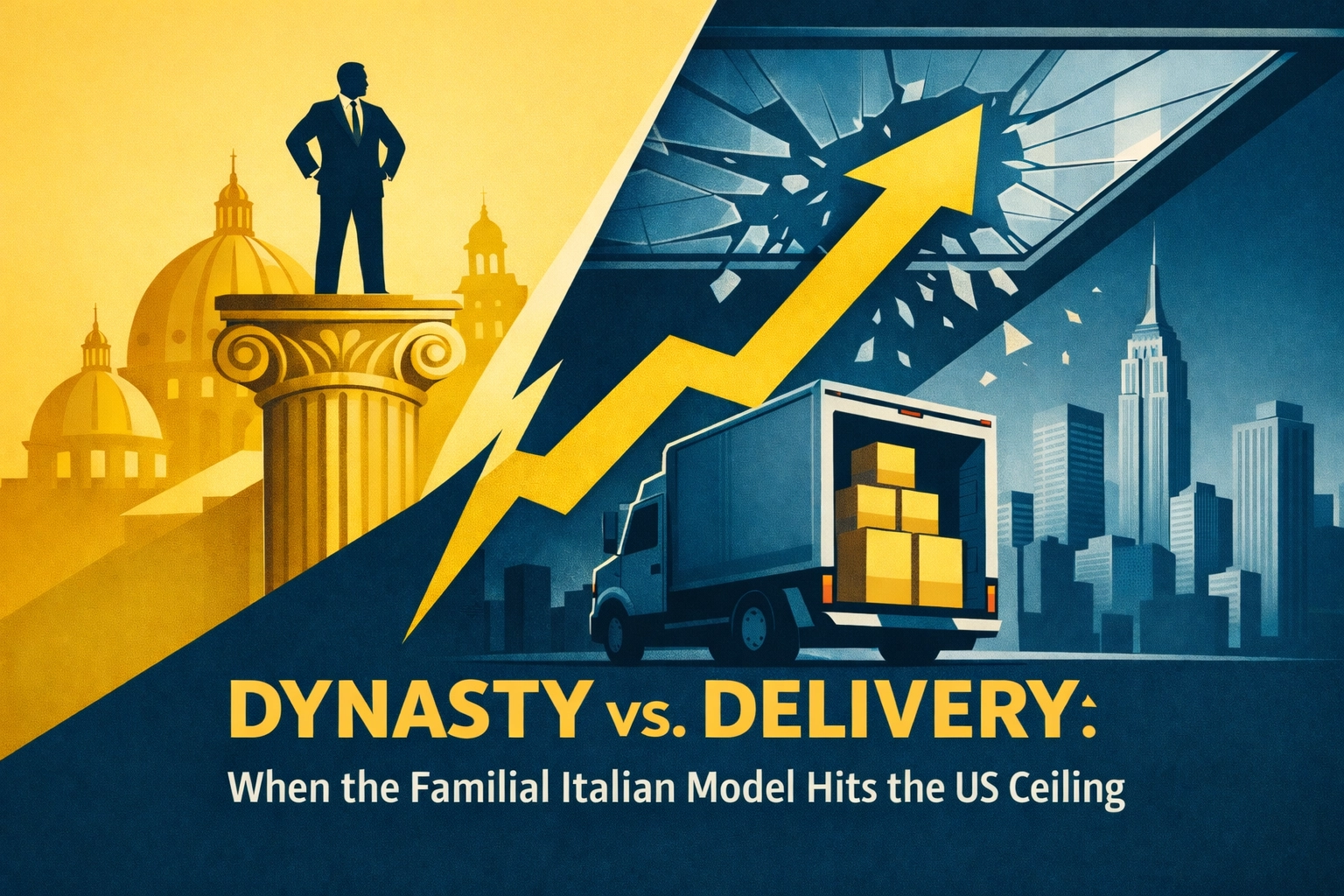
In the US market, "family" is a culture, but "delivery" is the currency. When an Italian firm attempts to scale in the States without evolving its governance, it hits a ceiling: not of capital or product quality, but of leadership.
The Familial Paradox: Strength in Italy, Liability in the US
In a typical Italian family-led firm, the organizational chart is often a suggestion. The real power resides in a centralized hub: the founder or the family board. This centralized family governance model creates incredible resilience. During a crisis, the family leans in, protects its workers, and makes rapid-fire decisions based on decades of intuition.
However, this model is inherently centralized. In the Milanese boardroom, "trust" is synonymous with "proximity." You trust the people you’ve known for thirty years, the ones who grew up in the same province, the ones who understand the unspoken language of the firm’s soul.
When that firm opens a US subsidiary, it usually hires a high-performing American executive to lead the charge. This is where the friction begins. The US executive expects executive autonomy. They expect a clear "swim lane" where they can make decisions, hire talent, and deploy budgets without waiting for a 3:00 PM CET phone call to Milan.
In many Italian PMIs, that autonomy is never actually granted. The founder continues to treat the US leader like a branch manager rather than a strategic partner. This is the moment a leader "loses the room," a phenomenon we’ve explored in our look at leadership failure points.

The "Glass Ceiling" of the Family Office
Why do so many US-based CEOs of Italian subsidiaries resign within the first 18 to 24 months? It’s rarely about the compensation. It’s about the "Shadow Org Chart."
In centralized family governance, the formal reporting lines are frequently bypassed by the "informal" lines of the family. A US Sales VP might be told they are in charge of the North American strategy, only to find out that a family-connected executive (who sits in Italy) has vetoed a local marketing spend because "it’s not how we do things."
This creates a "Glass Ceiling." Not for the business, but for the talent. Top-tier US talent: the kind needed to navigate the complexity of the American market: will not stay in an environment where they have responsibility but no authority. They feel like highly-paid secretaries tasked with translating Italian directives into English.
If your US growth has plateaued, or if you are seeing high turnover in your stateside leadership, it is time to ask: Are you running a business, or are you running a family outpost?
Transitioning to Professional Governance
Moving from a "Dynasty" model to a "Delivery" model does not mean losing the firm’s soul. You can keep the craftsmanship, the long-term vision, and the Italian heritage while adopting a professional executive governance structure.
Here is how Rinnovare advises firms to navigate this transition:
1. Decentralize the Decision-Making
The US market moves too fast for a centralized Italian approval process. If every hiring decision or contract over $50,000 needs to be signed off in Milan, you will lose the best candidates and the best deals. You must establish clear delegations of authority. Trust is built through performance metrics (KPIs), not through constant surveillance or proximity.
2. Move from "Vibes" to Data
In many Italian family firms, decisions are made on "sentimento": a feeling for the market. While intuition is valuable, it doesn't scale well across the Atlantic. To empower a US leadership team, you must provide them with a framework of data-driven objectives. This allows the Italian HQ to maintain control over outcomes without micromanaging the activity.
3. Professionalize the Board
Bringing in an independent, external advisor: someone who understands both the Italian mindset and the US market: is often the only way to break the family bottleneck. At Rinnovare, we often serve as this bridge, helping the family understand when their "protectionism" is actually hindering their "potential." You can learn more about this strategic alignment in our services overview.


The "Golden Handshake" vs. The "Posto Fisso"
One of the deepest cultural divides is how we view the employment contract. The Italian concept of Posto Fisso (a job for life) and the legal protections of the Italian labor code create a mindset of permanence.
In the US, "At-Will" employment and high executive mobility are the norms. Italian founders often view a US executive leaving after three years as a personal betrayal of the "family." In reality, it’s often just a career move.
By professionalizing the HR function and moving away from the "family loyalty" expectation, firms can create a more robust retention strategy that is based on mutual value rather than psychological debt.
Preserving the Soul, Enabling the Scale
The goal of professionalizing your US operations isn't to turn your Italian company into a soulless American corporation. The "Italian-ness" of the brand: the attention to detail, the passion, the heritage: is your greatest competitive advantage.
But "familial control" is not "heritage."
Familial control is a mechanism; heritage is a value system. You can scale your values while releasing control. When a founder realizes that their job is to set the vision and then get out of the way of their US executives, the ceiling disappears.
Growth in the US requires a fundamental shift in the Hidden Contract between the home office and the subsidiary. It requires moving from a model of "obedience" to a model of "ownership."
How Rinnovare Can Help
Navigating the transition from a family-led dynasty to a global professional powerhouse is a high-stakes endeavor. It requires more than just legal advice; it requires a deep understanding of human capital, leadership psychology, and the cultural nuances of both Italy and the US.
At Rinnovare, we specialize in helping international firms build the HR infrastructure and leadership alignment necessary for successful US expansion. Whether you need an Interim CHRO to stabilize a US team or a strategic advisor to help the Milanese board rethink its governance, we are the bridge across the Atlantic.
Don’t let your leadership model be the thing that keeps your brand from conquering the American market. It's time to trade the dynasty for delivery.
Contact us today to discuss how we can help you scale your US operations without losing your soul.