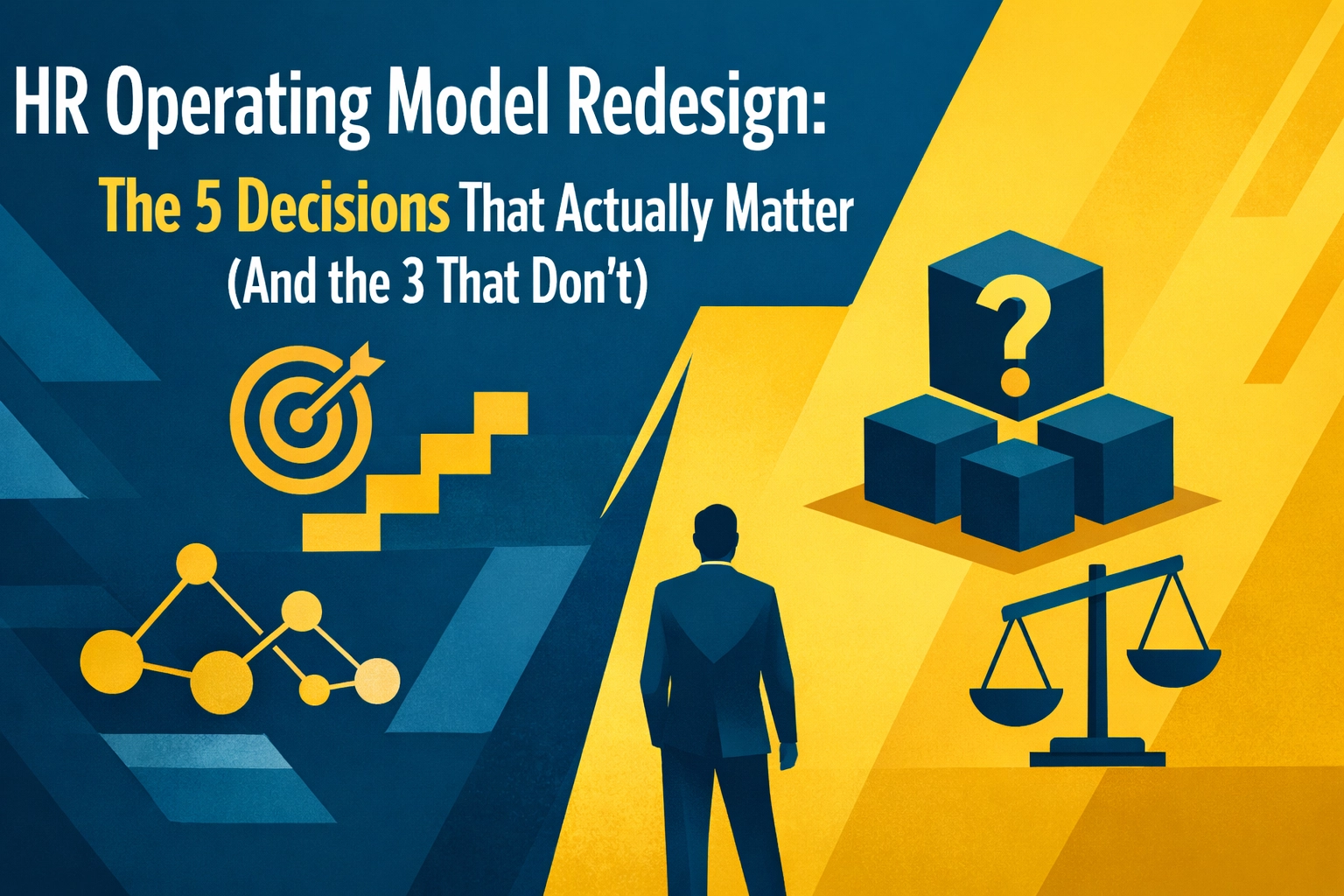
Most HR operating model redesigns fail before they start.
Not because the strategy is wrong. Not because the team lacks talent. But because executives spend six months debating things that don't move the needle while ignoring the five decisions that actually determine whether your HR function becomes a strategic lever or remains an expensive paper-pusher.
I've sat in enough conference rooms watching leadership teams agonize over org chart aesthetics while their talent strategy collapses. I've seen consultants deliver 47-page "future state models" that look beautiful in PowerPoint and die on contact with reality.
Here's what actually matters, and what you can stop wasting time on.
The 5 Decisions That Actually Matter
1. Strategic Alignment: What Business Problem Are You Solving?
Before you touch an org chart, answer this: What is your business strategy, and how does HR enable it?
If you're a PE-backed portfolio company focused on operational efficiency and margin expansion, you don't need a bloated HR team running engagement surveys. You need lean talent acquisition, tight comp structures, and workforce planning that protects EBITDA.
If you're a growth-stage tech company competing for scarce engineering talent, your HR model better prioritize employer brand, speed-to-hire, and retention of critical skills. Everything else is noise.
Your HR operating model isn't a generic best practice. It's a direct reflection of your competitive positioning. Cost-leadership strategies demand centralized, efficient HR delivery. Differentiation strategies require embedded HR partners who understand the business deeply enough to make real-time talent calls.
Most redesigns fail because they copy what worked at someone else's company without asking whether it solves your problem.

2. Structural Delivery Model: Who Does What, and Where?
This is the decision that determines whether your HR function operates as a unified machine or a collection of feudal kingdoms.
You have three structural levers:
- Centers of Excellence (CoEs): Deep expertise in talent acquisition, learning, compensation, etc. They set standards, build programs, and solve complex problems.
- Shared Services / Operations: Transactional work, payroll, benefits admin, onboarding logistics. High volume, low complexity, ripe for automation.
- HR Business Partners (HRBPs): Embedded advisors who translate business needs into people strategy. They're consultants, not order-takers.
The mistake most organizations make? They build all three without clarifying the handoffs. You end up with HRBPs who think they own talent acquisition strategy, CoEs who bypass business partners to "fix" problems directly, and shared services that become a black hole where requests disappear.
Define the structural model. Then define the workflows between the three. If you can't draw a clean RACI chart showing who makes decisions versus who executes, your redesign will collapse under its own bureaucracy.
3. Decision Rights and Accountability: Who Has the Final Say?
This is the invisible architecture that determines whether your HR function moves fast or drowns in consensus-building.
Who approves headcount? Who sets compensation bands? Who decides whether to make an exception to policy for a critical hire? Who owns the employee experience strategy?
If the answer is "it depends" or "we collaborate," you've already lost.
Decision rights don't mean one person does all the work. They mean one person (or role) is accountable for the outcome and has the authority to make the call when speed matters.
In high-performing HR models, CoEs own what (standards, frameworks, tools). HRBPs own how (application to specific business contexts). Business leaders own who (final hiring and performance decisions). Shared Services owns when (execution timelines and operational delivery).
Blur those lines, and you get the worst of all worlds: slow decisions, finger-pointing when things go wrong, and talented people who leave because they're tired of asking permission.
4. Technology and Data Infrastructure: Can You Actually Execute This Model?
You can design the most elegant HR operating model in the world. If your HRIS, ATS, LMS, and performance management tools don't talk to each other, you'll spend more time managing systems than managing people.
The technology decision isn't about buying the fanciest platform. It's about building an integrated stack that eliminates redundant logins, duplicate data entry, and manual workarounds that waste 30% of your HR team's time.
And here's the part most executives miss: If your HR team can't pull clean workforce data to answer basic questions, What's our turnover rate by manager? Where are our talent concentration risks? What's our cost-per-hire by business unit?, your operating model will never be strategic. You'll be too busy firefighting to see patterns.
Invest in the data infrastructure. Build dashboards that give HRBPs and business leaders real-time visibility. Automate the transactional work so your team has capacity for the strategic work.
5. Talent Allocation: Are Your Best People Working on Your Biggest Priorities?
This is the decision most HR leaders avoid because it's uncomfortable.
If you have 10 people on your HR team, where are they spending their time? If the answer is "recruiting backfill for high-turnover roles" or "answering the same policy questions over and over," you have a resource allocation problem masquerading as an HR problem.
High-performing HR models ruthlessly prioritize talent allocation. The best people work on the highest-leverage problems: leadership development for your executive bench, workforce planning for your next growth phase, retention strategies for critical roles.
Everything else gets automated, outsourced, or stopped.
Most HR teams are allergic to this conversation because it requires admitting that some roles don't need to exist. But if your redesign doesn't free up capacity for strategic work, you've just rearranged deck chairs.
The 3 Decisions That Don't Matter (But Consume All the Oxygen)
1. Org Chart Aesthetics and Title Inflation
Stop debating whether your VP of Talent should report to the COO or the CEO. Stop arguing over whether "People Operations" sounds more modern than "Human Resources."
Titles and reporting lines matter far less than decision rights and accountability. I've seen HR leaders with direct CEO access accomplish nothing because they lacked the authority to make real decisions. I've seen HR directors buried three levels down who transformed their companies because they had clear mandates and delivered results.
Design the model. Clarify the accountabilities. Then draw the boxes.
2. Perfect Alignment Before Launch
You will never have perfect consensus. If you wait until every stakeholder agrees with the new model, you'll still be in planning mode two years from now while your competitors move faster.
Launch the model at 80% confidence. Commit to a 90-day review cycle. Adjust based on what you learn. High-performing organizations treat operating model redesign as iterative, not one-and-done.
The need for speed beats the comfort of consensus.
3. Detailed Process Documentation Before Structure Is Clear
I've watched teams spend months mapping out 47 sub-processes before they've even decided who owns talent acquisition. This is backwards.
Structure first. Then process. Then documentation.
If you document workflows before the organizational structure is clear, you're cementing inefficiency. Figure out who does what, clarify the handoffs, and then write the playbook.
Most process documentation is security theater anyway, it makes executives feel like they've de-risked the transition, but it doesn't change behavior. What changes behavior is clear accountability and consequences for not following the model.
The Redesign That Actually Works
Here's the truth most consultants won't tell you: HR operating model redesign isn't a strategy problem. It's an execution problem.
The five decisions above aren't complex. They're just hard, because they require trade-offs, uncomfortable conversations, and the discipline to say no to things that don't matter.
If you're redesigning your HR function, start with these five. Ignore the noise around the other three. And if you need someone who's done this before: someone who's sat in the CHRO seat and rebuilt HR models in PE portfolio companies, growth-stage firms, and turnarounds: let's talk.
Because your operating model isn't just an org chart. It's the difference between HR as a strategic lever and HR as a cost center.
And right now, you're probably redesigning the wrong things.