You've just closed on a portfolio company. The HR leader resigned during diligence. Compliance risk is flashing red. The integration plan assumes a functioning People function, and you've got 90 days to prove the thesis.
So you call your network and get two answers: "You need an interim CHRO" and "You need HR transformation consulting."
They're both right. And they're both incomplete.
Here's what most advisory firms won't tell you: The question isn't which one you need. It's whether you need executive leadership, structural redesign, or both: and in what order.
Let's cut through the jargon.
The Real Question: Leadership Gap or Capability Gap?
Most PE Operating Partners frame this decision wrong. They ask, "Should we hire an interim or bring in consultants?" when the real question is: "What's actually broken, and who needs to own fixing it?"
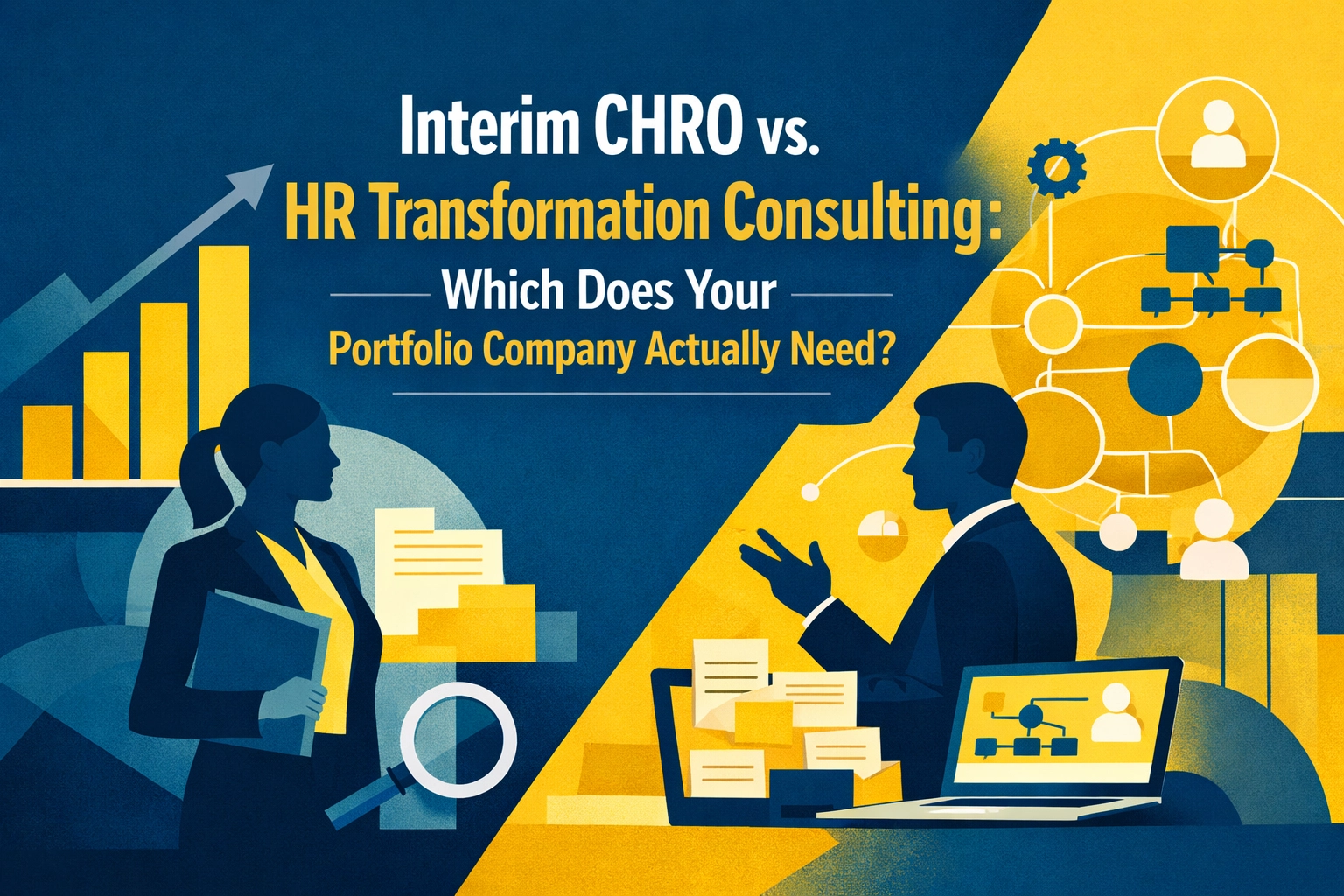
An Interim CHRO is executive leadership. Full accountability. Owns outcomes. Sits in the leadership team. Makes hiring and firing decisions. Represents HR in board meetings. Runs the function end-to-end while you stabilize, integrate, or search for a permanent leader.
HR Transformation Consulting is advisory. Project-based. Delivers frameworks, roadmaps, and recommendations. Guides your internal team through specific changes: digitalization, comp redesign, policy overhauls. But they don't run your Monday morning staff meeting.
The confusion happens because they sound similar. They're not.

You Need an Interim CHRO If…
Your portfolio company has a leadership gap, not just a project need.
Signal 1: There's No One in the Chair
Your CHRO exited. The VP of HR is solid operationally but not ready for the executive table. You're in the middle of a carve-out. You need someone who can make real-time decisions on comp, restructuring, compliance, and culture: not someone who needs to "run it up the chain."
Signal 2: You're in Active Crisis Mode
Union activity is escalating. You've got an EEOC investigation. Severance negotiations are stalled. Turnover in critical roles is spiking. These aren't strategy projects. These are live grenades, and you need someone with executive authority to own them.
Signal 3: Integration Is the Priority
Post-close, your two HR teams are running different HRIS platforms, different benefit plans, and different performance cycles. You don't need a consultant to "advise" on integration: you need an executive to lead it, make hard calls on redundancies, and align reporting structures before your first 100-day report to the fund.
Signal 4: Culture Is Actively Breaking
Turnover is above 25%. Glassdoor is ugly. The executive team isn't aligned on who stays and who goes. You can't delegate "fixing culture" to a project team. Culture change requires leadership: someone in the room when the CEO is deciding whether to do layoffs or push the growth plan.
The Advantage You Get:
An interim CHRO operates without internal politics. No long-term career agenda. No fear of "making enemies" when they recommend cutting underperformers or restructuring comp. They're there to stabilize, execute, and hand off a functional HR organization to your next permanent hire.
They also build while they fix. A strong interim doesn't just "keep the lights on": they leave behind better systems, cleaner compliance, and an executive-ready team.
You Need HR Transformation Consulting If…
You've got stable leadership but outdated infrastructure.
Signal 1: Your HR Leader Is Solid but Needs Expertise
You have a competent CHRO or VP of HR who knows the business, has the team's trust, and can execute: but they've never led a full digitalization, built an M&A integration playbook, or redesigned talent architecture for a portfolio rollup. They need a expert partner, not a replacement.
Signal 2: You're Fixing Specific Systems, Not the Whole Function
Your HRIS is a Frankenstein of spreadsheets. Your comp model hasn't been touched since 2015. Your performance process is a once-a-year checkbox exercise. These are defined projects with start and end dates. You don't need someone running your HR org: you need someone to architect the fix, document it, and train your team to sustain it.
Signal 3: You're Pre-Exit and Need to Professionalize
You're 18 months from exit. HR is "good enough" for day-to-day operations, but you know the next buyer will dig into compliance, systems, and scalability during diligence. You need consulting to build the infrastructure that creates enterprise value: without replacing your team in the process.
Signal 4: You Want Diagnosis Before You Commit
You know something's wrong, but you're not sure what. Transformation consulting often starts with a diagnostic: interview the leadership team, audit your HR processes, benchmark against best practices, and deliver a roadmap. If the roadmap reveals you need an interim, you can pivot. But you're not committing to a full-time executive before you have clarity.
The Trade-Off:
Consultants advise. They don't execute unless you contract for implementation (and that gets expensive fast). If your internal team doesn't have the bandwidth or capability to operationalize recommendations, your transformation roadmap becomes shelfware.

The Third Option: Why PE-Backed Firms Often Need Both
Here's what we see in carve-outs and turnarounds: You almost never need just one.
The pattern plays out like this:
Months 1–3: Deploy an Interim CHRO to stabilize leadership, stop the bleeding, and get compliance in order. They assess the team, handle urgent crises, and build enough trust with the executive team to make real decisions.
Months 4–9: With stable leadership in place, bring in transformation consulting to redesign core systems: comp architecture, talent processes, HRIS integration. The interim CHRO owns execution, but the consultants bring deep technical expertise the interim might not have (and doesn't need to have for a short-term role).
Months 10–12: Transition to a permanent CHRO who inherits a stable, modernized HR function: not a dumpster fire.
This sequenced approach is how Rinnovare works differently. We're not "interim-only" or "consulting-only." We provide both, and we know when to deploy which: or how to run them in parallel without creating turf wars or wasted spend.
How to Make the Call
If you're a PE Operating Partner or Portfolio CEO staring at this decision, here's the framework:
Ask yourself:
-
Do I have someone who can sit in the executive leadership team and own HR outcomes today?
- Yes → Transformation consulting
- No → Interim CHRO
-
Am I in active crisis (compliance, integration, turnover, litigation)?
- Yes → Interim CHRO
- No → Transformation consulting might be enough
-
Do I need someone to make real-time decisions, or do I need frameworks and recommendations my team can execute?
- Real-time decisions → Interim CHRO
- Frameworks and roadmaps → Transformation consulting
-
Is my priority stabilization or modernization?
- Stabilization → Interim CHRO first
- Modernization → Consulting first (but consider interim if your internal team is weak)
-
Am I building toward an exit, and does my HR function create value or risk in diligence?
- Risk → Interim CHRO to fix it
- Value → Consulting to professionalize and document it

The Bottom Line
Most advisory firms will sell you what they have. If they do interim placements, you need an interim. If they do consulting, you need consulting.
We think that's backwards.
You need what your portfolio company actually needs. Sometimes that's an interim CHRO who can lead through chaos. Sometimes it's transformation consulting to upgrade systems with your existing team. Often, it's both: in the right sequence.
The firms that win in PE aren't the ones that pick the "right" service. They're the ones that work with advisors who know the difference and aren't afraid to tell you when you need something other than what you asked for.
That's judgment over jargon.
If you're facing this decision and want a second opinion that isn't trying to sell you a pre-packaged solution, let's talk. Rinnovare works with PE-backed companies navigating exactly these complexity points: and we'll tell you what you actually need, not what's easiest for us to deliver.