"People are our greatest asset."
If I had a dollar for every time I saw that phrase in an annual report or heard it in a boardroom, I’d probably be retired on a beach in Sicily right now. But here’s the reality: while most leaders say it, very few actually manage their business as if it’s true.
Usually, there is a massive canyon between the "Business Strategy" (the stuff that involves revenue, EBITDA, and market share) and the "People Strategy" (the stuff that involves hiring, culture, and performance). On one side, you have the C-suite and PE partners looking at spreadsheets. On the other, you have HR looking at engagement surveys.
The space in between? That’s where value dies.
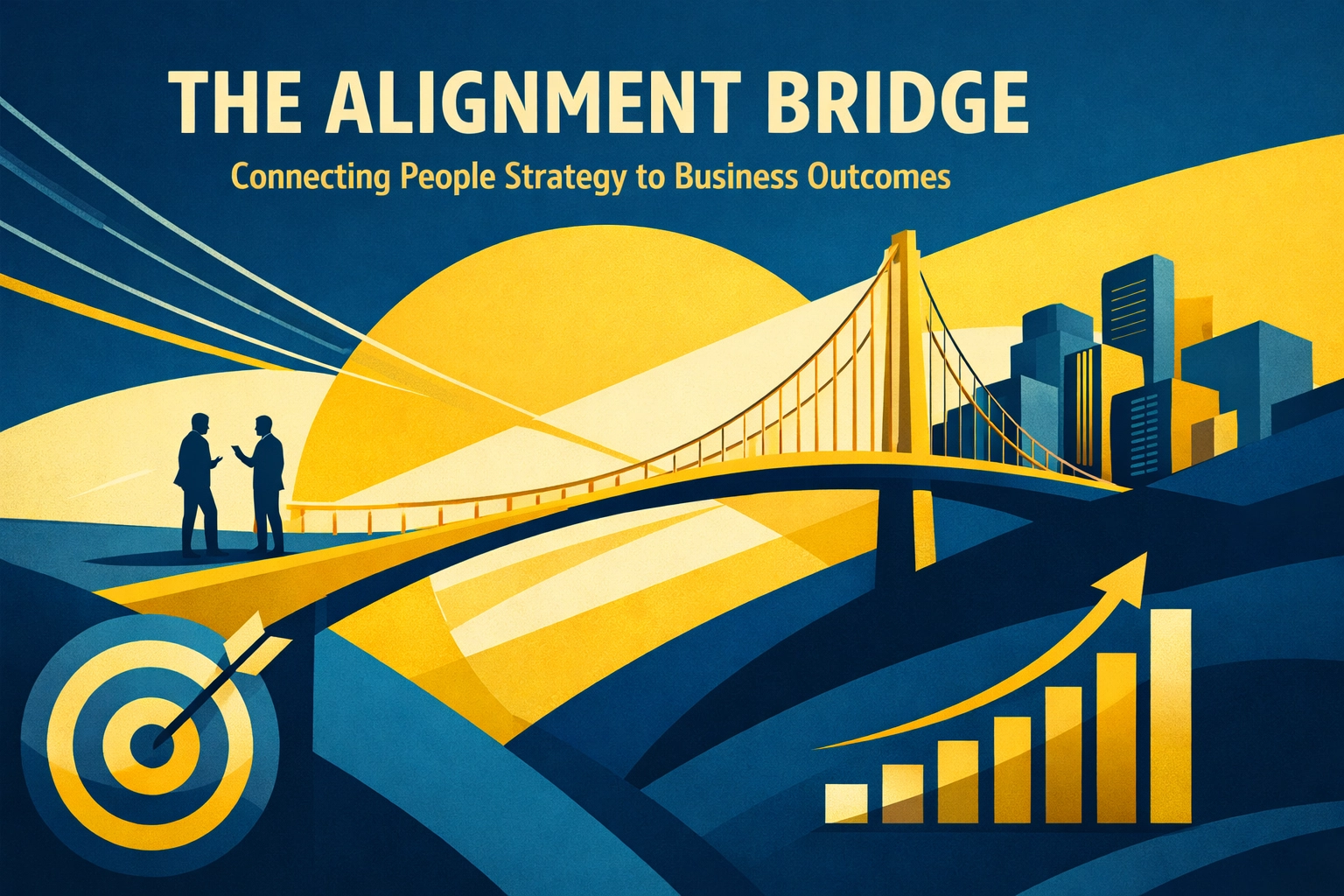
This is Part 3 of our 8-part series on People Strategy. In the first two entries, we talked about the foundational shift of treating HR as a competitive advantage. Today, we’re talking about the bridge. We’re going to look at how to ensure your people initiatives aren't just "nice-to-have" perks, but are the direct drivers of your most ambitious business outcomes.
The 60% Performance Gap
Let’s start with a number that should keep every CEO awake at night: 60%.
Research shows that strategic alignment accounts for roughly 60% of the performance gap between high-performing and low-performing organizations. That is a staggering amount of money left on the table simply because the people in the building aren't moving in the same direction as the goals on the whiteboard.
When I talk to growth-stage CEOs, the frustration is almost always the same: "We have the plan. We have the funding. But for some reason, we aren't moving fast enough."
The reason isn't usually a lack of talent. It’s a lack of connection. When nearly 70% of employees say their company’s strategy is unclear or unknown, you don't have a communication problem, you have an alignment problem. You are essentially asking your team to win a race while they are wearing blindfolds.
Moving from "HR Goals" to "Business Goals Achieved Through People"
To build the Alignment Bridge, we have to stop thinking about HR goals. HR goals are things like "reduce turnover by 10%" or "complete annual reviews by March." Those are fine, but they are internal metrics. They don't tell the full story.
Instead, we need to talk about Business Goals Achieved Through People.
If your business goal is to scale revenue by 3x over the next 24 months, your People Strategy shouldn't just be "hire more sales reps." It should be: "Build a high-velocity onboarding engine that reduces time-to-productivity for new reps by 40%."
See the difference? One is a task. The other is a strategic lever tied directly to the top line.

Step 1: Establish Crystal Clarity (The Foundation)
The first stone in the bridge is clarity. This sounds simple, but it’s where most organizations trip.
If you ask five different executives what the most important "Critical Move" for the business is this year, and you get five different answers, your People Strategy is already doomed. You cannot align a thousand people if the top five aren't on the same page.
Clarity means defining:
- What actually drives the business (the unit economics).
- Who our target clients are (and who they aren't).
- What our unique value proposition is.
- The 3–5 key initiatives that must succeed for us to win.
At Rinnovare, we often find that the "labyrinth" of organizational complexity is just a lack of shared definitions. When the leadership team achieves absolute clarity, the "maze" starts to look like a straight line.

Step 2: Cascade and Empower
Once the C-suite is aligned, the next challenge is getting that strategy down into the marrow of the organization.
A lot of leaders think "cascading" means sending a long email or holding an All-Hands meeting with 45 PowerPoint slides. It isn't. Cascading is about translation. It’s about helping a mid-level manager or a front-line engineer understand how their specific daily actions move the needle on the big-picture goals.
When people understand the "why," they don't need to be micro-managed on the "how." This is where efficiency comes from. It’s where speed comes from. If your team is empowered to make decisions because they understand the strategic guardrails, you’ve just removed the biggest bottleneck in your company: you.

Step 3: Encourage, Measure, and Reward Adoption
You get what you measure. And more importantly, you get what you reward.
If you say your strategy is "Customer Obsession," but you reward your sales team solely on new logos regardless of churn, you have a broken bridge. Your People Strategy (the incentive plan) is actively fighting your Business Strategy.
Building the bridge means looking at your performance management and asking:
- Does this system encourage the behaviors we need to win?
- Are we recognizing the people who take aligned actions?
- Are we fairly and quickly addressing the "brilliant jerks" who hit their numbers but destroy the culture and alignment?
Alignment isn't a one-time event; it’s a daily discipline of reinforcing the right behaviors.
The Outcomes of a Solid Bridge
What happens when the bridge is built? It’s not just about "better vibes" in the office. It’s about tangible, bankable results:
- Increased Speed: Decisions happen faster because everyone is using the same playbook.
- Higher Efficiency: Resources aren't wasted on projects that don't actually support the main goal.
- Better Retention: Top talent stays when they feel they are part of a winning, purposeful team.
- Premium Valuation: For PE partners, a company with a high degree of organizational health and alignment is a much safer, more scalable investment.
When your People Strategy is in lockstep with your business outcomes, HR stops being a cost center and starts being a profit driver.
Building Your Bridge
If you’re a CEO of a growth-stage company or a partner at a PE firm, take a look at your current initiatives. Are they "nice-to-haves"? Are they disconnected from your exit strategy or your growth targets?
If the answer is yes, it’s time to stop thinking about HR and start thinking about People Strategy.
At Rinnovare, we specialize in helping leadership teams bridge that gap. We don't do fluff, and we don't do jargon. We focus on evidence-based solutions that turn your talent into a measurable competitive advantage.
Feel free to reach out to us or explore our services to see how we can help you align your team for the next phase of growth.
The bridge between where you are and where you want to be is built with your people. Make sure it's strong enough to carry the weight of your goals.

This is Part 3 of our 8-part series on People Strategy. Stay tuned for Part 4, where we’ll dive into the mechanics of building a high-performance culture that survives the scale-up phase.