In the high-stakes world of Private Equity (PE), the traditional approach to Human Resources has long been a game of "defense." During the due diligence phase, the HR checklist is typically a hunt for red flags: unfunded pension liabilities, pending litigation, non-compliance with labor laws, or messy cap tables. While necessary, this defensive posture only protects the baseline value. It doesn't grow it.
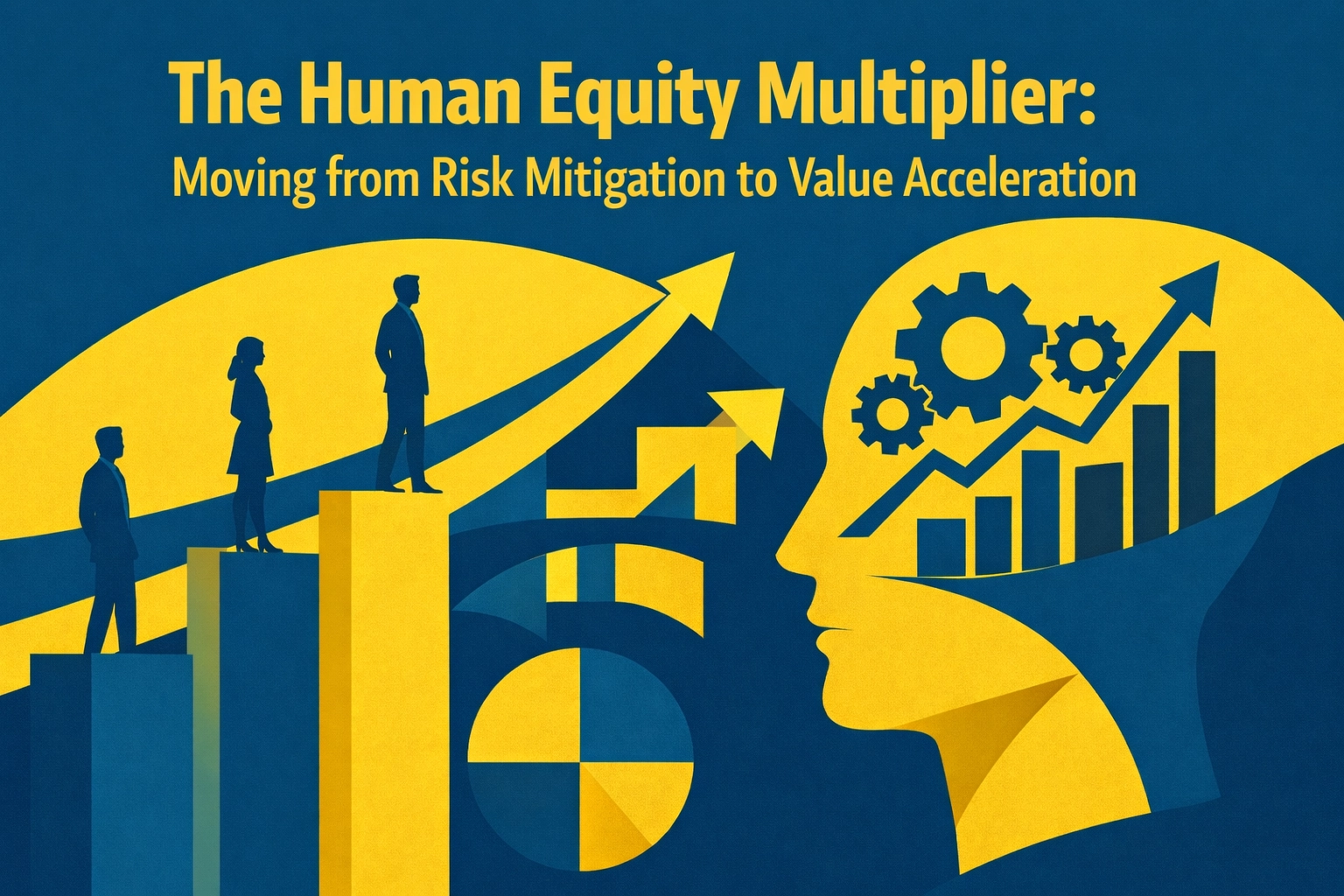
As we move through 2026, the most sophisticated PE firms are shifting their strategy. They are realizing that human capital is not just a risk to be managed, but the single greatest lever for Value Acceleration. This is the Human Equity Multiplier.
By moving from risk mitigation to active engineering of the HR operating model, firms can significantly boost their exit multiples. It is the transition from ensuring the wheels don't fall off to building a high-performance engine designed specifically to win the race.
The Limitation of Defensive Due Diligence
Traditional HR due diligence is transactional. It answers the question, "Is this company broken?" It looks at benefits harmonization, payroll stability, and employment contract validity. If the answer is "No, it's not broken," the deal moves forward, and HR is often sidelined until a crisis occurs or it’s time to prepare for an exit.
However, "not broken" is not the same as "optimized for growth." A company can be fully compliant and still suffer from a leadership vacuum, organizational drag, and a toxic culture that erodes enterprise value (EV) every single day. When a PE firm ignores the "offense" of human capital, they leave money on the table.
The Human Equity Multiplier is the strategic application of organizational design and leadership alignment to accelerate the investment thesis. It’s about ensuring that the people and the processes are not just "present," but are actively driving the business toward the desired exit.

Pillar 1: Leadership Alignment and the RQ Diagnostic™
The first step in driving Value Acceleration through human capital is assessing the "Renewal Quotient" of the leadership team. At Rinnovare, we use the RQ Diagnostic™ to move beyond subjective "vibes" and into hard data regarding leadership efficacy.
In many PE-backed firms, the bottleneck isn't the product or the market; it's the friction at the top. When a leadership team is misaligned on the strategy, every decision takes longer, costs more, and carries more risk. The RQ Diagnostic™ identifies these friction points early in the holding period.
By measuring the clarity of roles, the speed of decision-making, and the level of trust within the C-suite, we can quantify the "organizational drag." Removing this drag is the first "multiplier" effect. A leadership team that moves in total synchronization can execute a three-year plan in eighteen months. That velocity is a direct contributor to the exit multiple.
Pillar 2: Engineering the RQ Operating Model™
Once the leadership team is aligned, the focus must shift to the broader organization. Many mid-market firms: the primary targets for PE: have "accidental" operating models. They grew organically, and their processes are a patchwork of legacy systems and "the way we’ve always done it."
To drive Value Acceleration, the HR operating model must be re-engineered to support the specific investment thesis of the PE firm. If the goal is a rapid roll-up strategy, the HR model needs to be a "plug-and-play" engine for M&A integration. If the goal is organic tech-driven growth, the model needs to prioritize talent density and rapid innovation cycles.
This is where the RQ Operating Model™ comes into play. We design a bespoke framework that aligns the company’s human architecture with its financial goals. This includes:
- Talent Density Optimization: Ensuring the right people are in the "Value-Added" roles, not just the "High-Level" roles.
- Decision Rights: Clarifying who owns what, reducing the "meeting-about-a-meeting" culture that kills productivity.
- Performance Accountability: Moving away from soft engagement metrics and toward "Analytical Stewardship": where every role is tied back to the enterprise value.

Pillar 3: The Operating Cadence Audit as a Catalyst
One of the most common issues we see in PE-backed firms is a "tangled" operational rhythm. Revenue might be high, but internal clarity is zero. This usually manifests as a CEO who is "playing whack-a-mole" with daily crises rather than focusing on the exit.
A standalone Operating Cadence Audit acts as a circuit breaker. By examining how information flows through the company: from the boardroom to the front line: we can identify where the "signal" is being lost.
A high-velocity firm has a predictable, rigorous cadence. Meetings are not for "updates" (which should be handled via dashboard) but for "decisions." When you untangle a messy cadence, you reclaim 20-30% of the leadership team's time. In a PE environment, that time is the currency of value creation.
Moving from "Employee Engagement" to "Analytical Stewardship"
The traditional HR world is obsessed with "Employee Engagement" scores. While morale matters, it is often a lagging indicator and a weak metric for PE firms. You can have a "happy" workforce that is taking the company off a cliff.
The Human Equity Multiplier replaces "fluff" with Analytical Stewardship. This is the core of the Rinnovare manifesto. It’s about evidence-based renewal. We look at HR through the lens of a CFO.
- What is the revenue per employee?
- What is the "Human Capital ROI"?
- How much is leadership friction costing us in delayed project delivery?
By applying analytical rigor to human dynamics, we turn HR from a "cost center" into a "value creator." We are no longer just managing people; we are stewarding the most expensive and most impactful asset on the balance sheet.

The Math of the Multiplier
How does this actually impact the exit? Consider two identical companies in the same sector.
Company A follows the traditional PE path. They fix the finances, bolt on a few acquisitions, and keep HR in a "compliance" box. They exit at an 8x multiple.
Company B applies the Human Equity Multiplier. They use an RQ Diagnostic™ to align the team in month one. They implement an RQ Operating Model™ that scales without adding overhead. They use an Operating Cadence Audit to ensure the CEO is focused on strategy, not fires.
By the time of the exit, Company B has higher talent density, faster product cycles, and a leadership team that has proven they can execute with precision. They don’t just have better numbers; they have a better "machine." Strategic buyers will pay a premium for a machine that is self-sustaining and high-velocity. Company B exits at a 10x or 12x multiple.
That 2x-4x delta is the Human Equity Multiplier.
Implementing the RQ Roadmap™
Transitioning from "defense" to "offense" requires a plan. We call this the RQ Roadmap™. It is a phased approach that ensures the human capital strategy is always one step ahead of the business growth.
- Assess (The Diagnostic): Identify the friction.
- Architect (The Operating Model): Build the engine.
- Accelerate (The Cadence): Increase the velocity.
This isn't about "fixing" people; it's about "engineering" the environment in which people work. When the environment is designed for high performance, Value Acceleration becomes the natural byproduct.
Conclusion: The New Standard for PE HR
In the competitive landscape of 2026, simply "managing risk" is no longer enough to secure top-tier returns. The firms that win are those that treat human equity with the same level of financial and operational rigor as they do their capital structures.
At Rinnovare, we specialize in this transformation. We help PE firms move beyond the "defense" of due diligence and into the "offense" of value creation. Whether it's through a senior Interim CHRO acting as a "circuit breaker" or a full-scale RQ Operating Model™ implementation, our goal is the same: to maximize the exit multiple by unlocking the power of the Human Equity Multiplier.
The era of HR as a administrative function is over. The era of HR as a primary driver of Value Acceleration has arrived.
To learn more about how we transform HR into a competitive advantage, contact Rinnovare today or explore our full range of services.
