Primary Category: Cross-Border Leadership
Secondary Category: CEO Advisory
The Moment That Matters
You’ve successfully navigated the first phase of U.S. expansion. The product-market fit is confirmed, the initial revenue is flowing, and your European headquarters is satisfied with the early trajectory. You decide it’s time to pour fuel on the fire. You double the headcount in your New York or Chicago office within six months.
Then, the "wheels" start to wobble.
Decisions that used to take ten minutes now take ten days. Your original U.S. team: the "pioneers": seems frustrated by the new hires. The new hires are confused about who actually has the authority to sign off on a budget. You, as the leader, find yourself in more meetings than ever, yet you feel less in control of the outcome.
This isn't a talent problem. It isn't a market problem. It is a failure of the hidden infrastructure of growth. When U.S. teams break during scaling, it’s usually because the company tried to scale its output without scaling its Renewal Quotient (RQ).
The Scaling Paradox: Why More People Equals Less Velocity
In the early stages of a U.S. expansion, leadership is personal. You know everyone’s name, you see every email, and you are the ultimate arbiter of every decision. This "founder-led" energy is essential for survival, but it is toxic for scale.
The research is clear: teams in the U.S. break because companies add headcount without simultaneously upgrading the systems, governance structures, and organizational culture needed to support them. We call this the "Drift Tax™": the invisible cost of misalignment that eats your enterprise value from the inside out.
When you scale, you aren't just adding people; you are adding complexity. If your operating model remains informal, that complexity manifests as decision bottlenecks.
Your U.S. team begins to "learn" that they shouldn't move without your approval. Talented American executives, hired for their initiative, find themselves waiting for "the home office" or "the CEO" to weigh in on tactical details. This creates a false sense of control for the leader: you feel busier and more important: while the organization enters a cycle of constant escalation and slowing momentum.

The Three-Layer Stack: Structural, Emotional, and Application
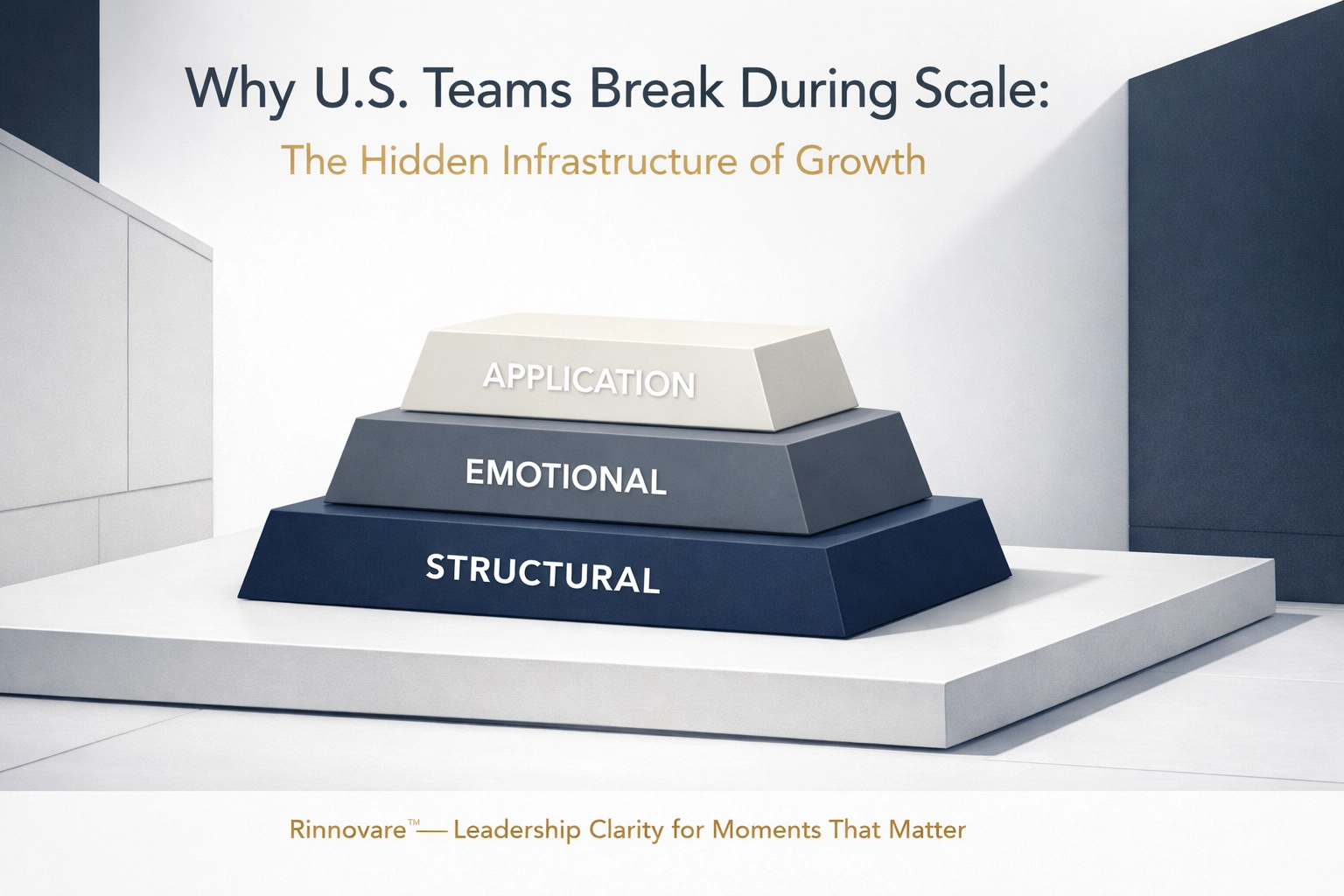
At Rinnovare, we look at organizational health through a Three-Layer Stack. When a U.S. team breaks during scale, we can usually trace the fracture to one of these layers:
- The Structural Layer (The Hard System): This is the RQ System™. It involves your RQ Operating Model™, decision rights, and accountability frameworks. If you haven't defined who owns what in the U.S. versus the European HQ, the structure will buckle under the weight of new hires.
- The Emotional Layer (The Soft System): This is The Hidden Emotional Contract™. It covers trust, dignity, and belonging. When you scale, the "old guard" often feels their status is threatened, while new hires feel like outsiders. If this isn't managed, your culture becomes a liability rather than an engine.
- The Application Layer: This is the day-to-day work: HR transformation, interim leadership, and tactical execution. Most CEOs try to fix scaling issues here, but you cannot fix a structural or emotional problem with an application-layer "patch."
The CEO Test: Is Your U.S. Team Reaching a Breaking Point?
As a Principal at Rinnovare, I often ask CEOs to run a quick pattern-recognition check. If you answer "yes" to more than two of these, your growth infrastructure is currently failing:
- The Re-litigation Loop: Are decisions that were "finalized" last week being reopened because someone in Europe or a new hire wasn't in the room?
- Shadow Decisions: Are your U.S. managers making "off-the-books" calls because the official process is too slow or opaque?
- The Hero Culture: Does everything still rely on one or two "heroes" to get across the finish line, rather than a repeatable process?
- Talent Churn at the 12-Month Mark: Are your high-performing U.S. hires leaving just as they hit their stride, citing "bureaucracy" or "lack of clarity"?
System Failure, Not Talent Failure
It is a common mistake to blame the people. "Maybe we hired the wrong VP of Sales," or "The U.S. team just doesn't understand our culture."
In reality, high-performing teams are calibrated systems. When you add headcount without scaling governance, you create silos. Your core team becomes trapped in unstructured onboarding, and your new hires lack the architectural context to make good decisions.
This is where the RQ Diagnostic™ becomes essential. It identifies the 12 signals that your leadership system is quietly destroying enterprise value. By measuring your Renewal Quotient (RQ), you can see where the structural layer (the "hard" system) is failing to support the emotional needs of the team.

Visual Suggestion: A diagram showing the Rinnovare Three-Layer Stack: Structural Layer (RQ System™) at the base, Emotional Layer (The Hidden Emotional Contract™) in the middle, and Application Layer at the top.
The Cross-Border Friction Point
For European leaders, the U.S. market presents a unique cultural challenge. U.S. employees typically expect a higher degree of autonomy and a very clear "What’s in it for me?" career path.
When a European HQ tries to maintain a "command and control" style from across the Atlantic, it violates The Hidden Emotional Contract™. The U.S. team feels micro-managed, and the European HQ feels the U.S. team is "going rogue."
Scaling requires moving from personal trust (I trust you because I know you) to systemic trust (I trust the process we’ve built together). This shift is facilitated by the RQ Roadmap™, which aligns the leadership rhythm and operating cadence so that everyone: on both sides of the ocean: knows how the game is played.
Protecting Enterprise Value
From a Private Equity or investor perspective, a "broken" team is a massive risk to enterprise value. Every week spent in a decision bottleneck is a week of lost market share and wasted burn rate.
If you are a growth-stage CEO, your job is no longer to be the best "operator." Your job is to be the architect of the leadership system. You must ensure that the "Hidden Infrastructure": the combination of the RQ Operating Model™ and The Hidden Emotional Contract™: is robust enough to handle the next 100 employees.

The Path Forward
Scaling doesn't have to be a series of breakages. It can be a series of renewals. By shifting your focus from "hiring more people" to "upgrading the system those people work within," you transition from a fragile startup to a resilient enterprise.
The transition from Series A to Series B and beyond is not about doing more of what made you successful; it’s about doing things differently. It’s about building an organization that can scale the product, rather than a leader who is trying to scale themselves.
If you’re facing this moment, the next step is a 30-minute clarity call.
Let's discuss how the RQ Diagnostic™ can help you identify the hidden fractures in your U.S. team before they become permanent breaks.