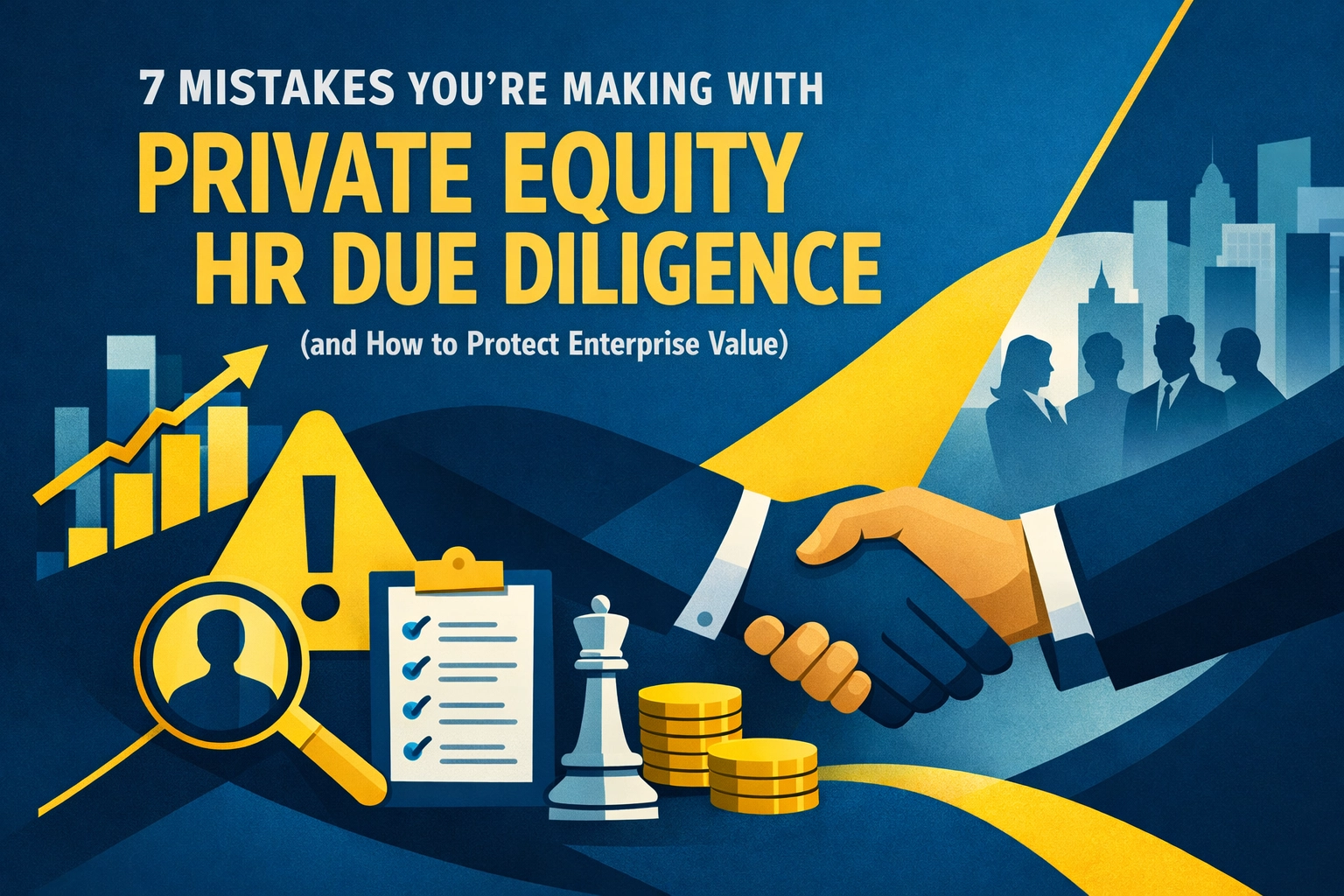
In the high-stakes world of Private Equity, the first 100 days are everything. You’ve crunched the numbers, scrutinized the EBITDA, and validated the market position. But as Philip Curran, Founder of Rinnovare, often observes, deals don’t usually fail because the spreadsheets were wrong. They fail because the "People Debt" was too high to execute the investment thesis.
Standard HR due diligence is often treated as a legal and administrative checkbox. You check the 401(k) compliance, look at the benefit plan costs, and ensure there are no pending labor lawsuits. That’s not due diligence; that’s an audit. Real HR due diligence: the kind that protects and creates enterprise value: requires looking under the hood at the organizational engine.
If you are relying on "standard" diligence, you are likely missing the very things that will kill your 100-day plan. Here are the seven most common mistakes PE firms make during HR due diligence and how to pivot toward a value-driven approach.
1. Treating HR as an Administrative Checkbox
The biggest mistake is viewing HR solely through the lens of cost and compliance. While knowing the burn rate and benefit liabilities is essential, it tells you nothing about the company’s ability to grow.
Enterprise value is driven by the execution of a strategy. If the HR function is purely transactional: focused on payroll and "policing" employees: it won't have the strategic muscle to support a rapid scale-up or a complex integration. At Rinnovare, we move beyond the admin. We look at whether the HR function is a "Value Protector" or a "Value Creator." If they are stuck in the weeds of paperwork, your 100-day plan is already at risk.
2. Ignoring "People Debt"
Just as software has technical debt, organizations accrue "People Debt." This is the hidden liability of deferred talent management. It manifests as:
- Critical roles filled by "placeholder" hires who can't scale.
- Toxic sub-cultures in key revenue-generating departments.
- A lack of succession planning for the "genius" founder who is supposed to exit in 24 months.
Standard diligence misses this because "People Debt" doesn't show up on a P&L. It shows up three months after the close when your key engineers quit or your sales head can't adapt to the new reporting cadence. Identifying this debt early allows you to price it into the deal or, better yet, build the repayment of that debt into your RQ Roadmap™.

3. Misjudging Leadership Cohesion
PE firms are great at evaluating a CEO. They are less consistent at evaluating the cohesion of the leadership team. A group of high-performing individuals is not the same thing as a high-performing team.
In the heat of a deal, leadership teams often "play nice" to get the transaction across the finish line. Once the ink is dry and the pressure of the new growth targets hits, the cracks emerge. We look for alignment: not just on the "what," but on the "how." If the CFO and the COO have fundamentally different views on operational rigor, that friction will act as a tax on every dollar of capital you deploy.

4. Overlooking the "RQ" Factor
At Rinnovare, we utilize the RQ System to evaluate organizational readiness. One of the most common mistakes is failing to perform a deep diagnostic on the human capital infrastructure.
Most firms ignore the "Relationship Quotient" and "Relevance" of the current HR model. Through our RQ Diagnostic™, we identify the gaps between where the organization is today and where it needs to be to hit the exit multiple. Without a diagnostic that measures more than just headcount and turnover, you are flying blind into the integration phase.
5. Assuming the Operating Model is Scalable
"What got you here won't get you there" is a cliché for a reason: it’s true. Many target companies have an HR operating model designed for a $50M business, even though the PE thesis is to take them to $250M.
Standard diligence rarely asks: "Can this HR structure support a 3x increase in hiring volume?" or "Does the current performance management system drive the behaviors required for a high-growth environment?" Failing to assess the RQ Operating Model™ during the pre-close or early post-close phase leads to "organizational organ rejection" when new processes are introduced too quickly or without the right foundation.

6. Relying Solely on Data Room Materials
The data room is a curated reality. It tells the story the seller wants you to hear. Mistake number six is failing to conduct deep-dive interviews with the "middle" layer of management.
The C-suite knows the script. The Directors and VPs know the reality. By ignoring the cultural sentiment at the mid-level, you miss the "cultural rot" that often hides behind a polished executive presentation. We focus on the "operating cadence": how work actually gets done: to determine if the organization has the discipline to meet the reporting and performance standards of a PE-backed entity.
7. The Absence of a Post-Close HR Roadmap
The most critical mistake is ending "HR diligence" at the close. The moment the deal is done, the clock starts. If you don't have a specific RQ Roadmap™ for the first 100 days, you will spend those months being reactive.
A proper HR roadmap identifies exactly which "People Debt" items need to be paid down first, which leadership gaps must be filled, and how the HR function will transition from an administrative cost center to a strategic partner. Without this, HR remains a "support function" rather than the engine of value creation.
How to Protect Enterprise Value
To avoid these mistakes, PE firms must shift their perspective. Human Resources is not a "soft" science; it is a critical component of the investment’s infrastructure. If the people systems are broken, the financial systems eventually will be too.
At Rinnovare, we specialize in helping Private Equity firms and their portfolio companies navigate these complexities. Whether it’s through an initial RQ Diagnostic™ during the due diligence phase or building a comprehensive RQ Operating Model™ post-acquisition, our goal is to ensure that your "People Strategy" is as rigorous as your "Financial Strategy."
Don't let "People Debt" kill your exit value. Start treating HR due diligence as a value-creation exercise rather than a compliance hurdle.
Ready to see what’s actually under the hood?
Drop us a line! Let's discuss how we can help you protect your investment and accelerate your growth.

For more insights on transforming HR into a competitive advantage, visit our About Page or explore our full range of Professional Services.