
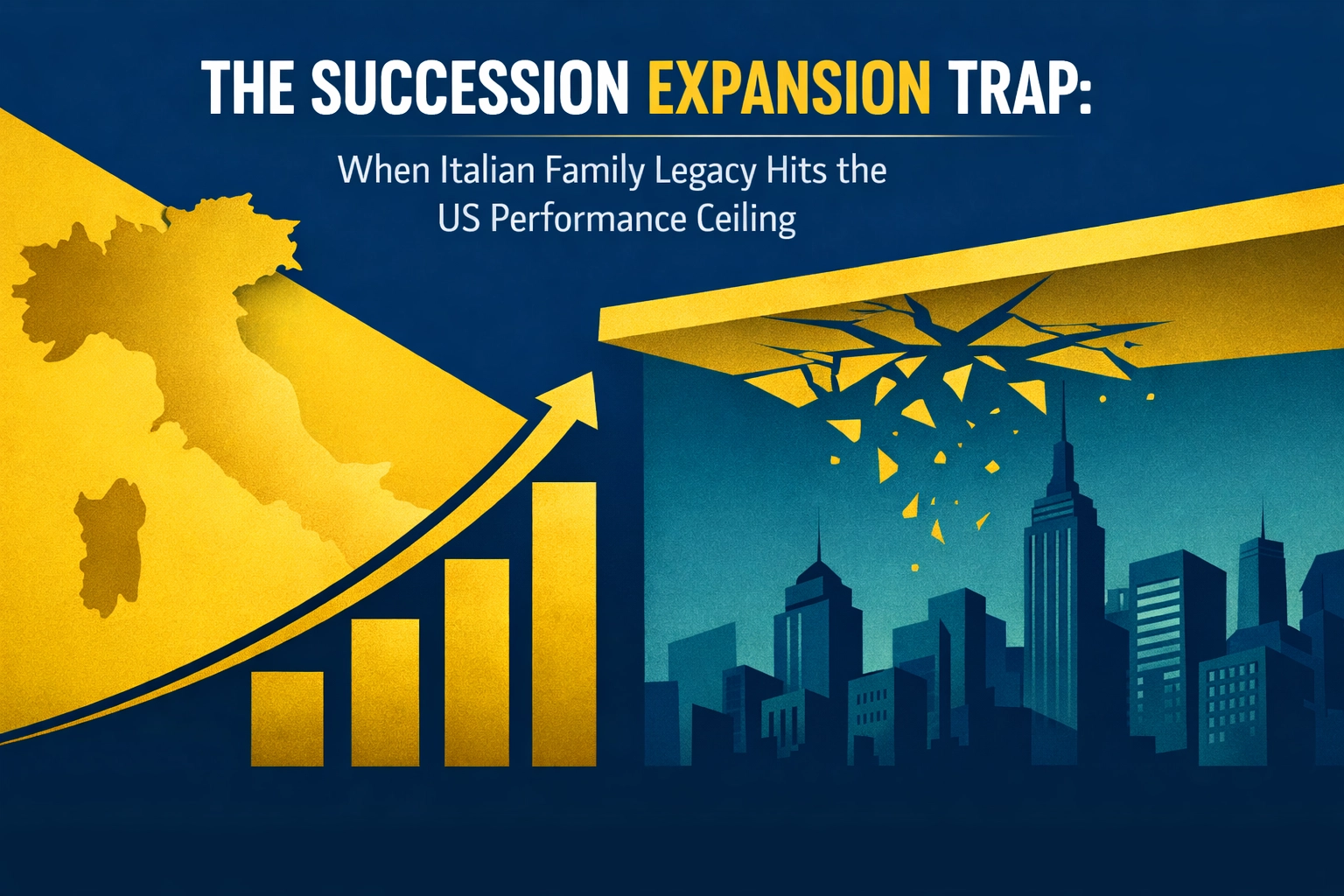
For many Italian family-owned enterprises, the United States is the ultimate frontier. It is the market that promises to transform a successful regional "dynasty" into a global powerhouse. Yet, for many of these firms, the journey across the Atlantic coincides with a more delicate internal transition: the passing of the torch from the founding patriarch or matriarch to the second generation.
This convergence creates what we at Rinnovare call the Succession Expansion Trap. It is a "perfect storm" where the cultural weight of European family legacy collides head-on with the cold, data-driven performance requirements of the US market. When these two massive shifts happen simultaneously, the organization doesn't just face a strategy problem: it faces an identity crisis that can stall growth, alienate top US talent, and threaten the family legacy itself.
The Collision of Two Worlds: Dynasty vs. Delivery
In our previous exploration of "Dynasty vs. Delivery," we identified the fundamental friction between leadership based on historical loyalty and leadership based on measurable output. In the context of an Italian firm entering the US, this friction is magnified.
The Italian model is often built on l'intesa: a deep, intuitive understanding between the founder and their long-term lieutenants. Decisions are frequently made around a dinner table or in private conversations where "feel" and historical context outweigh spreadsheets. This is the Dynasty model. It values continuity, personal loyalty, and the preservation of the family name above all else.
Conversely, the US market is the world capital of the Delivery model. US investors, partners, and employees expect transparency, high-velocity decision-making, and a culture of radical accountability. In the US, your "pedigree" or family history might get you a meeting, but only your performance metrics will keep you in the room.
When the second generation takes the reins during a US expansion, they are caught between these two opposing forces. They are expected to honor the founder’s "way of doing things" while simultaneously satisfying a US workforce that has no emotional attachment to the family’s history in Milan or Florence.

The Three Pillars of the Succession Expansion Trap
To navigate this trap, leadership must first recognize the three primary fractures that occur during this transition.
1. The Decision-Making Paradox
In the home office, the founder is often the "ultimate oracle." Every significant decision flows through them. However, a US expansion requires localized agility. If the second-generation leader in New York has to call Italy for every hire or marketing spend, the US operation will move too slowly to compete. The trap is sprung when the founder refuses to cede control, viewing the expansion as their "final legacy" rather than the second generation’s "new beginning."
2. The Talent Rejection System
US-based executives are highly mobile and performance-oriented. They join companies to build things and be rewarded for results. If they enter an Italian firm and find that the real power resides in "bloodline" rather than "bottom line," they will leave. We often see Italian firms struggle with high turnover in their US C-suite because the internal HR operating model is designed to protect the family hierarchy rather than empower professional management.
3. The Performance Ceiling
Italian firms often reach a "performance ceiling" in the US because they attempt to export their domestic culture wholesale. The "command and control" style that worked in a centralized Italian factory does not translate to a decentralized, competitive US sales and tech landscape. Without a clear Leadership Alignment strategy, the second generation ends up managing the "mess" of cultural friction rather than driving market share.

Engineering the "Circuit Breaker"
When the expansion begins to stall and family tensions rise, the organization needs more than a new marketing plan; it needs a "Circuit Breaker." This is where the concept of the Interim CHRO or an external advisory hand becomes critical.
The goal of this intervention is to stop the "overheating" of the business strategy. By implementing a neutral, evidence-based perspective, a firm can begin to untangle the emotional knots of succession from the operational needs of expansion. At Rinnovare, we use principles from our RQ™ system to identify where the system is failing.
While a full RQ Diagnostic™ can provide the high-level data needed to see these fractures, the immediate tactical need is often a reset of the "Psychological Contract" between the founder and the successor.
From Emotional Stewardship to Analytical Stewardship
To survive the Succession Expansion Trap, the second generation must transition the firm from Emotional Stewardship (protecting feelings and traditions) to Analytical Stewardship (protecting the brand's value through rigorous performance).
This doesn't mean abandoning the Italian heritage. On the contrary, the "Made in Italy" brand is a massive competitive advantage. However, the delivery of that brand must be modernized. This involves:
- Establishing an RQ Operating Model™: Defining clear roles, responsibilities, and decision-rights that apply in both the Italian headquarters and the US subsidiary.
- Professionalizing the HR Function: Moving beyond "payroll and compliance" and turning HR into a strategic lever that attracts and retains the best US talent.
- The 7-Day Rule: Implementing protocols to resolve cross-border conflicts quickly. If a decision between the US office and the Italian board takes longer than seven days, the "performance tax" becomes too high to sustain.

Case Study: The Hidden Cost of "Doing it the Family Way"
We recently observed a $400M Italian industrial firm attempting to launch its flagship product in the US. The founder’s son was appointed CEO of the US division. However, the founder maintained veto power over every US hire.
The result? The US division missed three consecutive product launch windows because the founder didn't "trust" the US-based marketing experts the son had recruited. The "Succession Expansion Trap" was in full effect: the son felt undermined, the US talent felt ignored, and the founder felt the US market was "too difficult."
The solution wasn't a better product; it was an RQ Roadmap™. By documenting the specific "rules of engagement" for the US market and creating a separate performance-based incentive structure for the US team, we were able to provide the founder with the "data-driven comfort" he needed to step back. The son was finally empowered to lead, not just as a family member, but as a CEO.
Conclusion: Renewal is the Only Path Forward
Expanding into the US while navigating a generational succession is perhaps the most difficult maneuver an Italian family firm will ever attempt. The trap is real, and the stakes are the survival of the enterprise.
At Rinnovare, we believe that Renewal is not about discarding the past, but about re-engineering the organization to honor that past through future performance. By aligning leadership, professionalizing the HR operating model, and moving toward analytical stewardship, Italian firms can break through the performance ceiling and turn their family legacy into a global standard.
If your firm is facing the dual challenge of international growth and leadership transition, it is time to stop "managing the mess" and start transforming your HR into a competitive advantage.
