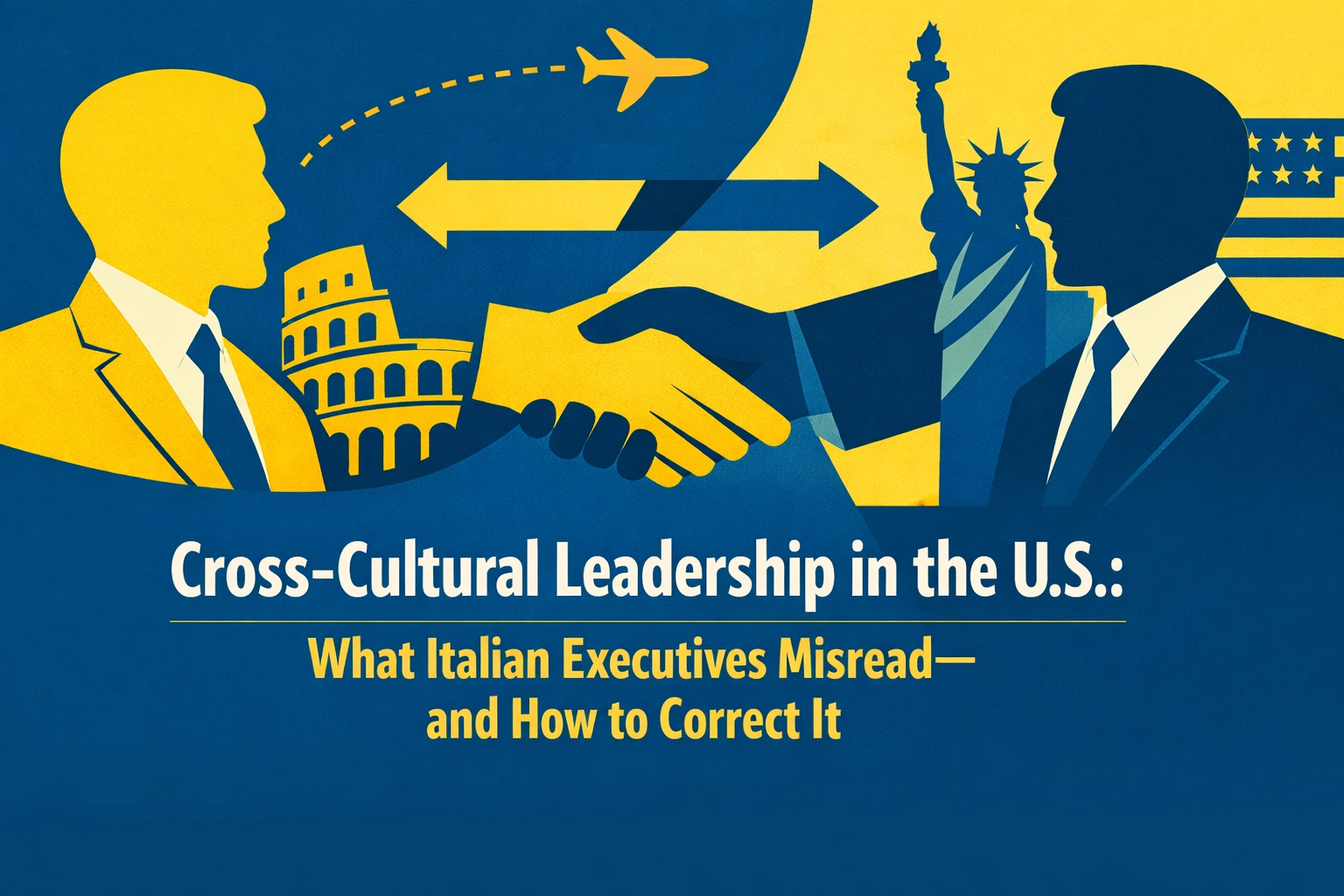
For the ambitious Italian organization, the United States represents more than just a market; it is the ultimate proving ground. The allure of scale, the depth of capital, and the prestige of "Made in Italy" creating a foothold in Manhattan or Silicon Valley is a powerful motivator. Yet, for every success story, there are three tales of quiet retreat, not because the product failed, but because the leadership model did.
The transition from a Mediterranean operating environment to an American one is often underestimated. Italian executives, frequently seasoned in high-context cultures where relationships, history, and "Bella Figura" dictate the pace of business, often find themselves adrift in the high-velocity, low-context, and strictly transactional environment of the U.S.
At Rinnovare, we act as the strategic translator. We don’t just bridge the language gap; we bridge the operating gap. Success in the U.S. requires more than a localized marketing plan; it requires an overhaul of how leadership is exercised, how decisions are made, and how accountability is enforced.
The Transparency Trap: Directness vs. Diplomacy
One of the first shocks for Italian leadership in the U.S. is the nature of communication. In Italy, business is an art of nuance. Criticism is often wrapped in layers of professional courtesy, and "no" is rarely said directly. This is the hallmark of a high-context culture where maintaining social harmony is as important as the bottom line.
In contrast, American business culture is aggressively direct. To an Italian executive, a U.S. colleague’s brevity can feel dismissive or even disrespectful. To the American, the Italian executive’s long, discursive meetings and indirect feedback feel like a lack of clarity or, worse, a lack of competence.
This "denial gap" is what we call The Bella Figura Fallacy. When Italian leaders prioritize "saving face" over addressing a performance issue directly, the American team loses trust. In the U.S., transparency is the currency of leadership. If you cannot speak plainly about what is failing, you cannot lead an American workforce.

Speed as a Strategy: The End of the Endless Consultation
In the Italian corporate structure, decision-making is often a communal, consultative process that eventually moves upward to a centralized authority. It is thorough, considered, and slow. There is a psychological safety in this consensus-driven model, often rooted in a desire for stability.
The American market, however, operates on a different clock. Here, speed is a competitive advantage. American employees expect to be empowered to make decisions within their remit. They value individual initiative over top-down permission.
When an Italian headquarters insists on reviewing every minor hire or operational expenditure in the U.S. branch, it creates a bottleneck that kills momentum. This is where the "Posto Fisso" mindset: a longing for structural permanence and slow-moving stability: clashes with the "fail fast" reality of the U.S. expansion. To succeed, Italian leaders must shift from a model of permission to a model of alignment.
Hierarchy vs. Flatness: Misinterpreting Empowerment
Italian organizations are traditionally hierarchical. The "Dottore" or "Presidente" carries a specific weight of authority that is visible and respected. In the U.S., hierarchies are often functionally flat. While the CEO is the boss, an intern might challenge a strategy in an open meeting.
Italian executives often misread this informality as a lack of discipline. They may respond by asserting authority more rigidly, which only alienates the American talent they worked so hard to recruit.
The correction lies in understanding that American respect is earned through results and transparency, not titles. At Rinnovare, we help executives navigate The Silence of the Boardroom, ensuring that the leadership team is aligned on how they will lead before the first American employee is even onboarded.

The Legal and HR Shock: At-Will vs. Protected
Perhaps the most jarring transition for Italian executives is the legal landscape of American employment. Coming from a system where labor laws are protective and dismissal is a long, arduous process, the concept of "at-will" employment feels like a superpower.
However, this flexibility is a double-edged sword. While it is easier to part ways with underperformers, the lack of traditional "protection" means that the burden of culture and retention falls entirely on leadership. In the U.S., people leave managers, not companies. If the leadership style is perceived as archaic or overly controlling, your best talent will walk across the street to a competitor before you’ve finished your morning espresso.
Furthermore, the U.S. regulatory environment regarding HR: compliance, DEI, and litigation: is a minefield. Many Italian firms treat HR as an administrative function (payroll and contracts). In the U.S., HR must be a strategic partner. This is why our CHRO advisory services are critical for international firms; we provide the enterprise-level strategy that prevents localized HR errors from becoming hard liabilities for the parent company.
The Solution: A Diagnostic Approach to Expansion
Expansion is not a "gut feeling" exercise. It is an architectural one. At Rinnovare, we move Italian firms away from the "trial and error" phase of expansion and into a structured framework of discipline.
We utilize the RQ™ system to ensure the organization is ready for the weight of the U.S. market. This isn't just about cultural sensitivity training; it's about building a leadership system that survives the first 180 days.
- RQ Diagnostic™: We begin by measuring the gap between the Italian headquarters' expectations and the reality of the U.S. operating environment. We identify where "Organizational Drift" is likely to occur: those areas where clarity on roles and decision rights is missing.
- RQ Operating Model™: We re-architect the leadership structure. This involves defining the specific interface between Italy and the U.S., ensuring that authority is delegated effectively while maintaining strategic control.
- RQ Roadmap™: We build the execution plan. This includes the operating cadence: how meetings are run, how performance is measured, and how the "transatlantic" culture is intentionally built.

The "Translator" of Operating Discipline
The goal of Rinnovare is to turn HR from an administrative burden into a competitive advantage. For the Italian executive, this means becoming a "bi-cultural" leader: one who retains the passion and vision of the Italian spirit but executes with the precision and speed of an American operator.
We help you avoid the common pitfalls:
- The Over-Parenting Trap: Managing the U.S. office like a small satellite rather than an independent growth engine.
- The Communication Void: Assuming that silence from the U.S. team means everything is going well (it usually means the opposite).
- The Value Alignment Gap: Failing to translate the "why" of the company into a language that motivates American workers.
Expanding into the U.S. is a bold move. It requires a partner who understands the nuances of the Mediterranean boardroom and the ruthlessness of the American market.
If you are noticing a loss of momentum in your expansion, or if your U.S. leadership team feels "out of sync" with headquarters, it is likely not a talent issue: it is an alignment issue.
The "Made in Italy" brand is a formidable asset. Don't let an outdated operating model be the thing that devalues it.

Ready to Align Your Transatlantic Leadership?
The bridge between Milan and New York is paved with strategic clarity. If you are ready to move beyond cultural friction and into high-performance execution, let's talk about how the RQ™ system can de-risk your expansion.
Explore our HR Transformation Consulting or Contact Philip Curran directly to begin your RQ Diagnostic™.
