The Moment That Matters
It’s 3:00 PM on a Tuesday. Your Head of HR, a high-performer you’re grooming for a C-suite role, is on their fourth "urgent" call of the week with the buyer of the division you sold three months ago. They aren’t discussing high-level integration or strategic alignment. They are troubleshooting a payroll glitch for 400 employees who no longer work for you.
Meanwhile, the talent strategy for your actual core business: the one that is supposed to drive your 2026 growth roadmap: has sat on their desk untouched for three weeks.
This is the moment the "clean" carve-out reveals itself as a lie. You realize that your top 10% talent is spending 40 hours a week acting as a back-office support function for a company you no longer own, while your own strategic engine stalls.
At Rinnovare, we call this the TSA Trap. And in the current deal environment, it’s not just a nuisance; it’s a quiet killer of enterprise value and IRR.
The Unwilling BPO: When Parent Companies Become "Zombies"
In 2026, we are seeing a dangerous trend in Private Equity value creation. Sellers are increasingly becoming unwilling Business Process Outsourcing (BPO) providers for the assets they’ve just offloaded.
On paper, a Transition Service Agreement (TSA) is a bridge: a necessary mechanism to ensure business continuity while the buyer stands up their own infrastructure. In reality, it often becomes a "zombie" support role that traps your best people in a loop of low-value, high-stress work.
According to recent research from our team at Rinnovare, specifically Rachel’s work on "Culture Contagion," the TSA doesn't just drain hours; it drains morale. When your A-players are forced to navigate the "Three-Way Contract" friction: balancing the needs of the seller, the buyer, and the staff caught in between: they begin to suffer from divided loyalties.
They didn't sign up to be a service center for a third party. When their sense of meaning and professional trajectory is sacrificed to fix legacy IT issues for a former subsidiary, they don't just get tired. They leave.

(Placeholder for image representing "The TSA Trap" – a diagram showing talent leakage from a core company to a divested entity)
The Structural vs. Emotional Cost
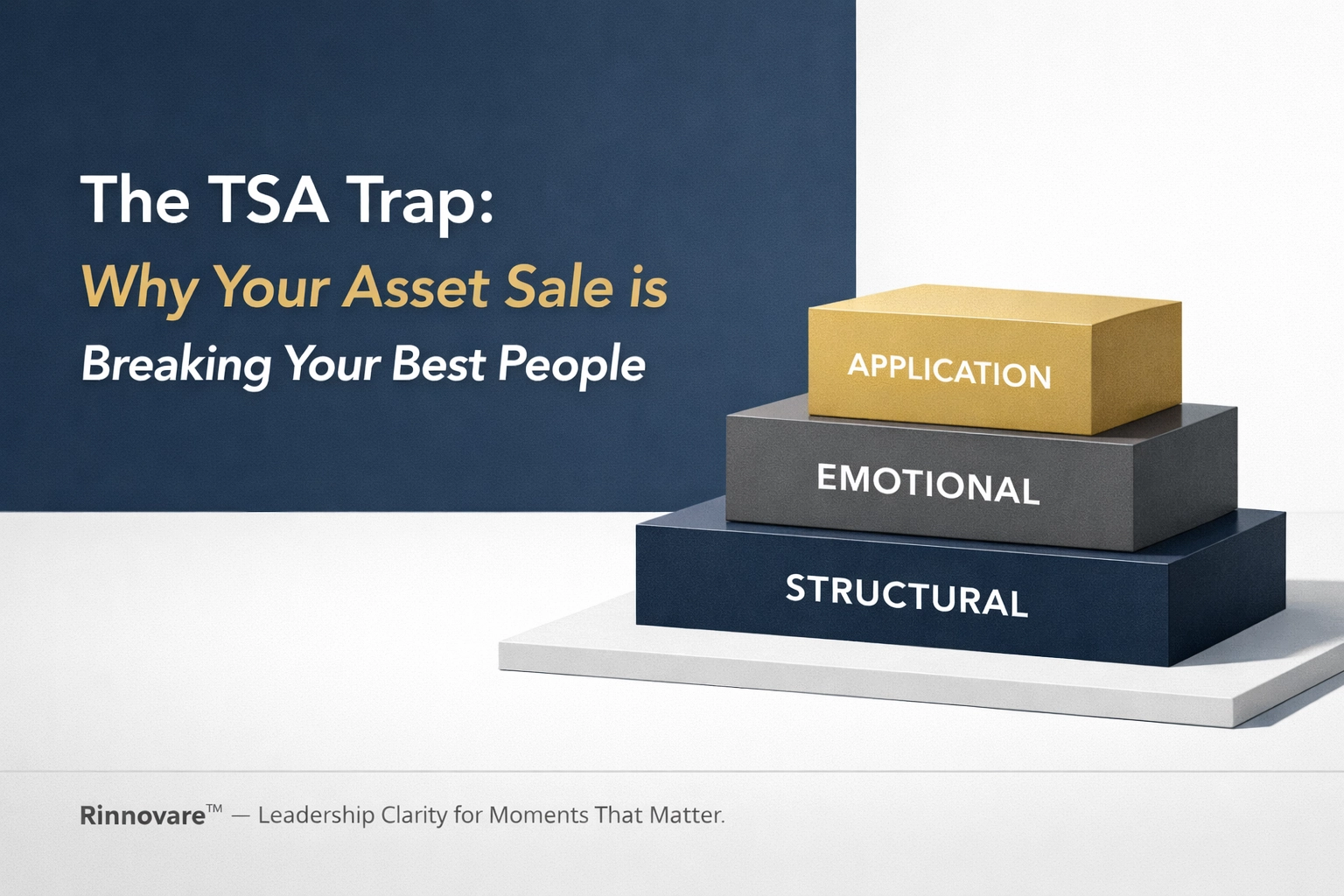
At Rinnovare, we look at every organizational challenge through a Three-Layer Stack:
- The Structural Layer (The Hard System): This is where the RQ System lives. During a TSA, the operating model is often broken. You have "Stranded Leadership Costs" where the leadership system of the parent is still structurally tethered to the divested asset, preventing the remaining organization from reaching its new optimal state.
- The Emotional Layer (The Soft System): This involves the Hidden Emotional Contract (HEC). Your people’s sense of fairness and belonging is tied to the work they do for your company. Forcing them into "zombie" support roles for a buyer violates that contract.
- The Application Layer: This is the day-to-day execution: the interim leadership and advisory work that fixes the mess.
If you only focus on the structural "To-Do" list of the TSA, you ignore the emotional contagion that is rotting your core team from the inside out.
The CEO Test: Are You Trapped?
As a Founder or Principal, you need a quick way to diagnose if your divestiture is actually an anchor. Ask yourself these four questions:
- The Liberation Test: If you terminated the TSA agreement tomorrow morning, would your leadership team feel a sense of liberation or a sense of structural collapse?
- The Talent Audit: Are your top 10% performers spending more than 15% of their time on divested asset issues?
- The Roadmap Delay: Can you point to a specific strategic initiative in your core business that has been delayed due to "transition noise"?
- The Shadow Burnout: Has turnover (or "quiet quitting") increased among the specific middle-management layers responsible for executing the TSA?
If these questions make you uncomfortable, you aren’t just dealing with a transition. You are dealing with stranded leadership costs that are actively eroding your IRR.

Why the "Clean Break" is a Myth (and How to Fix It)
Most PE firms and CEOs approach a carve-out as a financial and legal exercise. They focus on the EBITDA of the sold asset and the purchase price. But they fail to account for the RQ Diagnostic™ signals that indicate leadership misalignment during the transition.
When we deploy the RQ Diagnostic™, we often find that the "zombie" support roles aren't just a byproduct of the TSA; they are a symptom of a failure to reset the RQ Operating Model™ for the remaining business.
You cannot run a leaner, more focused company using the same leadership bandwidth and decision-making cadences you used when you were 30% larger. The "Stranded Leadership Cost" occurs when you keep the overhead of the old complexity but lose the revenue that justified it.
Practical Steps to Escape the Trap
To protect your best people and your enterprise value, you must move from "Transition Management" to "Leadership System Reset."
- Quantify the Shadow HR Cost: Don't just look at the TSA fee you're receiving from the buyer. Compare that to the opportunity cost of your executive team's time. Often, you are "selling" your best talent's time to the buyer at a massive discount.
- Audit the Hidden Emotional Contract: Be transparent with the team supporting the TSA. Acknowledge that this is "outside the core" and set a hard expiration date. If they feel the work is indefinite, they will look for the exit.
- Implement the RQ Roadmap™: Use the divestiture as a catalyst to rebuild your own operating model. Don't just "wait for the TSA to end." Proactively design the leadership system of the future entity today.

(Placeholder for a visual representation of the RQ Roadmap™ showing the transition from a complex legacy state to a streamlined future state)
The Rinnovare Difference
At Rinnovare, we specialize in the intersection of the hard and soft systems. We know that a successful asset sale isn't just about the closing date; it’s about the 180 days that follow.
We use the RQ Diagnostic™ to identify those "12 Signals Your Leadership System Is Quietly Destroying Enterprise Value": specifically focusing on how stranded costs and "shadow decisions" during a TSA can stall your growth.
We don't just offer tactical HR; we provide a Senior Advisor perspective that stabilizes the leadership system, rebuilds the Hidden Emotional Contract, and ensures that your best people are focused on the future of your business, not the ghost of the one you just sold.
Conclusion
A TSA should be a bridge to a more valuable future, not a cage for your best talent. If your "clean" carve-out is feeling increasingly messy, and your top performers are showing signs of "Culture Contagion" from a business you no longer own, it’s time to look at the structural and emotional health of your leadership system.
Don't let a temporary agreement become a permanent drag on your IRR.
If you’re facing this moment, the next step is a 30-minute clarity call.
Let’s talk about how to protect your people and your enterprise value.
Contact Rinnovare | Learn more about our Services | Read more on our Blog