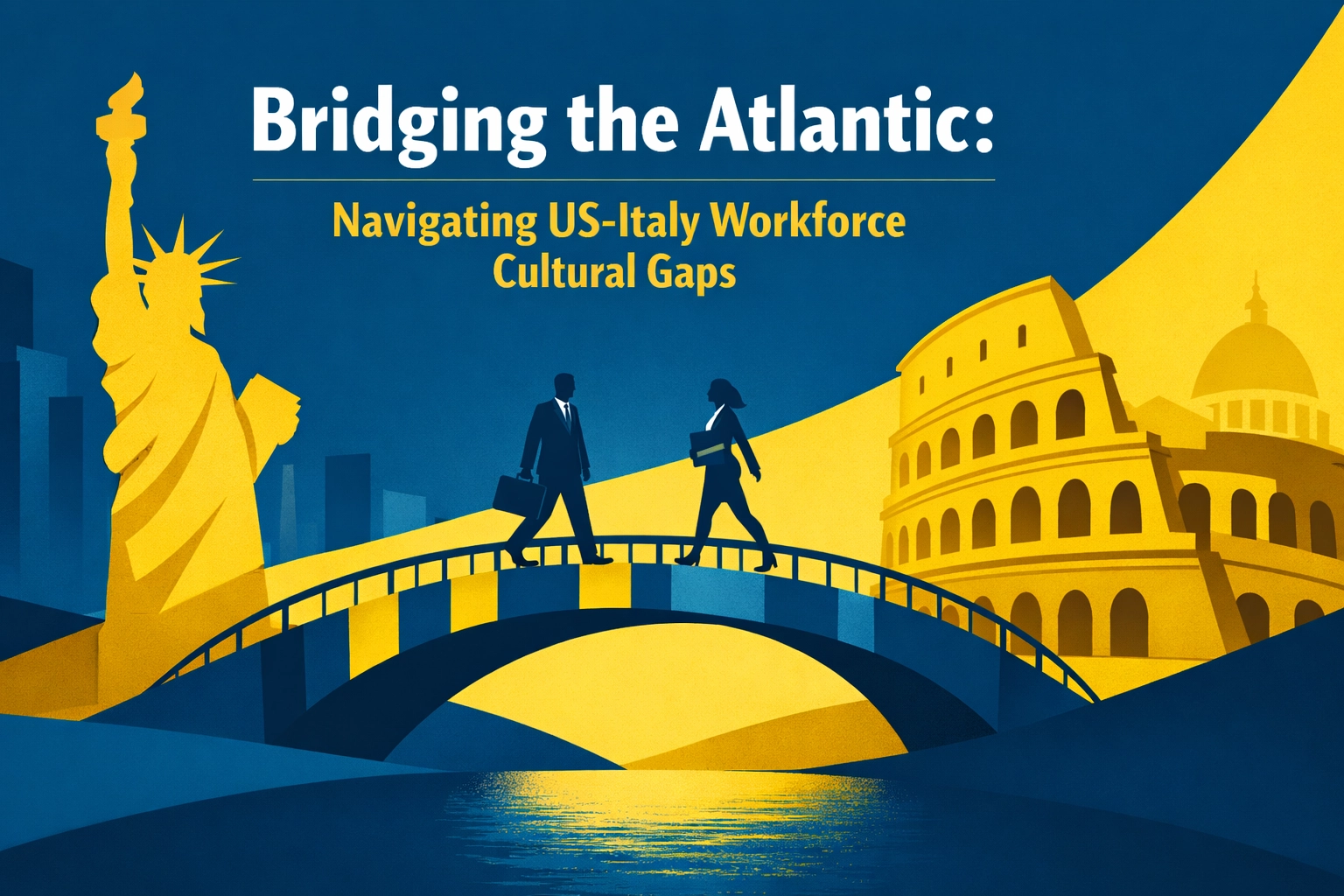
For American Private Equity (PE) firms and enterprise-level companies, Italy represents a landscape of immense opportunity: high-quality manufacturing, world-class engineering, and a heritage of "Made in Italy" excellence. However, many US investors and leadership teams find that their Italian acquisitions or subsidiaries quickly become operational puzzles.
The friction isn't usually found in the product or the market demand. It’s found in the human system.
When a US-based management style: driven by "at-will" flexibility, systematic procedures, and aggressive timelines: collides with the nuanced, relationship-heavy, and highly regulated Italian workforce environment, the result is often "organizational drift." Decisions stall, execution becomes inconsistent, and leadership friction erodes deal value.
At Rinnovare, we specialize in bridging this gap. Navigating the Atlantic requires more than a translation of language; it requires a translation of operating rhythm and cultural expectations.
The Invisible Friction in the Italian Investment
American business culture is built on the "What." What are the results? What is the deadline? What is the process? Italian business culture, conversely, is built on the "Who" and the "How."
In the United States, we tend to view the organization as a machine. If a part isn't working, we consult the manual, fix the process, or replace the part. In Italy, the organization is more akin to an ecosystem. You cannot simply "swap a part" without considering the root system of relationships and social contracts that hold the structure together.
For a US Private Equity firm, this often feels like moving through molasses. What was supposed to be a 90-day integration plan turns into a 12-month debate. Understanding why this happens is the first step toward restoring execution readiness.

Systems vs. Solutions: The Process Paradox
One of the most immediate points of friction is the approach to work organization.
The American Approach: Systematic and sequential. We identify a problem, create a step-by-step SOP (Standard Operating Procedure), and expect everyone to follow it to the letter. Efficiency is found in adherence to the process.
The Italian Approach: Flexible and adaptive. Italian professionals are world-renowned for their "arrangiarsi": the ability to find a creative solution to a problem, often by bypassing established rules that they perceive as obstacles to a better outcome.
When a US parent company imposes rigid American SOPs on an Italian team, the Italian team often views those procedures as "suggestions" or "bureaucratic noise." To the American manager, this looks like a lack of discipline. To the Italian employee, the American’s insistence on the "wrong" process looks like a lack of intelligence or common sense.
Without a senior-level bridge to reconcile these approaches, you end up with "shadow processes": the official way things are reported to the US, and the actual way things get done in the Italian plant. This lack of transparency is where deal value begins to leak.
The Relationship Premium: Why Transactions Fail in Milan
In the US, business is largely transactional. We can have a highly productive professional relationship with someone we don't necessarily like or know well personally. We value "getting straight to the point."
In Italy, the personal relationship is the foundation of professional trust. If you haven't taken the time to build a rapport: often over coffee or a long lunch: you haven't actually started the business meeting.
US executives often make the mistake of flying into Milan or Turin, heading straight to a conference room, and demanding status updates. They view the "small talk" as a waste of time. However, in the Italian context, that "small talk" is where the actual due diligence happens. It’s where the Italian team decides if they can trust your leadership.
If you skip the relationship-building phase, you will find that your Italian counterparts become politely non-committal. You’ll get a "yes" in the meeting, but no movement in the following weeks. This is because, in their view, no "real" agreement was reached because no "real" relationship exists.
For deeper insights into how these dynamics affect the early stages of an acquisition, see our guide on The First 90 Days: Why PE Deals Fail Without Interim CHROs.
Authority and Accountability: Navigating the Italian Hierarchy
There is a common misconception that because Italian communication is expressive and animated, the organizational structure is flat or democratic. The opposite is often true.
Italian business culture is historically hierarchical. While team members may express opinions loudly and passionately, the ultimate authority rests with the "Capo" or the senior leader. Decisions are rarely made by consensus; they are made by the person at the top after they have consulted their trusted circle.
The US Trap: American companies often try to implement "empowered, flat teams" in Italian subsidiaries. They expect mid-level managers to take initiative and make independent decisions.
The Reality: Without a clear signal from the top of the Italian hierarchy, those mid-level managers may hesitate to act, fearing they are overstepping their bounds. The US leadership interprets this as a lack of "ownership," while the Italian team is simply waiting for the "proper" authority to greenlight the action.

The "At-Will" Fallacy: Managing the Regulatory Divide
Perhaps the most dangerous friction point is the misunderstanding of labor norms. US leadership is accustomed to "at-will" employment, where the workforce can be scaled up or down with relative ease.
Italy is one of the most protected labor markets in the world. The "Statuto dei Lavoratori" and the various "Contratti Collettivi Nazionali di Lavoro" (CCNL) create a framework where termination is difficult, expensive, and legally fraught.
When a US PE firm enters the Italian market with a "slash and burn" cost-cutting mindset, they often trigger a massive backlash from trade unions (Sindicati) and local authorities that can paralyze operations and damage the brand's reputation for years.
Effective leadership in Italy requires a "discreet, senior-level expertise" that understands how to achieve flexibility within the bounds of Italian law. This isn't just about compliance; it's about the "social contract." In Italy, a company is often viewed as a pillar of the local community. Managing the workforce requires a level of diplomacy that most US HR departments simply aren't equipped to handle.
We discuss this shift in our article on The Renaissance of the Human: Why Tactical HR is Failing.
Building the Bridge: How Rinnovare Restores Alignment
The goal of cross-cultural management isn't to make the Italians act like Americans, or vice versa. The goal is to create a unified operating cadence that leverages the strengths of both.
At Rinnovare, we act as the "translation layer" between the US board/PE partner and the Italian operating team. We don't just provide "HR services"; we provide Executive Team Effectiveness.
Our Approach Includes:
- The Operating Cadence Audit: We diagnose whether your current meeting structures and reporting lines are actually facilitating work or creating cultural bottlenecks. (Learn more about The Operating Cadence Audit).
- Leadership Clarity (RQ™): We use our proprietary Renewal Quotient (RQ™) system to measure clarity and alignment within the Italian leadership team. This reveals whether the "drift" is caused by a lack of understanding of the US strategy or a cultural rejection of the delivery method.
- Interim CHRO Support: For PE firms in the midst of a turnaround or integration, we provide high-powered, interim HR leadership that understands both the American drive for ROI and the Italian need for relational trust.
If your Italian operations are feeling "disconnected" from the US headquarters, it is likely not a talent problem: it is a system failure. The cost of "organizational drift" is too high to ignore.
 (https://cdn.marblism.com/cBrxm5Q9QU-.png)

Conclusion: Turning Friction into Advantage
When you bridge the Atlantic successfully, you gain the best of both worlds: American systematic discipline and Italian creative agility. You get a workforce that doesn't just follow the rules but finds ways to innovate within them.
However, this doesn't happen by accident. It requires a sophisticated understanding of the "hidden contracts" that govern how work actually gets done in Italy.
Are you ready to stop the drift and start accelerating your Italian deal value? Let’s discuss how Rinnovare can provide the clarity and alignment your organization needs.
Contact Rinnovare today to schedule a consultation on your international workforce strategy.