Every quarter, I hear the same refrain from CEOs and Private Equity Partners: “HR is a black hole for capital.”
They look at the line items for payroll, benefits administration, recruitment fees, and the ever-growing headcount of “People Partners,” and they don't see a return. They see a cost center. They see a department that creates friction, slows down hiring, manages the “fun committee,” and keeps the company out of court: but does nothing to actually move the needle on EBITDA or enterprise value.
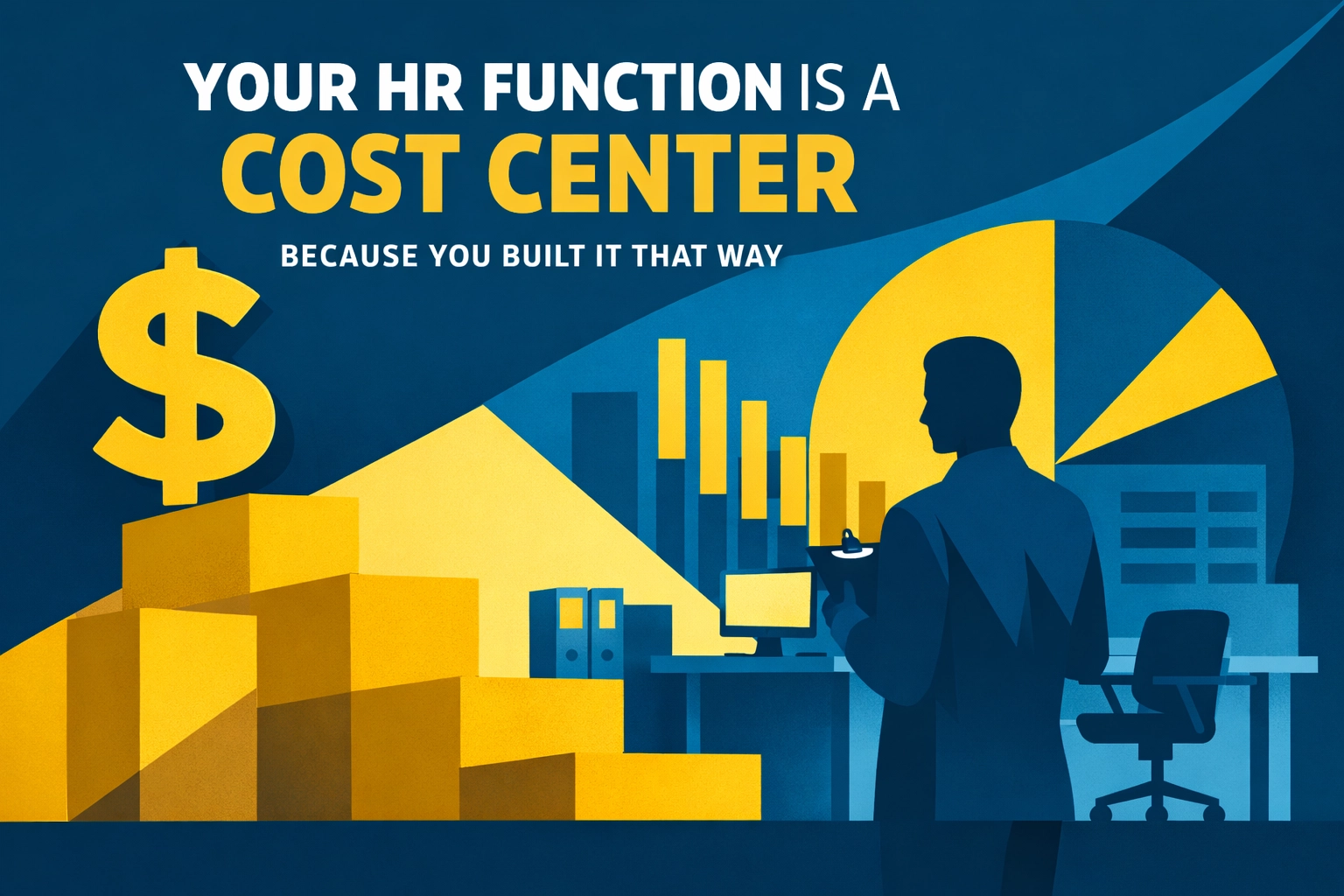
If that sounds like your organization, I have some uncomfortable news for you: Your HR function is a cost center because you built it that way.
You hired administrators when you needed architects. You prioritized compliance over capability. You relegated HR to the "back office" and then acted surprised when they didn't have a front-office perspective on the business.
At Rinnovare, we specialize in untangling this specific type of complexity. Whether it’s during a high-stakes transition or a period of chronic underperformance, we see the same pattern: a fundamental failure in the HR operating model that stems directly from the CEO’s desk.
The "Service Provider" Trap
Most companies treat HR as a service provider. The business has a need: a new hire, a termination, a benefits update: and HR fulfills that need. This is a purely tactical, reactive relationship.
When HR operates as a service provider, their success is measured by efficiency:
- How fast did we fill the role?
- How much did we save on the health plan?
- Did we finish the performance reviews on time?
While these things are necessary, they are foundational. They are "table stakes." If your HR leader’s primary focus is checking these boxes, they are an administrator, not a strategic asset. By keeping them in this box, you have essentially ensured that they can only ever be a cost center. They are spending money to keep the lights on, not investing capital to build a more efficient engine.

To move beyond this, you must stop hiring HR Managers when you actually need an architect. Organizational design consulting isn't about moving boxes on a chart; it’s about architecting a human system that can execute your strategy. If your HR leader doesn’t understand your P&L as well as your CFO does, they will never be able to build that system.
The Architecture of Performance
Real HR transformation consulting isn't about a new software implementation or a rebranded "People & Culture" department. It’s about a structural shift in how the function creates value.
Think of your company as a building. Most HR departments are the janitors: they keep it clean, fix the leaks, and make sure the fire code is met. But if the building is leaning to the left or doesn't have enough floor space for your growing team, the janitor can’t help you. You need an architect.
An "HR Architect" looks at the business through the lens of executive team effectiveness and organizational capability. They ask:
- Do we have the right leadership structure to execute our 3-year plan?
- Where is the "Drift Tax" slowing down our decision-making?
- How does our compensation strategy directly drive the behaviors that increase enterprise value?
- Is our HR operating model scalable, or will it break the moment we acquire our next competitor?

Private Equity and the "Culture Debt"
In the world of Private Equity, the cost center mentality is particularly dangerous. We’ve written before about the 7 mistakes PE firms make with HR due diligence, and at the top of that list is ignoring the structural health of the human capital.
When a PE firm buys a company, they usually have a strict 100-day plan. They focus on financial engineering, operational efficiencies, and market expansion. But they often leave the "HR stuff" to the existing team or a mid-level manager.
This creates "Culture Debt." Just like technical debt in software, culture debt is the future cost of choosing an easy, tactical solution now instead of a better functional approach that takes longer. If you don't align the leadership team and the organizational structure in those first few months, you are essentially betting against your own IRR.
This is where an interim CHRO becomes a force multiplier. An interim leader from Rinnovare doesn't come in to "run the department." They come in to re-architect the function, align the executive team, and ensure the human capital strategy is a mirror image of the investment thesis.
Moving from Compliance to Competitive Advantage
If you want HR to be a profit-enabler, you have to change the mandate. You have to move beyond compliance and toward competitive advantage.
This starts with executive team effectiveness. If your C-suite isn't aligned on what the HR function is supposed to do, the function will default to whatever is easiest: administrative tasks. The CEO must empower the CHRO to be an agitator and an advisor, not just a "Yes-Person."
Real leadership requires an HR partner who isn’t afraid to tell the CEO that the current organizational structure is the reason they are missing their targets. It requires someone who understands that every leader has two org charts: the one on paper and the "hidden contract" of how work actually gets done.

The Rinnovare Approach: Untangling the Complexity
At Rinnovare, we don't do "traditional" HR consulting. We don't give you a 400-page deck on "employee engagement" and walk away. We help you build a business-driven HR function from the ground up.
Our work in organizational design consulting and HR transformation is focused on one thing: Enterprise Value. We look for the friction points: the places where your current structure is actively fighting your strategy.
Whether you are navigating a complex M&A integration: where HR integration is the secret to deal value: or you are a CEO who realizes your current HR team is in over their heads, we provide the senior-level judgment needed to bridge the gap.

Stop Complaining and Start Architecting
The next time you look at your HR budget and feel a sense of dread, don't ask "How can we cut this?" Ask "Why isn't this building my business?"
If the answer is that they are too busy with payroll, open enrollment, and the holiday party, then you know exactly what the problem is. You've built a cost center. You’ve hired for the past, not the future.
The shift from cost center to value creator isn't easy. It requires a hard look at your HR operating model, a willingness to challenge long-held assumptions about "cultural fit," and the courage to bring in outside expertise to reset the foundation.
If you’re ready to stop treating your most expensive asset like an administrative burden, let’s talk. We help organizations transition from the chaos of tactical HR to the clarity of strategic architecture.
It’s time to stop paying the "Drift Tax" and start building an organization that can actually win.
