If you are an operations leader, you are likely frustrated. You’re looking at your latest cohort of new hires and wondering where the "A-players" went. At the same time, if you talk to a job seeker – even a highly qualified one – they’ll tell you they are shouting into a void. They apply for roles they are perfectly suited for, only to receive a generic rejection email three minutes later.
There is a massive disconnect in the talent market today. On one side, companies are desperate for high-performers to drive enterprise value. On the other side, millions of qualified professionals are being locked out of the building.
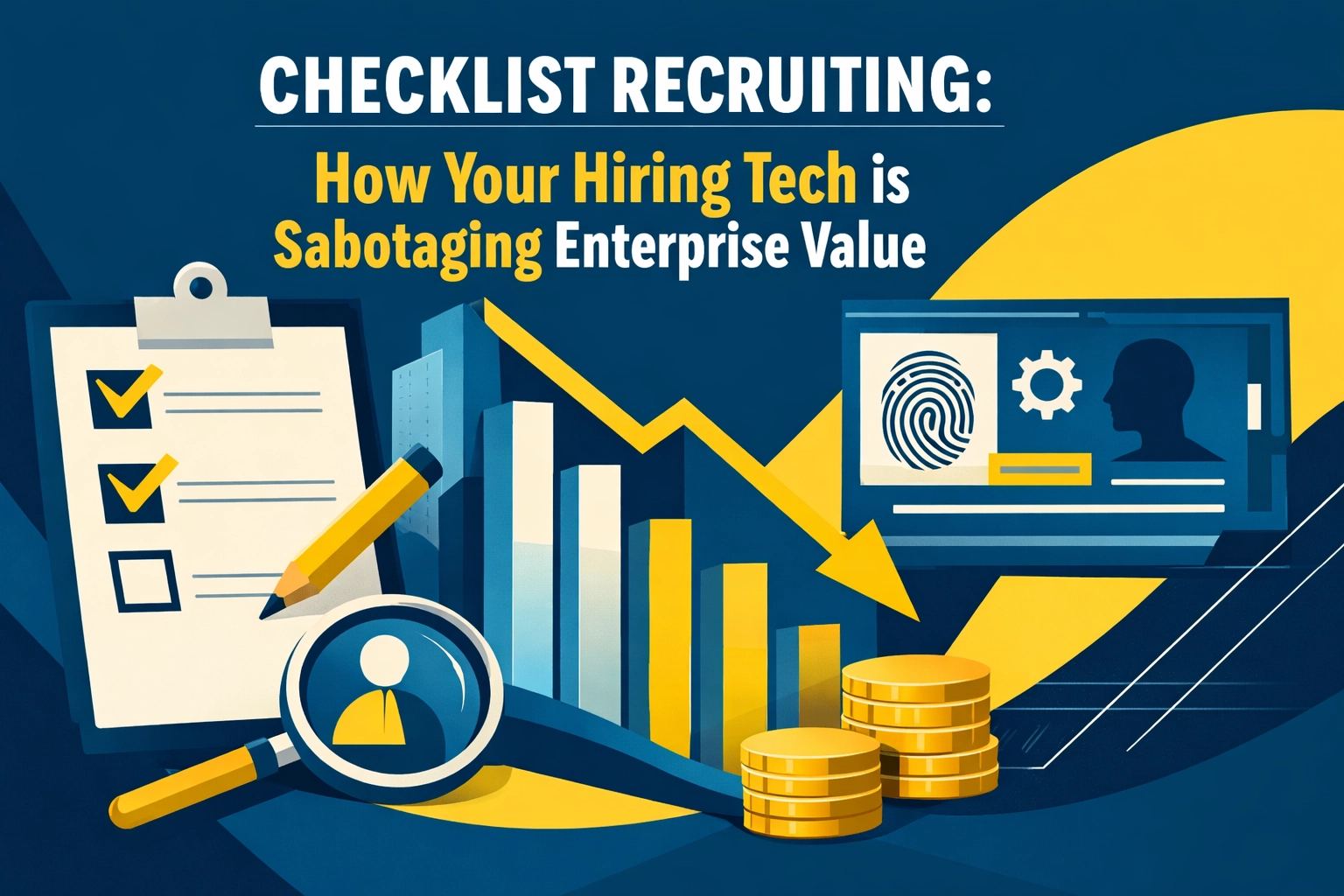
The culprit? An over-reliance on Applicant Tracking Systems (ATS) and the rise of what I call "Checklist Recruiting." We’ve traded human judgment for an automated checklist, and in the process, we are systematically sabotaging our own growth.
The Algorithmic Lobotomy
It’s time to call this what it is: an algorithmic lobotomy. In the pursuit of "efficiency," many HR departments have outsourced their most critical thinking to a software filter.
The data is damning. According to a 2025 Harvard Business School update on the "Hidden Workers" phenomenon, over 27 million qualified workers in the U.S. are systematically screened out by ATS filters. We’re talking about people with the exact skills needed, but who might have a six-month employment gap, a non-traditional degree, or a resume that isn't formatted to please a bot.
Even more shocking? The leaders of these companies know it’s happening. In that same HBS study, 88% of executives admitted that their automated systems vet out highly skilled candidates simply because they don't match every single "checkbox" in the pre-programmed criteria.
We’ve reached a point where the tech isn't helping recruiters find the best people; it's giving them permission to stop looking.

Drowning in the Shallow End
To be fair to the recruiting world, the sheer volume of noise is staggering. Data from Greenhouse shows that the average number of applications per job has tripled since 2017. Between "Easy Apply" buttons and AI-generated resumes, recruiters are drowning.
But instead of swimming, they’ve reached for an anchor.
When a recruiter is faced with 1,000 applications for a single mid-level manager role, the instinct is to filter down to 10 names as fast as possible. This is where "Checklist Recruiting" becomes a defense mechanism. The recruiter stops asking, "Is this person a great fit for our culture and our goals?" and starts asking, "Does this resume have the exact keyword for 'Project Management' in the header?"
This isn't just about laziness – though in my experience, that certainly can be a factor – it’s about a total loss of role comprehension. When recruiters don't understand the nuance of a position, they fall back on the computerized checklist. They become administrators of a process rather than assessors of talent.
The "First Come, First Hired" Bias
If you think adding "AI" to your ATS will solve this, think again. Recent studies into AI-driven screening tools (particularly those leveraging Large Language Models) show a massive "first-mover" bias.
Because these systems are designed to process and rank data quickly, they often prioritize the first few resumes they see that meet a basic threshold. It’s not a meritocracy; it’s a lottery. If a "Perfect-Fit" candidate applies on day three, they might never even be seen because the AI has already filled the recruiter's "Review Queue" with the first 50 people who hit the keyword requirements.
For a Private Equity firm or a high-growth enterprise, this is a disaster. You aren't hiring the best talent available; you’re hiring the fastest applicants who knew how to game the algorithm.

The Cost to Enterprise Value
Why does this matter to anyone outside of HR? Because bad hiring is an enterprise value killer.
When you hire based on a checklist, you get "Checklist Employees." You get people who can do the task as described but lack the critical thinking, adaptability, and leadership qualities that drive a business forward.
- Misalignment with Strategy: A bot can’t tell you if a candidate has the "grit" to handle an organizational transformation. It only knows if they have five years of experience in Excel.
- Increased Attrition: When candidates are screened in by mistake or through a rigid process, the "fit" is often superficial. These hires wash out within 12 months, leading to a cycle of repeated recruitment costs and lost productivity.
- The Opportunity Cost of "Hidden Workers": When you filter out 27 million people, you are ignoring a massive pool of talent that your competitors might be smart enough to tap into.
At Rinnovare, we see this play out constantly in our advisory work. Companies complain about a "talent shortage" while their own tech is actively rejecting the very people who could solve their problems.
A Better Alternative: Human-Centric Diagnostics
The alternative to Checklist Recruiting isn't to go back to the 1980s and read every resume by hand. It’s about re-introducing senior-level judgment and a diagnostic-led approach to the process.
At Rinnovare, we advocate for a model where the "human" is moved back to the front of the funnel for critical roles. This involves:
- Deep Role Comprehension: Before a single job post goes live, there must be a diagnostic phase. What are the actual business outcomes this person needs to achieve? This goes beyond a list of "skills" and into the "why" of the role.
- Structured Calibration: Moving away from gut feelings and bot-filters toward evidence-based assessment. We focus on aligning the operating model with the talent strategy.
- The "Anti-Checklist" Review: Looking for the "Hidden Workers." This means intentionally reviewing candidates who fall outside the traditional filters but possess the underlying competencies required for success.

Protecting Your Investment
If you are a CEO or a PE partner, you need to look under the hood of your talent acquisition machine. Is your HR team actually recruiting, or are they just managing a software subscription?
The goal of hiring isn't to clear the inbox. The goal is to build a high-performance organization that creates competitive advantage. When you let an ATS dictate who gets an interview, you are abdicating one of the most important levers of enterprise value.
It’s time to stop the algorithmic lobotomy. It’s time to put the "human" back in Human Resources.
If your current hiring process feels like a black box that keeps producing mediocre results, let’s talk. We help organizations move beyond the checklist and build teams that actually perform.
Contact Rinnovare today to learn how we can help you lobotomy-proof your talent strategy.
