For decades, the private equity playbook was driven by financial engineering, leverage, and cost-cutting. Success was measured in spreadsheets. But as markets have matured and competition for quality assets has intensified, the "financial lever" has become table stakes. Today, the most sophisticated Operating Partners and CEOs recognize that the next frontier of alpha isn't found in the debt structure: it’s found in leadership discipline.
The traditional approach to "human capital" in PE has been reactive: find a "rockstar" CEO, replace the CFO, and hope the culture catches up to the investment thesis. However, research indicates that nearly 70% of CEOs in PE-backed companies are replaced during the holding period. This isn't just a hiring problem; it’s a systems problem.
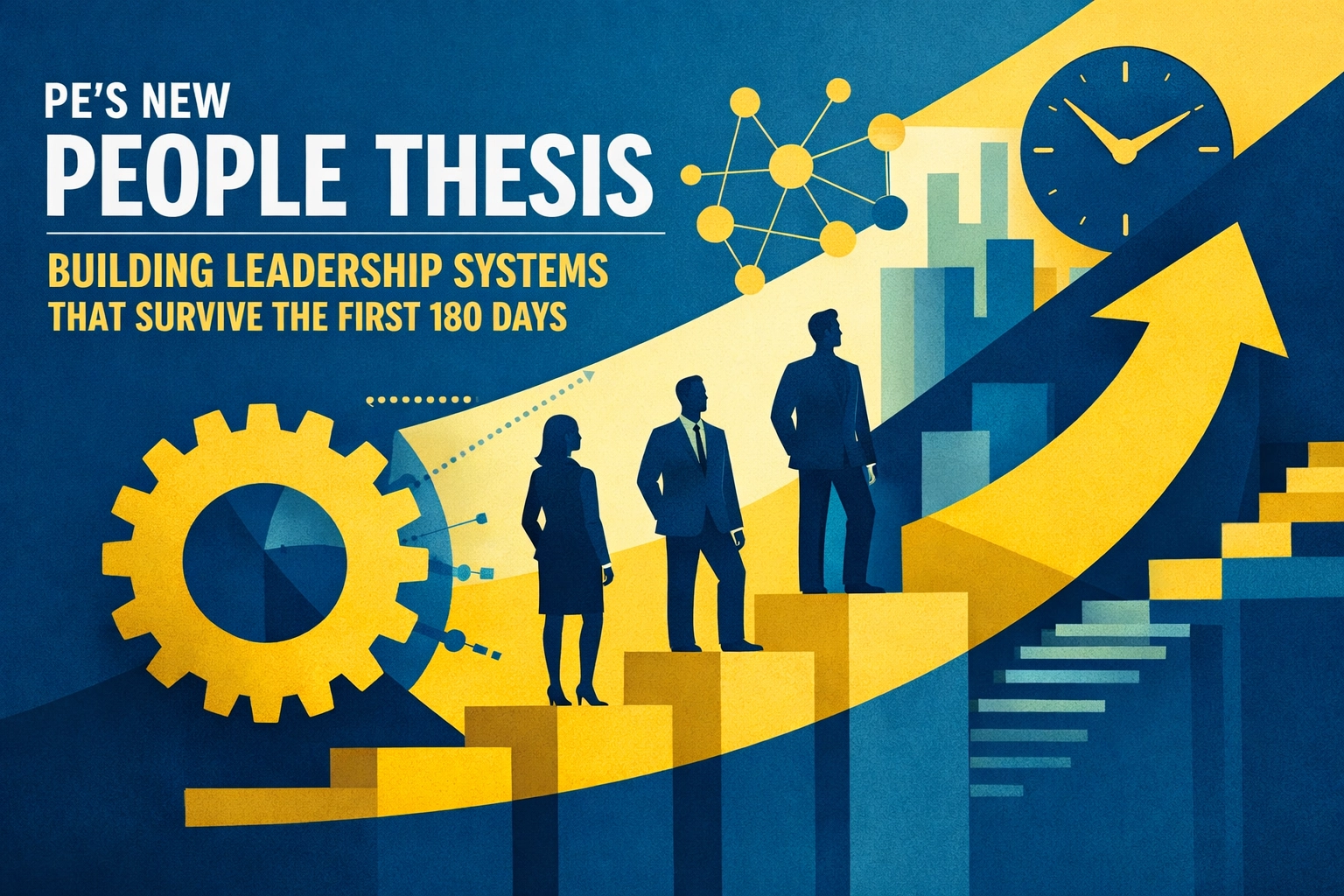
At Rinnovare, we call this the New People Thesis. It is the shift from relying on individual executive "heroics" to building a rigorous, repeatable leadership system that survives: and thrives: during the critical first 180 days post-deal.
The 180-Day Danger Zone
The first six months after a deal closes are the most volatile. This is the period where the "drift tax" is highest. Strategic intent is often lost in translation as the new owners' expectations collide with the legacy organization’s habits.
Without a structured approach to leadership and organizational clarity, the organization enters a state of paralysis. Decision-making slows, top talent becomes restless, and the value creation plan begins to slip before the ink is even dry on the closing documents. To de-risk this period, PE firms must move beyond traditional compliance-based private equity HR due diligence and move toward a diagnostic-first approach.

Beyond the Compliance Checklist: Modern HR Due Diligence
Most HR due diligence is a forensic exercise: looking at benefits, liabilities, 401(k) compliance, and employment contracts. While necessary, this tells you nothing about the company’s ability to execute your 100-day plan.
Modern due diligence must assess the "Renewal Quotient" (RQ) of the leadership team. Can they handle the pace of a PE-backed environment? Are the decision rights clearly defined, or is the company governed by shadow hierarchies?
By identifying these "people-system" failures before the deal closes: or immediately thereafter: Operating Partners can install the necessary guardrails. This is where the RQ Diagnostic™ becomes a critical tool. It provides an objective, data-driven look at where the organization is misaligned, identifying "organizational drift" before it manifests as a missed quarterly target.
The RQ Diagnostic™: Seeing the Invisible
The RQ Diagnostic™ serves as the early-warning system for the portfolio. It measures the gap between the investment thesis and the current leadership capability.
When growth slows or execution becomes uneven, the root cause is almost always a breakdown in clarity. Are roles clearly defined? Are the priorities communicated in a way that the frontline can actually execute? Does the leadership team have the discipline to hold each other accountable?
By running an RQ Diagnostic™ in the first 30 days, a CEO and their Operating Partner can see the "invisible" friction points. This diagnostic-first approach allows for surgical interventions rather than broad, disruptive changes that can spook the workforce.

The Strategic Interim CHRO: Stability in High-Stakes Transitions
One of the most common mistakes in the first 180 days is leaving the HR function in the hands of a "legacy" administrator or rushing to hire a permanent CHRO before the new operating model is even defined.
A high-stakes transition requires a strategic interim CHRO. This isn't a "gap-filler" role; it is a transformation role. An interim CHRO from Rinnovare acts as a bridge, stabilizing the people systems, resetting expectations, and architecting the new leadership culture without the baggage of internal politics.
The interim CHRO is responsible for:
- Installing Leadership Systems: Moving from consensus-driven cultures to performance-driven protocols.
- Mapping Decision Rights: Ensuring the CEO isn't a bottleneck for every minor operational choice.
- Preparing for Scale: Installing the talent architecture and operating cadence required for the next stage of growth.
This allows the CEO to focus on the market and the board, knowing that the internal "engine" is being professionally tuned for performance.
Architecting the RQ Operating Model™
Once the diagnostic is complete and the interim leadership is in place, the focus shifts to the RQ Operating Model™.
Most portfolio companies outgrow their operating models long before they realize it. A structure that worked for a $50M founder-led business will fail a $250M PE-backed enterprise. The RQ Operating Model™ re-architects the organization for the investment thesis. It defines how work gets done, how information flows, and how the executive team functions as a system rather than a collection of high-performing individuals.
When the executive team functions as a system, they move faster. They spend less time in "alignment meetings" and more time on market-facing value creation. This systemic discipline is what ensures the deal survives the transition from the "honeymoon phase" into the "execution phase."

The RQ Roadmap™: De-Risking the Exit from Day One
Value creation in PE is ultimately about the exit. The RQ Roadmap™ is the tactical plan that links organizational health to the exit thesis.
If the goal is to sell to a strategic buyer in year five, the leadership systems must be robust enough to withstand a deep due diligence process from the next buyer. If the organization is still dependent on a few "hero" leaders, the valuation will suffer.
The RQ Roadmap™ ensures that:
- Succession is built-in: The organization isn't reliant on a single point of failure.
- Accountability is transparent: Metrics and KPIs are clear at every level.
- The Culture is an Asset: The culture is characterized by discipline and clarity, not just "perks."
For a deeper look at what happens when this alignment fails, read our analysis on Silence of the Boardroom: When Executive Misalignment Becomes a Hard Liability.
Conclusion: Leadership Discipline as the Ultimate Multiplier
The new people thesis in private equity is simple: Systems beat stars.
You can hire the best CEO in the world, but if you drop them into a broken leadership system with unclear decision rights and "people debt," they will eventually fail. By utilizing a diagnostic-first approach: leveraging the RQ Diagnostic™, RQ Operating Model™, and RQ Roadmap™: PE firms can de-risk their investments and accelerate value creation.
The first 180 days are too important to leave to chance. Whether it is through rigorous private equity HR due diligence or the deployment of a strategic interim CHRO, the goal is the same: to build an organization that is as disciplined as the financial model that bought it.
Ready to see where your portfolio stands? Drop us a line to discuss how an RQ Diagnostic™ can reveal the hidden drift in your leadership team.
