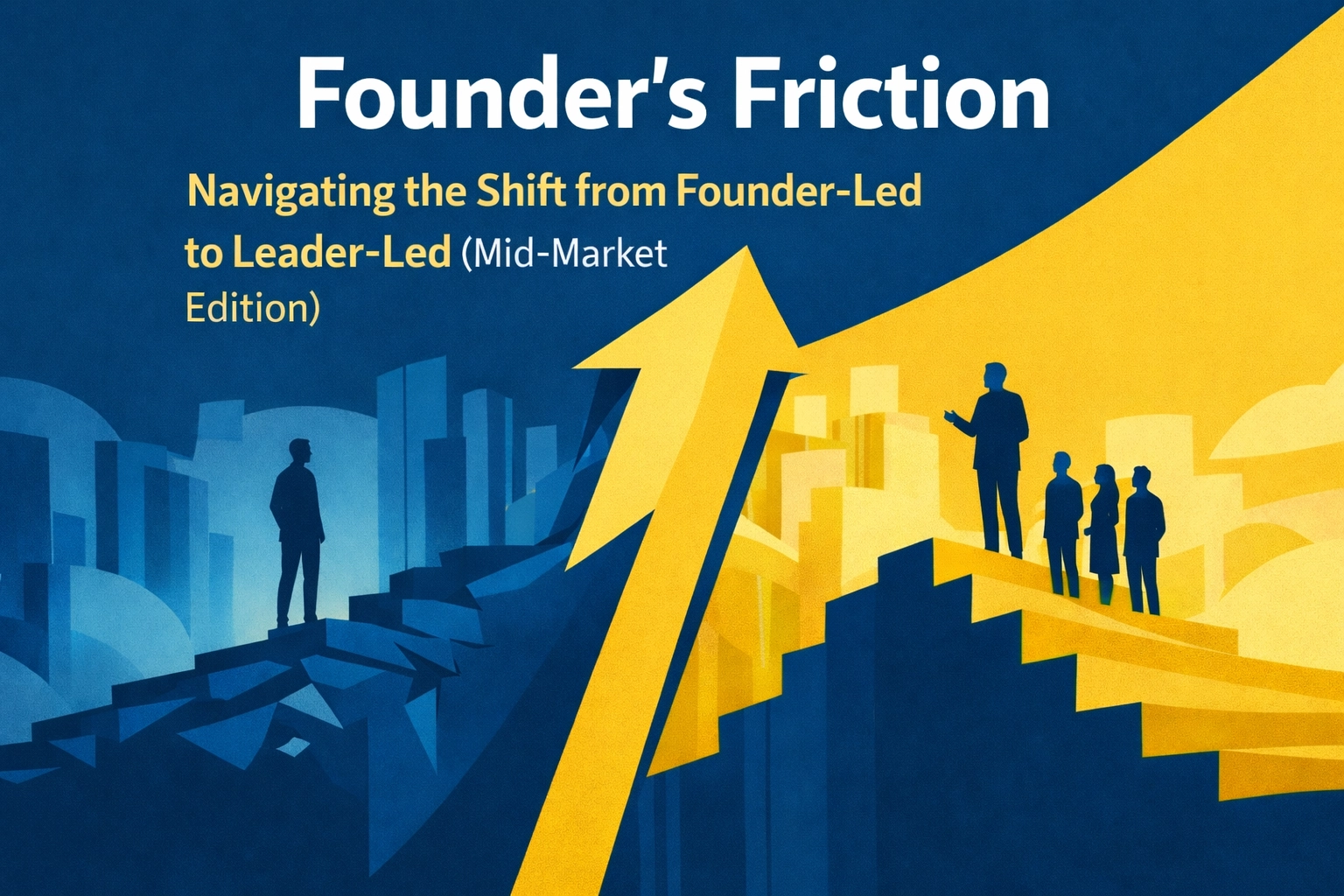
For many CEOs, the journey from an early-stage company to a mid-market or upper-mid-market enterprise (roughly 150–1,500 employees, and beyond) feels less like a steady climb and more like a series of high-impact collisions. In the beginning, the company is an extension of the founder’s personality, will, and work ethic. Every decision, from the product roadmap to the office coffee brand, passes through a single point of failure: the founder.
But then, the "ceiling" appears.
You reach a point where the very traits that fueled your early success: your hands-on intensity, your "heroic" problem-solving, and your refusal to delegate the critical details: become the primary obstacles to your growth. This is what we call Founder’s Friction. It is the structural and psychological drag that occurs when a founder’s personal bandwidth can no longer sustain the complexity of the organization.
Navigating this shift from a founder-led, personality-driven organization (often an extension of the founder’s personality) to a leader-led enterprise is the most dangerous transition a CEO will ever make. It is the moment where many scale-ups stall, and where even the most brilliant founders find themselves exhausted, second-guessing their instincts, and looking for a way to see around the corners they know are coming.
The Anatomy of Founder’s Friction
In the early days, friction is often productive. In a small team of three to ten people, heated debates over a single feature or a specific hire sharpen the company’s vision. This "productive friction" forces rigorous thinking and ensures that every dollar is spent with purpose.
However, as you move past the early scaling phase and into true mid-market complexity, the nature of that friction changes. It shifts from being a tool for quality control to a bottleneck for execution. When a CEO of a 500-person company still insists on being the final word on mid-level operational decisions, the organization begins to atrophy. Talented executives stop taking initiative because they know they’ll eventually be overridden. Speed-to-market slows. The culture begins to feel heavy.
This is the "Hero Trap." The founder feels an immense pressure to remain the hero who saves the day, not realizing that every time they step in to solve a problem personally, they are preventing the leadership team from building the "muscle" required to lead the company to $100M and beyond.

The Mid-Market Danger Zone
In the mid-market and upper-mid-market, the "complexity tax" grows exponentially.
- At ~150 employees: You are outgrowing informal alignment. Communication is still fast, but you can feel the seams.
- At ~500 employees: You are a multi-layered organization. Silos begin to form. The founder can no longer "see" everything.
- At ~1,500+ employees: You are an institution. You require systems, governance, and a high-functioning executive suite that operates independently of the founder’s daily input.
The friction arises because the founder’s role must evolve at the same speed as the organization. If headcount (and complexity) has doubled, but the CEO is still operating with the mindset of an early-stage founder, the "Denial Gap" begins to widen. We’ve discussed this phenomenon before in our analysis of The Bella Figura Fallacy, where the desire to maintain a certain image of control actually kills the expansion.
Seeing Around Corners: The Decision-Making Gap
The most significant shift in this transition is the nature of decision-making. In a founder-led environment, decisions are often based on intuition, "gut," and historical context that only the founder possesses. In a leader-led environment, decisions must be based on evidence, data, and the collective judgment of a senior team.
The stakes also change. A bad hire at 50 people is a headache; a bad executive hire at 1,000+ is a hard liability that can destabilize the entire board. When executive misalignment becomes a reality, the silence in the boardroom becomes deafening. You can read more about how executive misalignment becomes a hard liability here.
The challenge for the scaling CEO is that they often lack a confidential space to weigh these high-stakes facts. They are surrounded by people who have a vested interest in the outcome: investors, board members, and employees. To "see around corners," a CEO needs more than a management team; they need a sounding board that has seen these patterns play out across decades and different industries.

From Doing to Leading: The Architecture of the Shift
To resolve Founder’s Friction, the CEO must consciously move from the "Primary Doer" to the "Chief Architect." At Rinnovare, we often guide this transition using our proprietary RQ™ system (Rinnovare Quotient): a discreet, senior-level way to bring clarity when strategy, structure, and leadership behavior start to fall out of alignment.
The RQ™ system consists of three products:
- RQ Diagnostic™: A fast, evidence-based read on where founder-led instincts are creating avoidable drag (decision rights, role clarity, leadership effectiveness, and culture signals).
- RQ Operating Model™: The practical architecture for a leader-led enterprise (accountability, decision pathways, governance, and executive operating rhythms).
- RQ Roadmap™: A sequenced plan that protects enterprise value while the CEO’s role evolves and the leadership team builds real capacity.
This work typically shows up as three critical shifts:
- Transitioning from Consensus to Clarity: Early-stage companies often rely on consensus. As you scale, you need clear accountability. The CEO’s job shifts from making sure everyone agrees to making sure the right people are in power to make the right calls.
- Dynamic Roles: The people who helped you get to $10M may not be the ones to take you to $100M. This requires a "moral obligation" to the health of the firm over personal loyalties: a difficult but necessary realization.
- Establishing an Operating Cadence: Without a structured rhythm, the CEO is constantly pulled back into the "whirlwind" of daily operations. Establishing a rigorous operating model is what separates the companies that scale from the ones that plateau.
How Rinnovare Helps CEOs Move From Founder-Led to Leader-Led
Founder’s Friction is not a character flaw. It is a predictable outcome when a personality-driven organization outgrows the founder’s personal operating system.
Rinnovare works discreetly with mid-market and upper-mid-market CEOs (roughly 150–1,500 employees) and their leadership teams to make the shift to a scalable, leader-led enterprise—without losing speed, standards, or the founder’s intent.
We do that using the proprietary RQ™ system (Rinnovare Quotient):
- RQ Diagnostic™ creates a clear, evidence-based view of where complexity is accumulating (decision rights, role clarity, leadership effectiveness, culture signals) and where the founder is still functioning as the “default system.”
- RQ Operating Model™ establishes the architecture of a leader-led enterprise: accountability, decision pathways, governance, and executive operating rhythms that do not depend on the founder’s daily intervention.
- RQ Roadmap™ sequences the transition so it’s practical, board-ready, and survivable—aligning leadership behavior, structure, and operating cadence without unnecessary disruption.
If you recognize Founder’s Friction in your organization, we can help you regain clarity, reduce leadership drag, and align the enterprise around how decisions get made and who owns what.
To learn more about our work in HR transformation and leadership alignment, visit our services page or contact us directly.
The goal isn’t to remove the founder from the system—it’s to build a system that can scale beyond the founder.