The boardroom conversation has shifted. It used to be about "digital transformation" in a general sense: moving to the cloud, ERPs, and payroll automation. Today, the hype is narrower and more dangerous: the promise of AI-driven "empathy."
We see it in the marketing decks of every new HR-tech startup. They promise AI chatbots that can "sense" employee burnout, sentiment analysis tools that claim to "understand" morale, and automated coaching platforms that simulate a mentor’s voice.
For a Private Equity partner looking at a lean portco or a CHRO managing a global workforce, the efficiency play is tempting. Why pay for high-touch, senior HR intervention when a Large Language Model (LLM) can deliver "support" at scale for pennies on the dollar?
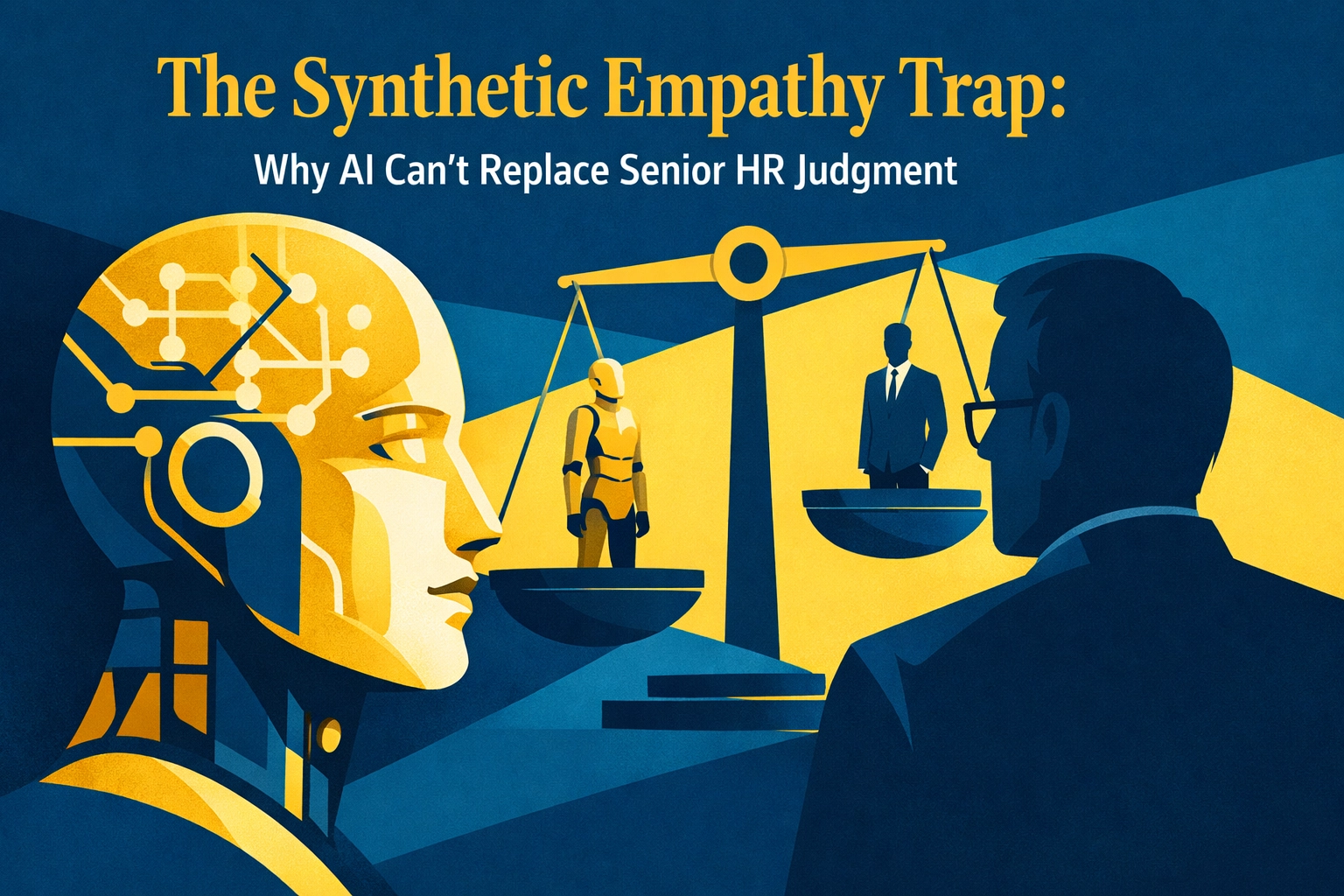
But there is a trap. We call it the Synthetic Empathy Trap.
At Rinnovare, we spend our time in the trenches of organizational transformation. We’ve seen that while AI can process data at a speed no human can match, it cannot: and will never: replace the emotional stewardship and nuanced judgment required to lead a company through a high-stakes transition.
The Illusion of Understanding
To understand the trap, we have to look under the hood of "Empathetic AI."
AI systems use natural language processing (NLP) and facial recognition to detect emotional cues. If an employee types phrases associated with frustration, the AI triggers a "sympathetic" response. It’s a sophisticated version of pattern matching. It is math, not meaning.
The research is clear: AI lacks consciousness. It doesn't "feel" the weight of a restructuring plan. It doesn't "understand" the fear of a middle manager whose department is being merged. It simply associates certain emotional signals with predefined appropriate responses.
When you substitute genuine human connection with this synthetic mimicry, you aren't providing support. You are providing a script. And in a high-stakes environment: like a post-merger integration or a major pivot: employees can smell the script from a mile away.

The Accountability Gap: Moral Reasoning vs. Algorithms
The most critical limitation of AI in the HR context is the absence of moral reasoning.
In senior HR leadership, we aren't just following a handbook. We are making "gray area" decisions. Whether it’s a disciplinary action involving a high-performer or a sensitive termination during a downturn, these moments require a sense of justice, self-reflection, and, most importantly, accountability.
An AI cannot be held accountable. If an algorithm recommends a course of action that destroys team morale or triggers a legal liability, the AI doesn't face the Board. It doesn't lose sleep over the ethical implications.
This is where the Silence of the Boardroom becomes a liability. When executive teams lean on automated insights rather than human judgment, they create a vacuum of responsibility. Senior judgment is the anchor that holds an organization to its values when things get messy. AI has no anchor; it only has a data set.
Emotional Stewardship: The Rinnovare Perspective
At Rinnovare, our work is often described as "emotional stewardship." This isn't a "soft" skill; it’s a hard business requirement for long-term value creation.
When we conduct an RQ Diagnostic™, we aren't just looking at headcounts and org charts. We are looking for the "unspoken." We are listening for the tension in the room during a leadership offsite. We are identifying the subtle power dynamics that an AI-driven sentiment survey would completely miss.
AI can tell you what is happening (e.g., "Retention is down 12% in the engineering pod"). It cannot tell you why it’s happening in a way that accounts for the human ego, legacy loyalties, or the "face-saving" culture that often plagues international expansions: what we call The Bella Figura Fallacy.
The Danger of Emotional Atrophy
There is a secondary risk to the Synthetic Empathy Trap: the atrophy of your leadership’s own emotional intelligence.
If managers begin to rely on AI to script their difficult conversations or to "read" their team’s mood, they stop practicing the basic human skills of conflict resolution and authentic connection. In a PE-backed growth environment, you need leaders who can navigate disagreement and build trust manually.
If your HR infrastructure becomes a series of automated gates, you are effectively training your leaders to be "emotionally illiterate." When a real crisis hits: the kind that isn't in the AI's training data: they won't have the muscle memory to lead through it.

The Drift Tax: When AI Costs More Than It Saves
In our framework, we talk about the Drift Tax. This is the hidden cost of misalignment between an organization’s strategy and its people.
The Synthetic Empathy Trap is a major contributor to the Drift Tax. When employees feel they are being managed by a machine, engagement doesn't just dip: it becomes transactional. The "human contract" is broken. Employees stop giving discretionary effort and start doing the bare minimum required by the algorithm.
For a CEO or a PE Partner, this is a disaster for enterprise value. You might save $500k on HR headcount by automating "empathy," but you lose $5M in productivity and innovation because your culture has become hollow.
Where AI Actually Belongs (And Where It Doesn't)
To be clear: Rinnovare is not anti-technology. We use sophisticated data analysis to inform our RQ Operating Model™.
AI is an incredible tool for:
- Administrative Efficiency: Cleaning up messy HR data, automating payroll queries, and managing benefits enrollment.
- Pattern Recognition: Spotting trends in high-volume recruiting or identifying systemic gaps in compensation.
- Decision Support: Providing data-backed scenarios for workforce planning.
But AI is a terrible Decision Maker.
The "Senior Judgment" we provide isn't just about having the right answer; it’s about having the right discretion. It’s knowing when to follow the data and when to ignore it because you’ve seen this movie before and you know how it ends for the people involved.
Reclaiming the Human Advantage
As we look toward the next decade of HR transformation, the winners won't be the companies with the most AI bots. They will be the companies that use AI to free up their senior leaders to do what only humans can do: lead with empathy, act with moral courage, and provide the stewardship that a growing organization needs.
If you are looking at your current HR function and wondering if it’s "future-proof," don't start with a software demo. Start with a diagnostic of your leadership alignment.
The RQ Roadmap™ isn't built on synthetic empathy. It’s built on the hard-won experience of professionals who understand that at the end of every spreadsheet is a human being.
Don't fall for the trap. Efficiency is a metric, but judgment is an asset.
Ready to move beyond the hype and build a high-performance HR function?
Contact Rinnovare to learn how our RQ™ system transforms HR into your greatest competitive advantage.
