Let’s be honest: when was the last time you looked at your own job description? If you’re a CEO or a CHRO in a high-growth environment, the answer is likely "the day I signed the offer letter."
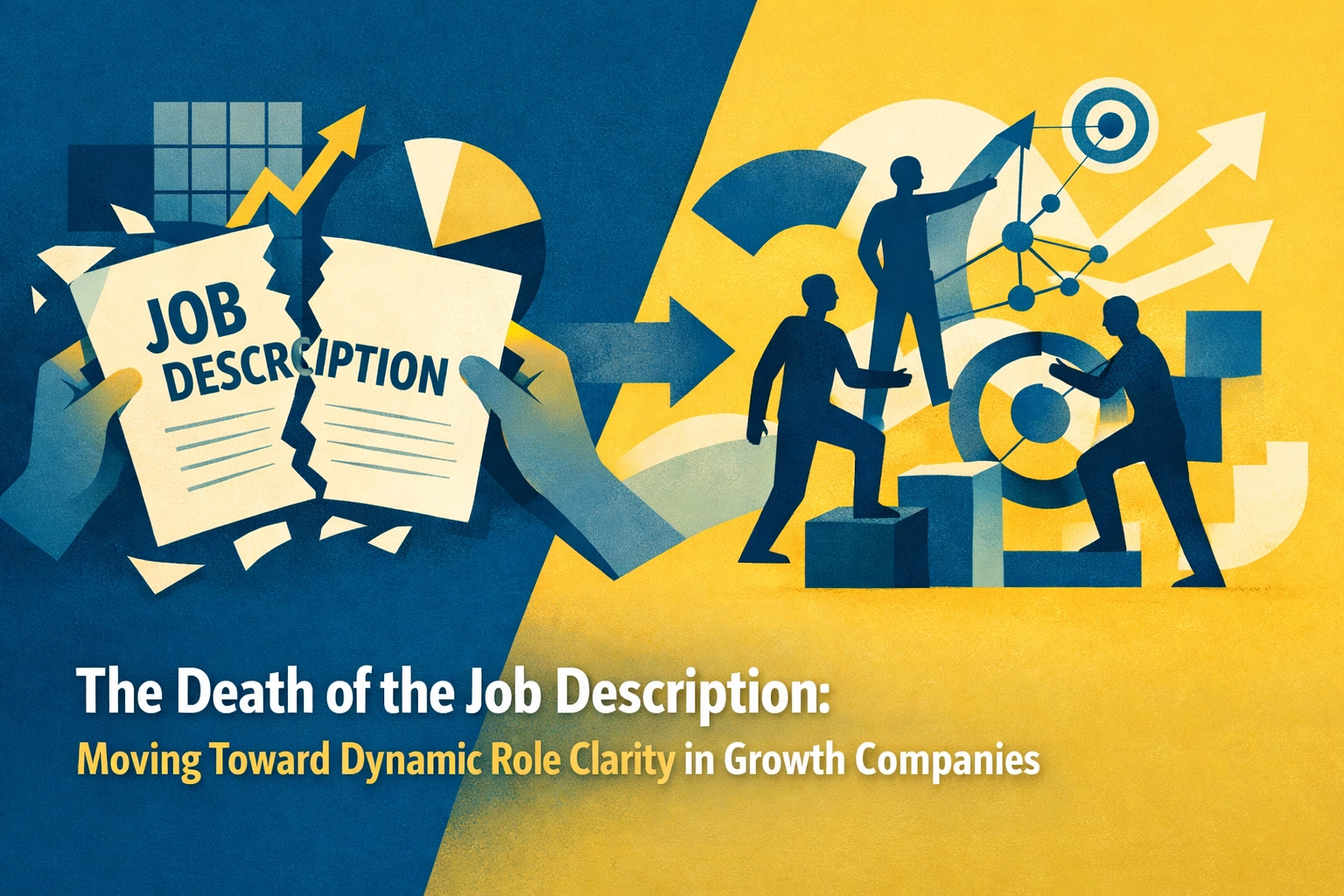
In the world of Private Equity-backed scale-ups and fast-moving enterprises, the traditional job description is effectively dead. It’s a static document in a kinetic world. By the time the ink dries on a five-page list of "responsibilities and requirements," the market has shifted, the strategy has evolved, and the actual needs of the business have moved three steps ahead.
At Rinnovare, we see this every day. Companies hire brilliant people based on a fixed set of tasks, only to find those people drowning in "unwritten" work six months later. This isn't just an HR annoyance: it’s a structural liability. When roles are fuzzy, decision-making slows to a crawl, and the "Drift Tax" begins to erode your enterprise value.
The Static Trap: Why JDs Fail Growth Companies
The traditional job description is a relic of the industrial age. It was designed for stability, predictability, and silos. But growth isn't stable. Growth is chaotic.
When a company scales from 50 to 500 people, or when a PE firm installs a new leadership team to drive a turnaround, the most dangerous thing you can have is a team of people who are "staying in their lane" based on a document written two years ago.
The problems with static JDs are compounding:
- They focus on tasks, not outcomes. A JD tells you what to do, but it rarely tells you what to achieve.
- They ignore interdependencies. Roles don't exist in a vacuum. In a growth company, the interface between Sales and Product, or Finance and Operations, is where the real work happens. Static JDs fail to define these handoffs.
- They become "The Denial Gap." We’ve talked before about the Bella Figura Fallacy: the tendency to save face rather than admit a structure isn't working. A static JD provides the perfect cover for underperformance: "I did everything on my list."

Untangling the Complexity: Enter Dynamic Role Clarity
Our Founder and Principal, Philip Curran, often talks about "untangling complexity" as the primary service we provide at Rinnovare. You can't untangle a knot by pulling on both ends; you have to find the specific loops that are binding the whole thing together.
In an organization, those loops are Decision Rights and Accountabilities.
Dynamic Role Clarity is the move away from "What is my job?" toward "What do I own, and what can I decide?" It’s a shift from a person-based task list to a role-based structure that is built to evolve.
The RQ Operating Model™ Approach
To solve the clarity crisis, we utilize the RQ Operating Model™. This isn't just about drawing boxes on a chart; it’s about defining the "connective tissue" of the organization.
When we step into a growth-stage company, we look for where the wires are crossed. Are two executives fighting over the same budget? Is a critical product launch stalled because no one knows who has the final "go/no-go" authority?
This is where we measure the Renewal Quotient (RQ). A low RQ often stems from Executive Misalignment, which manifests as role confusion further down the chain. By implementing the RQ Operating Model™, we create a framework where roles are defined by their contribution to the strategy, not their historical functions.

Suggested Image: A clean, modern diagram showing a circular organizational model with overlapping areas of accountability vs. a traditional rigid hierarchy.
Decision Rights: The Real Currency of Success
If you want to move fast, you have to know who makes the call. In many growth companies, decisions get sucked up into a "black hole" at the executive level because mid-level managers don't feel they have the "right" to decide.
Dynamic Role Clarity requires a formalization of decision rights. We often use variations of the RAPID framework or other accountability matrices, but the goal is always the same: Surgical Clarity.
- Who Recommends? (The person doing the legwork)
- Who Decides? (The single point of accountability)
- Who Performs? (The team executing)
- Who is Consulted? (The experts whose input is needed, but who don't have a veto)
When you define these rights, the "Job Description" becomes a living document of empowerment. It stops being a list of chores and starts being a mandate for leadership. This is a core part of our Services at Rinnovare: moving companies from "who does what" to "who decides what."
Measuring the Cost of Confusion: The Drift Tax
When roles are static and the business is dynamic, you pay a "Drift Tax." This is the invisible cost of meetings about meetings, "checking in" with five different people because the hierarchy is unclear, and the general friction that slows down execution.
We believe that The Drift Tax is one of the greatest threats to enterprise value in PE portfolios. If your team is spending 20% of their time navigating internal ambiguity, you are effectively burning 20% of your payroll.
Dynamic Role Clarity eliminates the drift. By moving to a model where roles are reviewed and "renewed" on a regular cadence (at least quarterly in high-growth phases), you ensure that the organization’s talent is always pointed at the current highest-value priority.

How to Start the Shift
If you’re a CEO or CHRO sensing that your current job descriptions are holding you back, here is how you begin the transition to dynamic role clarity:
1. Audit the "Grey Space"
Look at the projects that are currently stalled. Who is "responsible" for them? If more than one person thinks they are the lead: or if no one does: you have a role clarity issue. This is the first step in our RQ Diagnostic™.
2. Define "Accountability Units"
Stop thinking about individuals and start thinking about the outcomes the business needs. Group those outcomes into "Accountability Units." Then, and only then, assign people to lead those units.
3. Establish an Operating Cadence
Clarity isn't a one-and-done event. It requires a rhythm. Our Operating Cadence Audit helps leaders identify where the weekly, monthly, and quarterly touchpoints should be to recalibrate roles as the strategy shifts.
4. Visualize the Interdependencies
Use dynamic tools, not PDFs. A modern org chart should be a living map that shows not just who reports to whom, but how teams collaborate on specific goals.

Suggested Image: A screenshot of a collaborative digital workspace or a visual representation of a "Role Map" that highlights connections between different departments.
The 10-Year Marathon
In growth companies, we often focus on the sprint. But building a sustainable, high-value enterprise is a marathon. You cannot finish that marathon if your team is constantly tripping over each other because they don't know where their role ends and the next one begins.
Dynamic Role Clarity is about more than just efficiency; it’s about Engagement. Research shows that employees who have total clarity on what is expected of them are nearly three times more likely to be engaged at work. In a talent market where the best people have endless options, providing a clear "lane to run in" is a significant competitive advantage.
Moving Forward with Rinnovare
At Rinnovare, we don't do "standard" HR. we don't believe in the status quo. We believe in Transforming HR to Create Competitive Advantage.
If your organization feels tangled: if you’re seeing the symptoms of the Drift Tax, executive misalignment, or the slow death of execution: it’s time to move beyond the job description. It’s time for a structure that moves as fast as you do.
Whether it’s through our RQ Diagnostic™, the RQ Operating Model™, or building a custom RQ Roadmap™, we help growth-stage leaders find the clarity they need to win.
Let's untangle the complexity together.

Interested in seeing where your organization stands? Contact us to learn more about the RQ Diagnostic™ and how we help growth companies scale without the chaos.