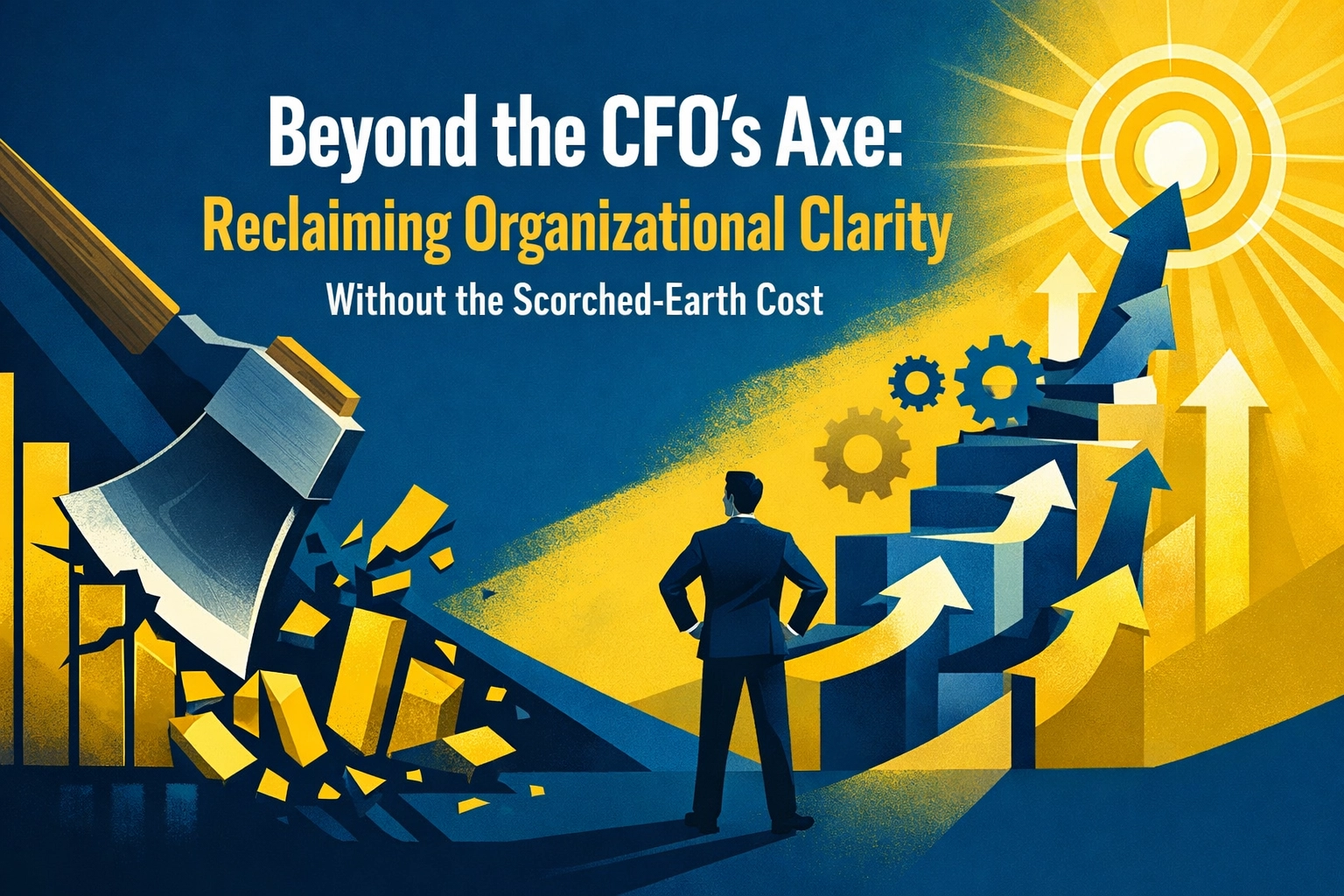
Let’s be honest: when a growth-stage company hits a plateau or a Private Equity firm closes a mid-market deal, the first instinct is often to look for the "axe."
We’ve all seen the play. The spreadsheets come out, the "non-essential" headcount is highlighted in red, and the CFO is tasked with finding 15-20% in savings by the end of the quarter. It’s fast, it’s measurable, and it looks great on a 90-day report.
But there’s a reason we call it the "scorched-earth" approach. While you might save a few million on the payroll, you often end up burning the very tribal knowledge and operational muscle required to actually scale. You fix the balance sheet today, only to find that you’ve crippled the engine for tomorrow.
At Rinnovare, we spend a lot of time in the "Post-Close Autopsy" phase, looking at why these aggressive cuts fail. What we’ve found is that the problem usually isn’t the size of the team: it’s the clarity of the design.
The Illusion of Efficiency
There is a massive difference between a "lean" organization and a "clear" one.
A lean organization might have fewer people, but if those people are operating in a state of constant ambiguity, they are wasting massive amounts of energy. I call this the Drift Tax. It’s the hidden cost of "who is doing what?" and "why are we meeting about this again?"
When you swing the axe without a design-first mindset, you don't actually remove the complexity; you just distribute it across fewer, more stressed individuals. This leads to what we call Executive Misalignment, where the remaining leadership team starts pulling in opposite directions simply to keep their own departments afloat.

Visibility: The First Discipline of Clarity
The research is clear: organizations achieve health when they move from reactive spending cuts to strategic business model examination. But you can’t examine what you can’t see.
Visibility is about more than just having a dashboard. It’s about having a "single version of the truth." In many growth-stage companies, the CEO is looking at one set of KPIs, the CFO is looking at the burn rate, and the Head of Sales is looking at a pipeline that hasn’t been scrubbed in months.
Before you cut a single role, you need to understand the value chain.
- Which activities are actually driving the needle?
- Which processes are redundant "legacy" leftovers from the startup phase?
- Where is the friction?
Instead of radical cuts, we advocate for radical simplification. This means eliminating the duplicative reports, the unnecessary approval layers, and the "process for the sake of process" that bogs down senior leadership.
The RQ™ System: A Surgical Approach to Growth
At Rinnovare, we don't believe in blunt instruments. We use the Renewal Quotient (RQ™) system to diagnose where an organization is leaking value and how to restructure for performance without the trauma of a mass layoff.
This isn't a "vibe check." It’s an evidence-based framework consisting of three canonical products:
- RQ Diagnostic™: We go deep into the plumbing. We look at the gaps between strategy and execution, identifying where the "Drift Tax" is highest. This provides the data needed to make senior-level judgments rather than just hitting a budget number.
- RQ Operating Model™: This is the blueprint. We redesign the organizational structure to ensure that every role is aligned with the long-term value creation plan. This is where we find efficiency through design, not just reduction.
- RQ Roadmap™: A tactical, step-by-step plan to transition from the current state to the high-performance model.
Often, we supplement this with a standalone Operating Cadence Audit to fix how information flows through the company. If your meetings are broken, your organization is broken. Fixing the cadence often does more for the bottom line than firing three middle managers.

The Cross-Border Context: From Italy to the U.S.
We see a specific version of this "Axe vs. Clarity" problem when European companies: particularly those from Italy: try to scale into the U.S. market.
There is often a temptation to keep the U.S. team "lean and mean" to manage risk. However, the complexity of the U.S. market requires specific local expertise. If an Italian Founder tries to manage the U.S. expansion with a skeleton crew that lacks autonomy, they fall into the Bella Figura Fallacy. They try to "save face" by maintaining a certain image, but beneath the surface, the lack of a clear operating model is causing the expansion to stall.
In these cases, "swinging the axe" back at headquarters to fund the U.S. expansion is a recipe for disaster. You end up with a weakened core and a confused satellite office. The solution isn't fewer people; it's a more sophisticated design that accounts for the cultural and operational distance between Milan and New York.
Moving from Reductions to Reclaiming Capacity
When you focus on organizational design rather than just headcount, something interesting happens: you reclaim capacity.
Instead of your senior leaders spending 40% of their time on "internal alignment" (translation: arguing in Slack), they spend that time on growth. This is the difference between a CFO who views the organization as a cost center and a Founder who views it as a value-creation engine.
Efficiency isn't just about the "out" (money leaving the company). It’s about the "in" (the value produced per unit of human effort).
If you have 100 people and they are only 60% effective because of a messy structure, you have the equivalent of 60 people working. If you fire 20 people but keep the messy structure, you now have 80 people working at 60% effectiveness: the equivalent of 48 people. You haven't fixed the problem; you've just lowered the ceiling.
The Founder’s Judgment
As the Founder or Principal, your job is to apply judgment where the spreadsheet fails.
Evidence-based solutions require looking at the data, but they also require an understanding of the human architecture of the business. PE partners, in particular, need to resist the urge to demand immediate "synergies" (layoffs) post-close and instead demand a "Design Audit."
Ask yourselves:
- Is this role redundant, or is the process it supports broken?
- Are we missing our targets because we have too many people, or because our people are confused?
- Does our current operating model support the company we want to be in three years, or the company we were three years ago?

Final Thoughts
The "CFO’s Axe" is a tool of desperation. Clarity is a tool of leadership.
Before you decide that your margins are a "people problem," take a look at your design. Use the RQ Diagnostic™ to find the leaks. Stop paying the Drift Tax and start investing in an operating model that actually works.
Growth doesn't have to be a scorched-earth campaign. With the right design, you can find the efficiency you need while keeping the talent that will get you to the finish line.
If you’re ready to move beyond the axe and start building for clarity, drop us a line. Let’s look at the blueprint together.
About Rinnovare
We help growth-stage companies and PE partners transform HR into a competitive advantage. Through our RQ™ system, we provide the clarity and organizational design needed to scale without the "scorched-earth" cost. Whether you're navigating a post-close integration or a complex cross-border expansion, we bring the senior-level judgment your business deserves.